Spot the claim that sounds right and is not, before it costs a pump, a stock of food or a budget. Nine lessons on the mistakes clever people make, each with a check you can do in a few minutes.
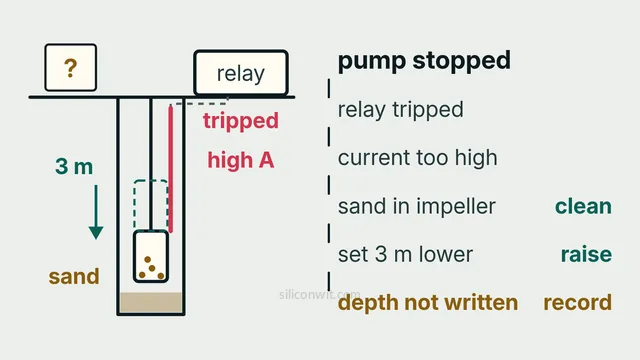
The cold room alarm sounds at two in the morning, and the technician goes back to sleep because it was the door the last three times. This time the compressor has stopped. A supplier reports 15 percent less fuel at three sites and the purchase is approved in the same meeting. A generator budget of 150 USD a month meets a first invoice of 430 USD. A pump trips twice a week while 900 USD of parts are changed at random.
Nobody in these stories was careless. In this course you learn the habits that catch such mistakes: count in place of remembering, ask how many were tried, give every number its range, ask what else could cause it, halve the search, and put a decision on paper where someone can check it.
How a claim is checked
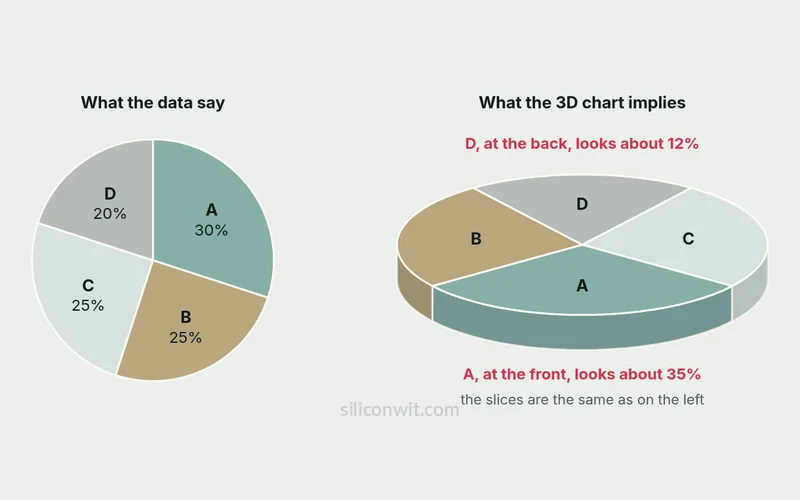
1Read past the pictureA 3D pie puts slice A at the front, where 30 percent looks about 35, and D at the back, where 20 looks about 12.
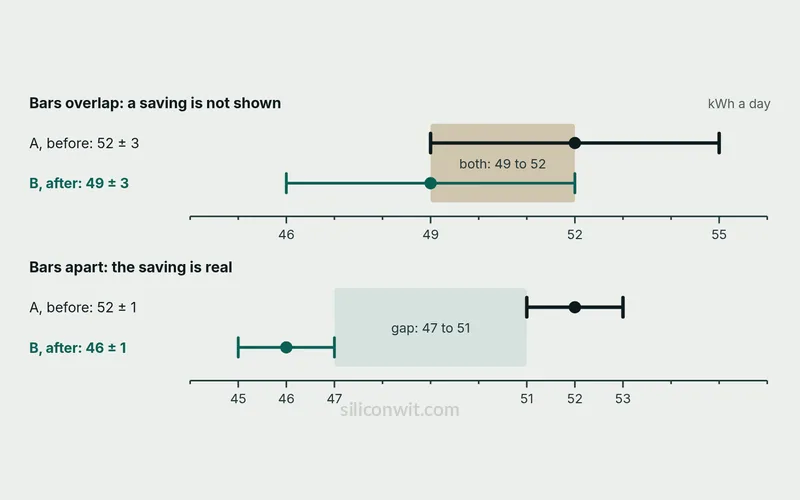
2Give every number its range52 ± 3 against 49 ± 3: the bars overlap, so the saving is not shown. With ± 1 a gap opens.
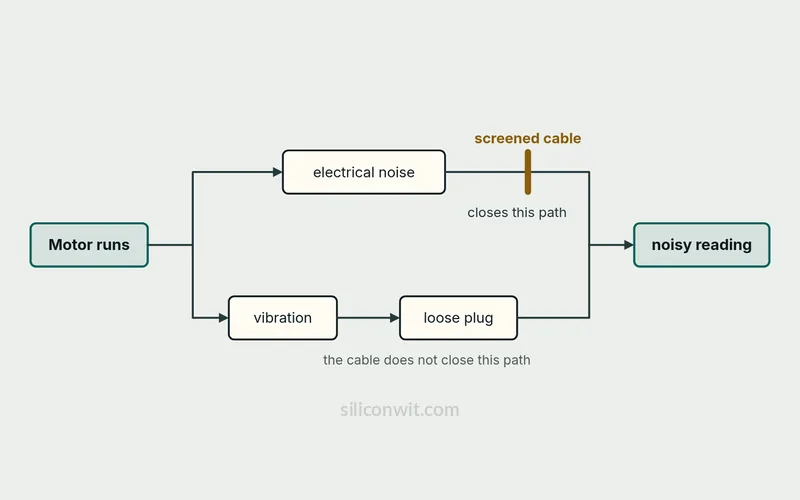
3Ask what else caused itA screened cable closes the path through electrical noise. The vibration and the loose plug remain.
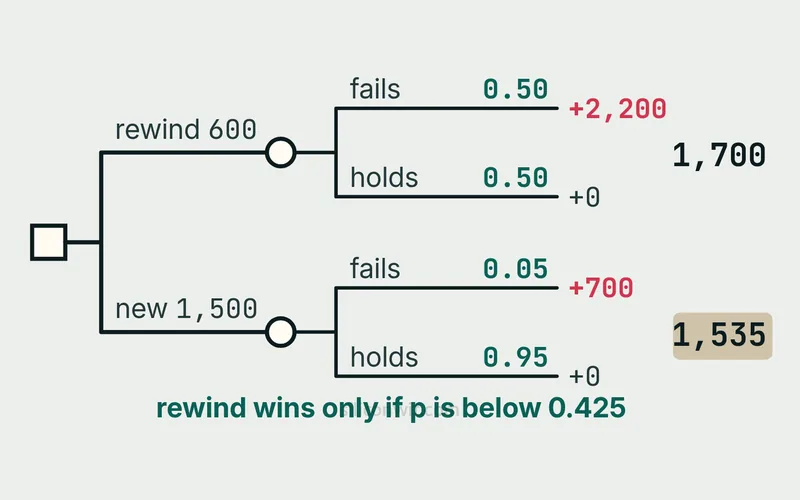
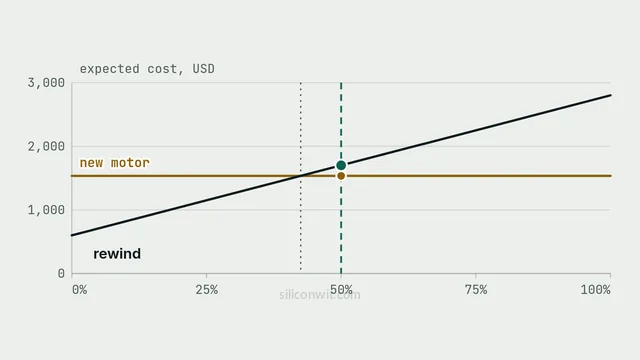
4Put the decision on paperA rewind for 600 USD or a new motor for 1,500: 1,700 against 1,535 on average.
You will be able to
Name the trick in an argument, a chart or a statistic, and answer it calmly
Give an estimate with its range, and test a cause before you trust a fix
Find a fault by halving the search, and decide with a matrix and an expected cost
New to this? Start with lesson 1: why the alarm that is "always the door" lost the stock.
You need Paper and a calculator. Python for the scripts in some lessons, if you have it.
The engineering behind it
Spot the argument that sounds right and is not, and keep what was measured apart from what was assumed.
Each number below was hidden under a claim that sounded right. A few lines of arithmetic found it.
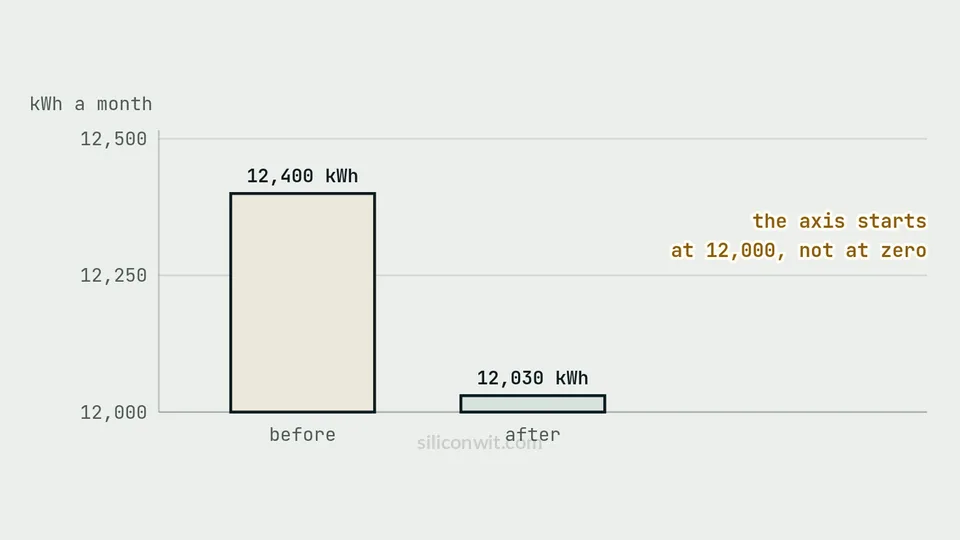
3 percentthe real fall from 12,400 to 12,030 kWh, behind a chart whose first bar looks 13 times tallerCharts
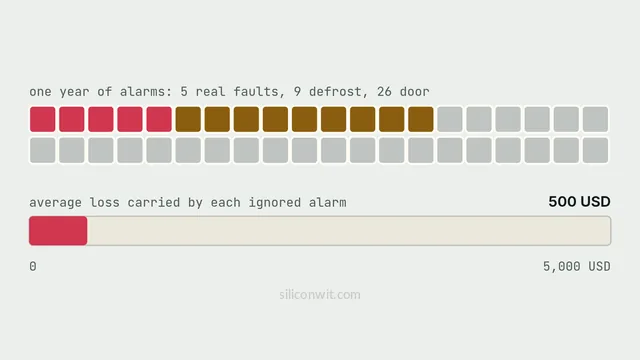
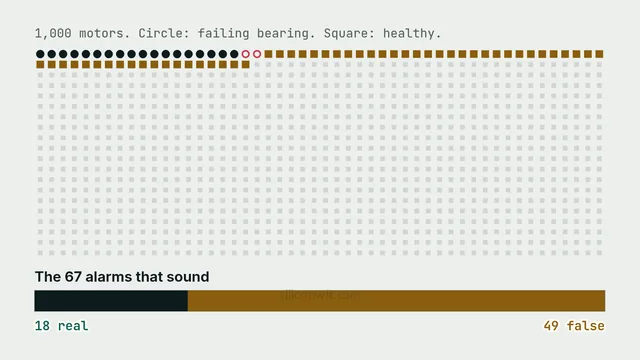
27 percentof the alarms are real, 18 of 67, from a vibration alarm that catches 90 percent of failing bearingsStatistics
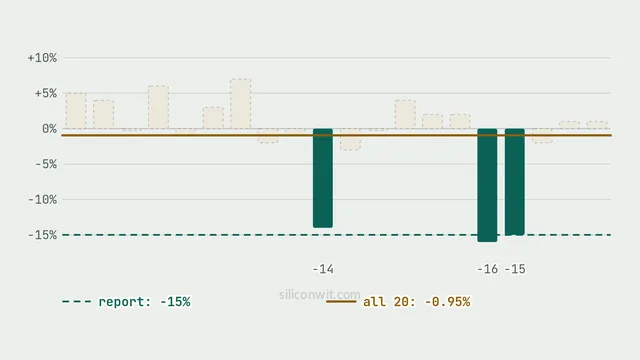
1 percentthe average fall in fuel use over all 20 sites, behind a report of 15 percent at three of themArguments
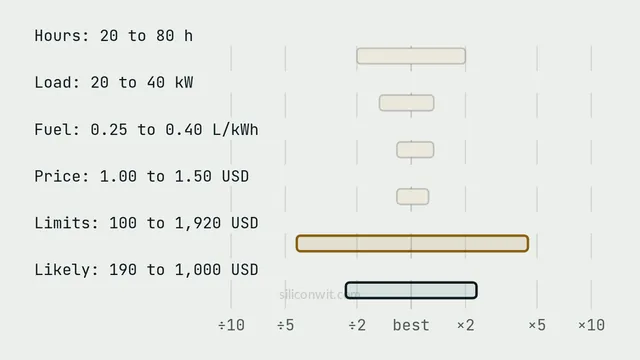
190 to 1,000 USDthe likely diesel cost of a month, around a best guess of about 430 USD; the budget said 150Estimation
42.5 percentthe rewind is the better choice only if fewer than this share of rewound motors fail againDecisions
Fast thinking for the familiar. Slow thinking for what is costly.
System 1
The fast answer
Long experience in this exact field
Clear and fast feedback
A wrong call is cheap to correct
The test: would I soon learn that I was wrong?
System 2
The slow answer
The problem is new, or hard to reverse
Probabilities and large numbers
A ten minute walk against 500 USD for each ignored alarm
The test: what does a wrong answer cost?
What you work with
Real casesPumps, cold rooms, generators and the bills they bring.
A few lines of arithmeticMost claims are checked by hand in minutes.
A question for each trapA calm reply to use in the next meeting or review.
Some PythonShort scripts in five lessons show the traps in data.
Decisions on paperA matrix, an expected cost, a premortem and a checklist.
No special toolsPaper, a calculator and your own records.
Honest limits. This is not a course in mathematical statistics. A monitoring screen is charts of sensor data, so every trick in these lessons can mislead the person who acts on it: show the zero, keep the raw line beside the smoothed one, and show the range.
The hardest bugs to fix are the ones in your own reasoning. You can write flawless C, design elegant circuits, and still make terrible engineering decisions because of a cognitive bias you did not notice or a statistical mistake you did not catch. This course is your debugger for thinking itself. Every lesson uses real engineering scenarios, from code reviews to design meetings to test reports, so the concepts stick where they matter most.
Why Critical Thinking for Engineers?
Engineers make high-stakes decisions under uncertainty every day. Which architecture should we choose? Is this test data sufficient to ship? Should we rewrite this module or keep patching it? The quality of those decisions depends not just on technical knowledge, but on how clearly you reason about the evidence in front of you.
Better Technical Arguments
Learn to recognize when a colleague’s argument (or your own) relies on a logical fallacy rather than evidence. Spot straw man arguments in code reviews, false dichotomies in architecture debates, and appeals to authority when someone invokes a framework’s popularity instead of its fit.
Bias-Resistant Decisions
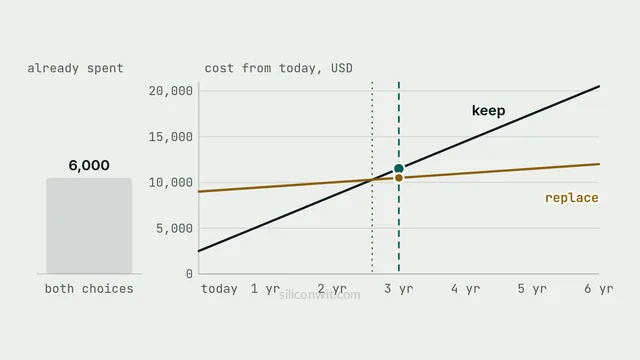
Understand the cognitive shortcuts your brain takes automatically, and learn when those shortcuts help and when they mislead. Confirmation bias, sunk cost fallacy, survivorship bias, and anchoring affect engineering decisions far more often than most engineers realize.
Statistical Literacy
Stop misinterpreting p-values, drawing conclusions from tiny sample sizes, and confusing correlation with causation. Whether you are evaluating test results, reading research papers, or analyzing sensor data, statistical reasoning is a core engineering skill.
Honest Data Presentation
Learn how charts and data visualizations can mislead, intentionally or accidentally. Then learn how to present your own data clearly and honestly so your audience can trust your conclusions.
Course Structure
Each lesson follows a consistent pattern:
The Concept
A clear explanation of the thinking error, bias, or statistical pitfall, grounded in how the human brain actually works.
Engineering Examples
Real scenarios from debugging sessions, design reviews, test reports, technical forums, and project planning where the concept shows up.
Recognition Checklist
Concrete signs that you or someone else is falling into the trap, so you can catch it in real time.
Countermeasures
Practical techniques to mitigate the error in your own thinking and in team decision-making.
Exercises
Scenarios to practice identifying and countering each thinking error.
Lessons
Lesson 1: How Your Brain Tricks You
How Your Brain Tricks You. Explore System 1 (fast, intuitive) and System 2 (slow, deliberate) thinking from Kahneman’s research. Learn when engineering intuition saves you and when it leads you astray through anchoring, availability heuristic, and substitution.
Lesson 2: Logical Fallacies in Technical Arguments
Logical Fallacies in Technical Arguments. A field guide to the 15+ fallacies most common in engineering contexts: ad hominem, false dichotomy, appeal to authority, straw man, appeal to common practice, nirvana fallacy, and more. Each with a real engineering example and a countermeasure.
Lesson 3: Cognitive Biases in Engineering Decisions
Cognitive Biases in Engineering Decisions. Confirmation bias, survivorship bias (with Wald’s airplane armor story), sunk cost fallacy, Dunning-Kruger effect, hindsight bias, bandwagon effect, and anchoring. How these biases shaped engineering disasters and everyday project failures.
Lesson 4: Statistics Done Wrong
Statistics Done Wrong. Inspired by Alex Reinhart’s book. P-value misinterpretation, p-hacking, small sample sizes, overfitting, confounding variables, base rate neglect, and the multiple comparisons problem. “We ran the test 3 times and it passed. Ship it.” Why that reasoning fails.
Lesson 5: How to Lie with Charts and Data
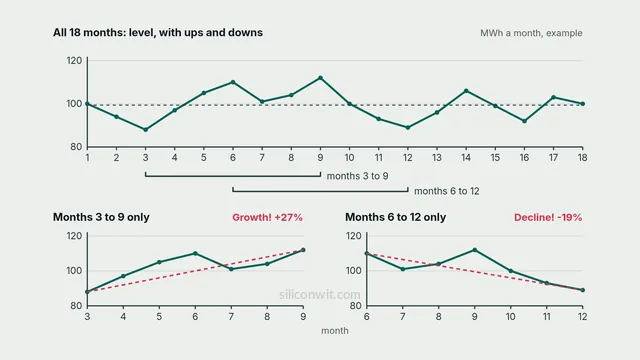
How to Lie with Charts and Data. Inspired by Darrell Huff and modern data visualization research. Truncated axes, cherry-picked windows, misleading scales, 3D pie charts, dual y-axes, pictogram abuse, and Simpson’s paradox. Learn to spot deception and present your own data honestly.
Lesson 6: Estimation, Uncertainty, and Confidence
Estimation, Uncertainty, and Confidence. Fermi estimation, error bars, significant figures, false precision, error propagation, confidence intervals, and measurement uncertainty budgets. “How sure are you?” should be a question you ask about every number.
Lesson 7: Correlation, Causation, and Evidence
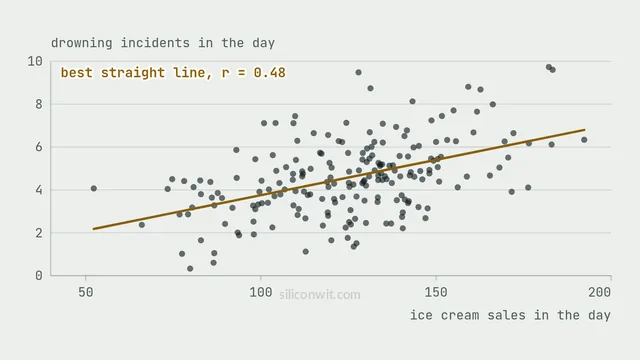
Correlation, Causation, and Evidence. “We added a capacitor and the bug went away” does not mean the capacitor fixed the bug. Post hoc fallacy, confounding variables, controlled experiments, A/B testing, and the hierarchy of evidence.
Lesson 8: Debugging as Scientific Reasoning
Debugging as Scientific Reasoning. Debugging IS the scientific method applied to code and hardware. Hypothesis-driven debugging, binary search on hypotheses, rubber duck as Socratic method, and common debugging fallacies.
Lesson 9: Making Better Engineering Decisions
Making Better Engineering Decisions. Decision matrices, trade-off analysis, premortems, checklists, reversible vs irreversible decisions, and NASA’s lessons from Challenger. A practical framework for every engineering choice.
Who Is This Course For?
No prerequisites
This course does not require any specific technical background. It is useful for:
Hardware engineers who make architecture and component selection decisions
Software engineers who participate in code reviews and design discussions
Graduate students and researchers who interpret experimental data and read papers
Engineering managers who evaluate proposals and make resource allocation decisions
Anyone who wants to think more clearly about technical problems
The examples lean toward engineering and technology, but the principles apply universally. If you have ever lost an argument you should have won, or won an argument you should have lost, this course will help you understand why.
Recommended Reading
These books inspired the course and are excellent companions:
Book
Author
Focus
Thinking, Fast and Slow
Daniel Kahneman
Dual-process theory, cognitive biases
How to Lie with Statistics
Darrell Huff
Data presentation tricks
Statistics Done Wrong
Alex Reinhart
Common statistical errors in research
Logically Fallacious
Bo Bennett
Comprehensive logical fallacy reference
The Art of Thinking Clearly
Rolf Dobelli
Cognitive biases in everyday decisions
Made by
Engineers and researchers who build what they teach.