Vibration Fault Diagnostics in Motors


Electric motors drive the pumps and fans that a plant cannot run without. Before a motor fails, its vibration changes. A technician on a round can miss a fault that develops between visits. Cloud monitoring catches more, but it adds delay, data costs and a dependence on the network. When the link drops, so does the warning.
What we did
We are building a fault classifier that runs on a low-cost STM32 microcontroller, with no cloud in the loop.
The test rig uses a Baldor Reliance three-phase induction motor: 0.33 HP, 400 V, 50 Hz, four poles, 1425 rpm rated, run at rated speed. We compare a healthy baseline with two induced faults: shaft misalignment and structural looseness.
A triaxial ADXL345 accelerometer is rigidly mounted on the motor casing. An STM32F411CEU6 on a custom KiCad PCB shield samples it at 3200 Hz over SPI. For each window of 2048 samples, the firmware removes the DC offset, applies a Hann window and computes the FFT magnitude spectrum with CMSIS-DSP. It keeps 256 frequency bins per axis, up to 400 Hz.
The spectrum is log-scaled, normalised per window and passed to a compact 1-D convolutional network. The network has three convolutional layers of 8, 16 and 16 filters, global average pooling and a three-class output, about 1.6k parameters in all. It will be trained offline in Keras, with whole recording sessions held out for testing, then quantised to INT8 and deployed with ST X-CUBE-AI.
What we found
- Data collection and model development are in progress. No classification results are available yet.
- Accuracy for the healthy, misalignment and looseness conditions, together with the model’s memory footprint and inference time on the STM32F411, will be reported at the poster session.
Why it matters
A plant operator who can put a small, cheap board on each motor gets warnings on site, in real time, without paying for a data link or waiting for a cloud reply. The test design holds out whole recording sessions, which is a stricter check than mixing windows from the same recording into training and test data.
Limits
This summary is written from the conference abstract. No results exist yet. The rig covers one motor, one speed and two fault types, so bearing faults, other speeds and other motor sizes are outside this study. Performance on a working plant, with its background vibration, has not been tested.
Where to read it
- Conference poster: doi.org/10.33803/ea8udx, Book of Abstracts of the 10th DeKUT International Conference on Science, Technology, Innovation and Entrepreneurship (STI&E 2026), 2026.
- Authors: Thoithi Joan Mumbi, Kennedy Karuri, Dennis Kipruto, Abdulrhaman Hassan, Eric Mumo, Samuel Macharia Kang’iri.
Cite this work
Mumbi, T. J., Karuri, K., Kipruto, D., Hassan, A., Mumo, E., & Kang’iri, S. M. (2026). Vibration Fault Diagnostics in Motors. Book of Abstracts of the 10th DeKUT International Conference on Science, Technology, Innovation and Entrepreneurship (STI&E 2026). https://doi.org/10.33803/ea8udx
@inproceedings{Mumbi_2026,
  title={Vibration Fault Diagnostics in Motors},
  url={http://dx.doi.org/10.33803/ea8udx},
  DOI={10.33803/ea8udx},
  booktitle={Book of Abstracts of the 10th DeKUT International Conference on Science, Technology, Innovation and Entrepreneurship (STI&E 2026)},
  publisher={Dedan Kimathi University of Technology},
  author={Mumbi, Thoithi Joan and Karuri, Kennedy and Kipruto, Dennis and Hassan, Abdulrhaman and Mumo, Eric and Kang’iri, Samuel Macharia},
  year={2026},
  month=Nov
}Where next
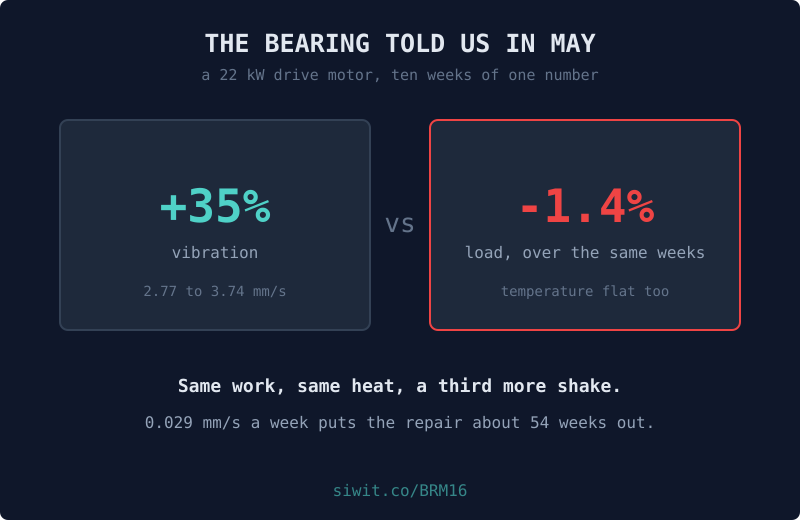 The Bearing Told Us in May: Reading a Vibration TrendVibration on a 22 kW drive motor rose 32% in nine weeks while load and bearing temperature stayed flat. It crossed an ISO zone boundary on 16 July, the bearing was changed on 8 August, and the reading fell by two thirds.Post · Remote monitoringSpeed-Induced Dilation and Prototype Alignment in Federated Bearing Fault DiagnosisA bearing fault model trained at some shaft speeds fails at a new one. Plotting the spectrum on a log frequency axis turns the speed change into a simple shift, and accuracy at an unseen speed rises from 59.6% to 81.0%.Paper · IoT and AIoT
Discussion
No comments yet. Ask a question, share a result from your own build, or suggest a clearer way to explain it.
Join the discussion. Anyone can read. To comment, reply or mark a comment helpful, sign in with your SiliconWit account.
Comments