Lesson 1: Feedback: open loop against closed loop
Measure, compare, correct. On-off control, the band, and why a compressor that starts too often does not last.
Make a machine hold its value by itself, steadily, while the world around it changes. Eleven lessons on five machines you will meet in real plants.
A cold room compressor that starts twelve times an hour can fail years before it should. The setpoint says 4.5 bar, the gauge says 4.25, and it has said so for a week. A technician raises the gain because the pressure is slow, and the drive begins to speed up and slow down every two seconds. A water heater goes several degrees past its setpoint every morning, and a lower gain only makes it slow. In each case the equipment is sound, and the control is the fault.
In this course the same five machines return in every lesson: a cold room compressor, a hot water tank, a booster pump on a variable speed drive, a conveyor and a storage tank. You describe a process from one step test, predict its offset and its overshoot, find its stability limit, tune a PID loop and write it as firmware. The last lesson commissions the booster pump loop in order, and proves from logged data months later that it still holds.
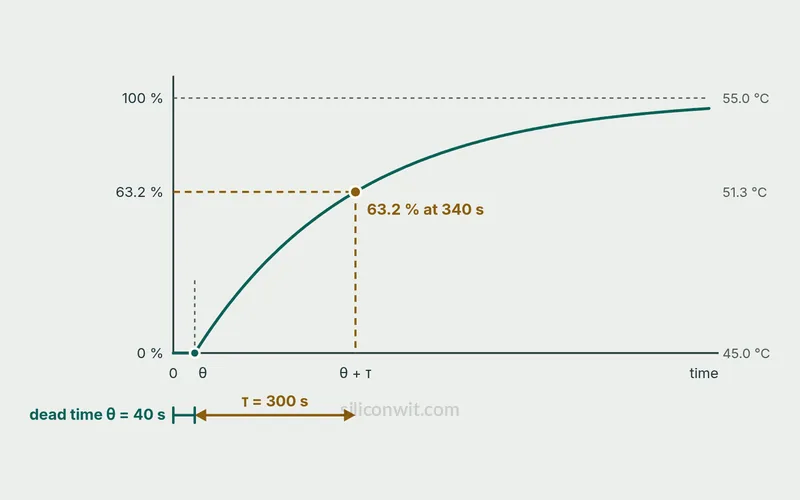 1Test the processOne step of the heater gives a dead time of about 40 s and a time constant of about 300 s.
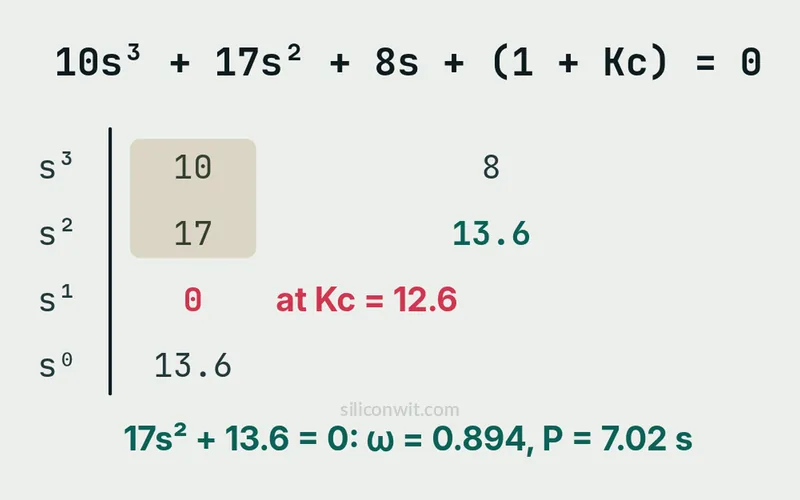 2Find the limitThe Routh test gives the gain at which a loop swings for ever: 12.6, with a period of 7.02 s.
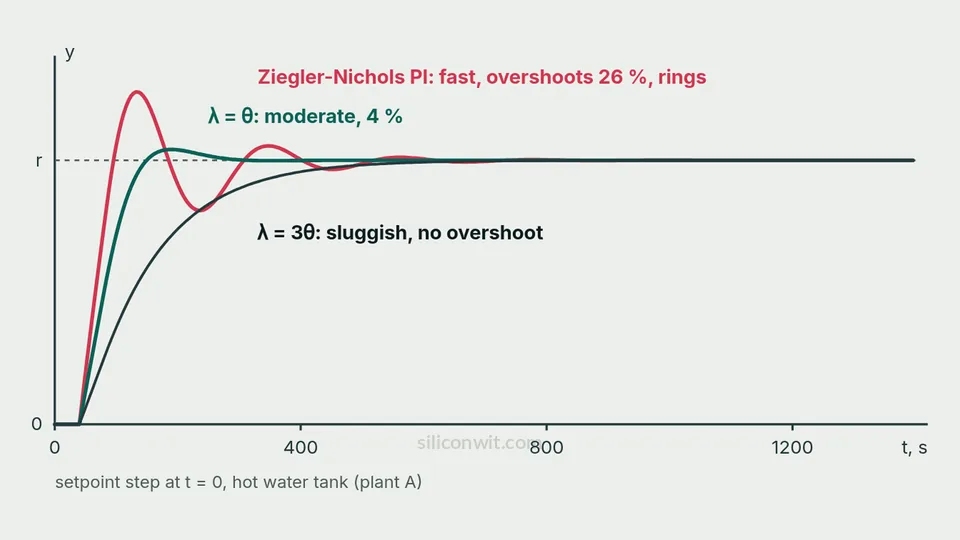
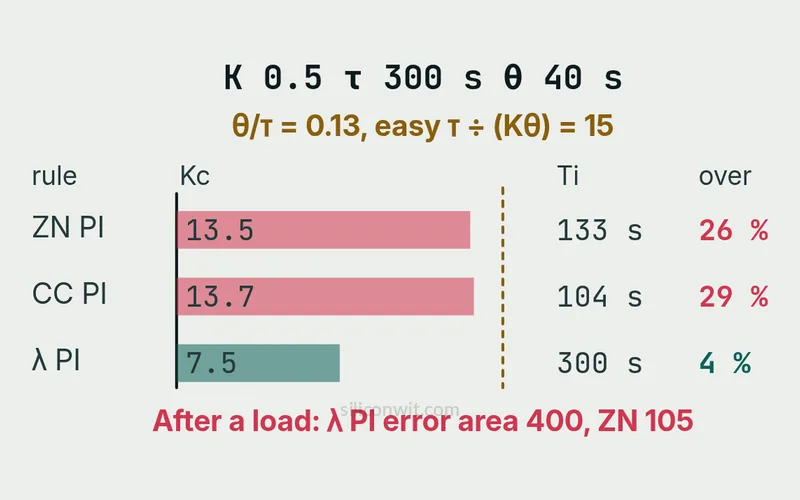 3Tune with marginThree rules from one step test: 26 and 29 percent overshoot, or 4 percent with lambda tuning.
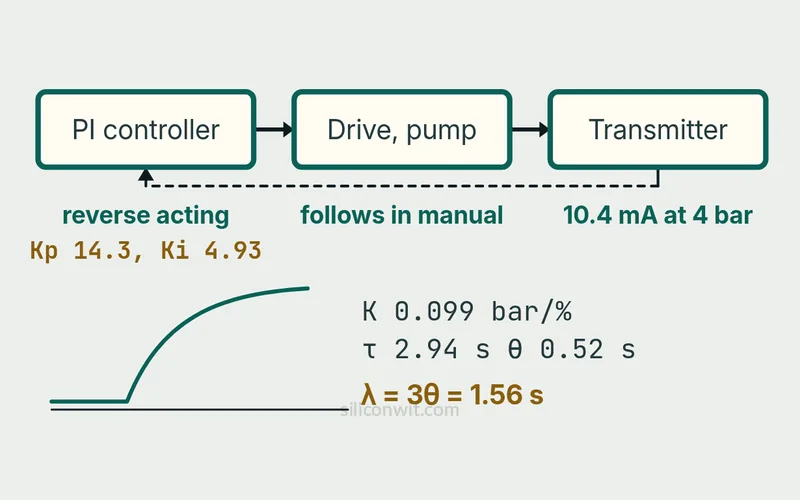 4Prove it holdsSensor, final element in manual, action, bump test, settings, then a signed record.
New to this? New to control? Start with lesson 1: on-off control, and why a compressor that starts too often does not last.
You need A computer with Python, numpy, scipy and matplotlib. Every machine is simulated in the lessons.
Hold a temperature, a pressure, a speed or a level where you want it, and keep it there when things change.
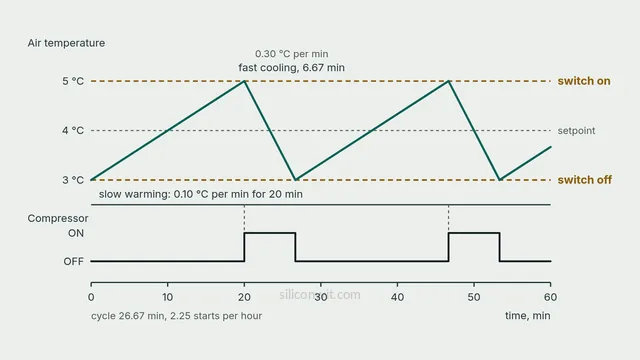 Lesson 1 · 24 minFeedback: Open Loop Against Closed LoopMeasure, compare, correct: on-off control, its band, and why a compressor that starts too often does not last.Open and closed loopController actionOn-off bandStarts per hour
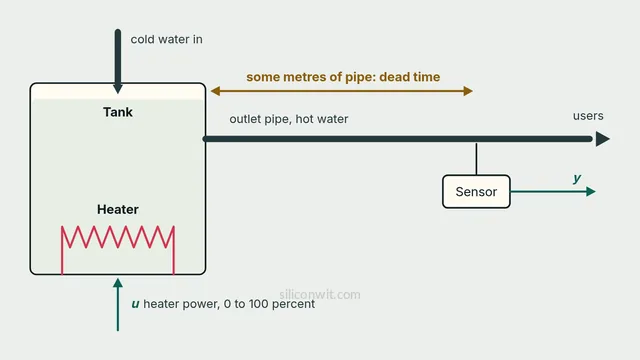 Lesson 2 · 26 minFirst-Order Processes and Dead TimeDescribe a process with three numbers taken from one step test.Step testTime constantDead timeFOPDT model
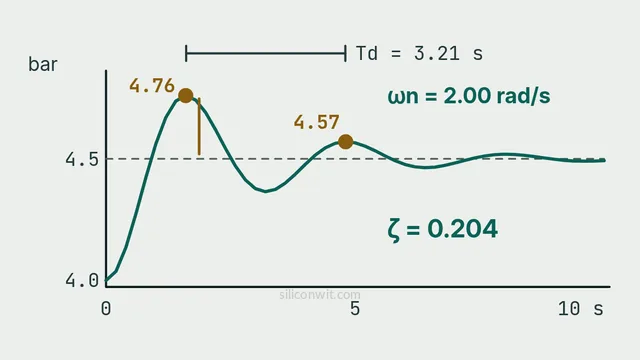 Lesson 3 · 25 minSecond-Order Systems and DampingOvershoot, ringing and settling, and how two numbers predict them.Natural frequencyDamping ratioOvershootSettling time
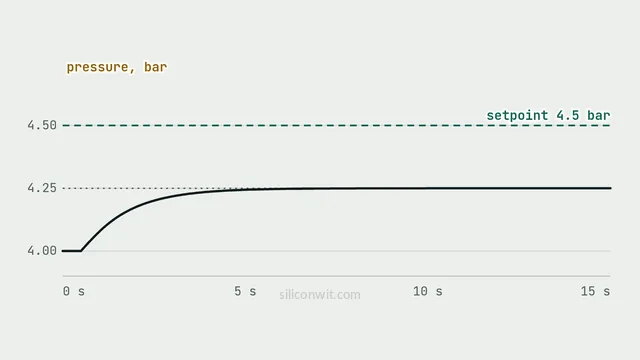 Lesson 4 · 24 minTransfer Functions and Block DiagramsPredict the 0.25 bar offset of a pump loop from its drawing, before the pump starts.Transfer functionsBlock diagramsFinal value theoremOffset
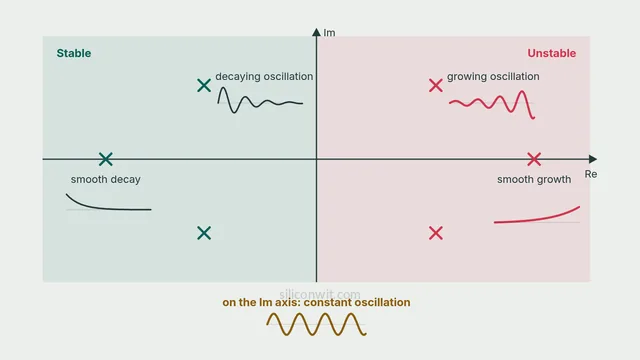 Lesson 5 · 25 minStability: Poles and the Routh TestFind the gain at which a loop starts to swing, and its period, on paper.PolesRouth testUltimate gainDead time
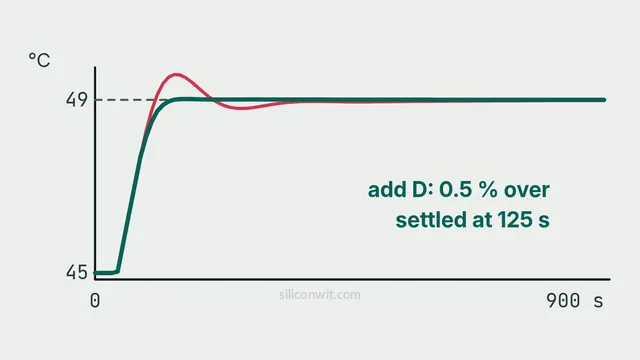 Lesson 6 · 25 minPID Control: What Each Term DoesWhat P, I and D each do, what each costs, and how to convert between the two forms of the settings.ProportionalIntegralDerivativeISA and parallel form
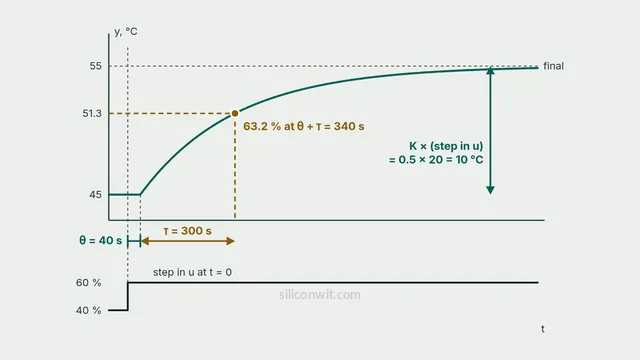 Lesson 7 · 27 minTuning a PID LoopThree step-test rules tried on the same two machines, and how to choose between speed and margin.Ziegler-NicholsCohen-CoonLambda tuningLoad recovery
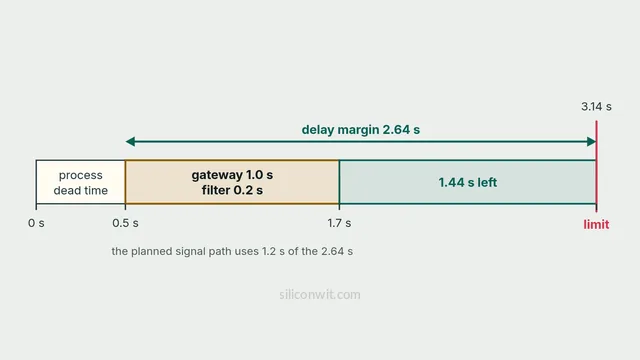 Lesson 8 · 25 minFrequency Response and Stability MarginsMeasure how close a loop is to its limit: gain margin, phase margin and delay margin.Bode plotGain marginPhase marginDelay margin
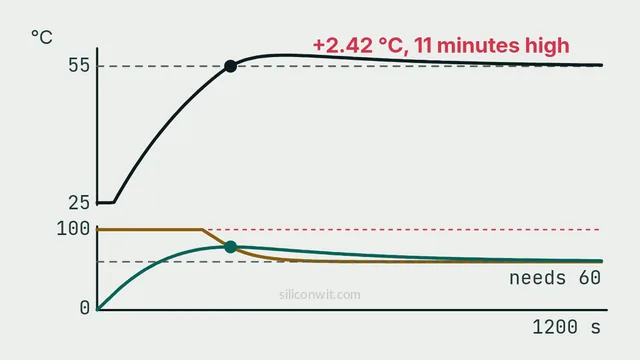 Lesson 9 · 25 minWhat Breaks Real Loops: Saturation, Windup and NoiseWhat the linear model leaves out: output limits, integral windup, noise, sticking valves and badly placed sensors.SaturationAnti-windupMeasurement filterStiction
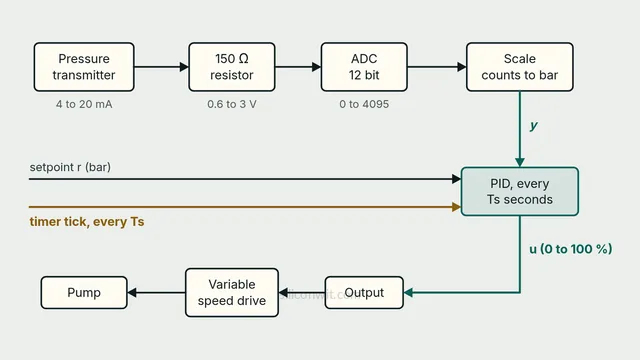 Lesson 10 · 25 minDigital Control: From Equation to FirmwareTurn the PID equation into firmware that keeps its tuning, its limits and a safe answer to a broken wire.Sample timePID in CBumpless transfer4 to 20 mA faults
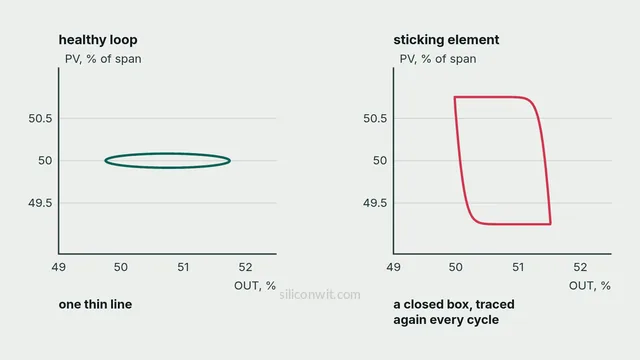 Lesson 11 · 28 minCommissioning a Loop and Proving It HoldsCommission the booster pump loop in order, sign the record, and prove months later that it still holds.Bump testCommissioning orderLoop measuresStiction or tuning
A gain is not 14.3 because the last loop had 14.3. Each setting comes from a test of the process, and each margin from what the plant may still do.
The test: does a lower gain stop the swing?
The test: does the swing remain, and go slower?
Honest limits. The loop runs in the controller or the firmware. A remote record can compare sites, but it does not close the loop: a swing of 3 s cannot wait for a remote connection.
A cold room that drifts two degrees overnight spoils stock. A pump that hunts for its pressure wears out its bearings and wastes electricity while it does. In both cases the equipment is sound and the control is poor. Control engineering is the skill of making a machine hold a value by itself, steadily, when the world around it keeps changing. #ControlEngineering #PID #ProcessControl
This course teaches that skill on five pieces of equipment you will meet in real plants: a cold room compressor, a hot water tank, a booster pump on a variable speed drive, a motor-driven conveyor and a storage tank. The same five return in every lesson, so each new idea is tried on a machine you already know.
Every lesson works a real problem by hand, step by step, and then checks the answer with a short Python script that you can run. Several lessons have a figure you can move: change a setting and see the response change.
A computer with Python, and three libraries.
pip install numpy scipy matplotlibYou should be comfortable with algebra and with the idea of a rate of change. The lessons on differential equations and on complex numbers in Applied Mathematics are useful before the lessons on transfer functions and frequency response, and you can read them when you reach that point.
Lesson 1: Feedback: open loop against closed loop
Measure, compare, correct. On-off control, the band, and why a compressor that starts too often does not last.
Lesson 2: First-order processes and dead time
Describe a process with three numbers taken from one step test.
Lesson 3: Second-order systems and damping
Overshoot, ringing and settling, and how two numbers predict them.
Lesson 4: Transfer functions and block diagrams
The algebra of loops, and why proportional control leaves an offset.
Lesson 5: Stability: poles and the Routh test
Why every loop has a gain it cannot pass, and how to find it.
Lesson 6: PID control: what each term does
Proportional, integral and derivative action, each tried alone and together.
Lesson 7: Tuning a PID loop
Three tuning rules from one step test, compared on the same process.
Lesson 8: Frequency response and stability margins
Bode plots, gain margin and phase margin, and what dead time costs.
Lesson 9: What breaks real loops
Saturation, windup, noise and sticking valves: faults that no tuning removes.
Lesson 10: Digital control: from equation to firmware
Sample time, the discrete PID, and a complete controller in C.
Lesson 11: Commissioning a loop and proving it holds
The order a commissioning engineer works in, and the record that shows the loop still holds months later.
| Machine | What is held | What kind of process it is |
|---|---|---|
| Cold room with an on-off compressor | Air temperature | On-off control with a band |
| Hot water tank with an electric heater | Water temperature | Slow, with dead time |
| Booster pump on a variable speed drive | Line pressure | Fast, with a little dead time |
| Conveyor driven by a DC motor | Speed and position | Second order |
| Storage tank with a control valve | Level | Integrating: it never settles by itself |
Safety functions are a separate discipline. An emergency stop, a pressure relief valve and a high-temperature cut-out are not control loops and must never depend on one. Work inside a mains panel is for a licensed electrician. The methods here are for the control loop, and for understanding why it behaves as it does.
Engineers and researchers who build what they teach.
SiliconWit makes these courses. We also run siliconwit.io, a monitoring service.