コンテンツにスキップ

Integrated Stepper Motor and Motion Control

Integrated Stepper Motor and Motion Control hero image

このコンテンツはまだ日本語訳がありません。

Modified:
Published:

Real firmware rarely uses just one peripheral. CNC machines, 3D printers, and laboratory positioning stages combine timers, interrupts, serial communication, analog input, and non-volatile storage into a single program that must respond to multiple events without missing a step pulse. This lesson builds a single-axis stepper motor controller that accepts movement commands over UART, generates precisely timed step pulses, homes against a limit switch, and lets you jog the axis with a potentiometer. Every peripheral from the course appears in one working system. #StepperMotor #CNC #MotionControl

What We Are Building

Single-Axis Stepper Motor Controller

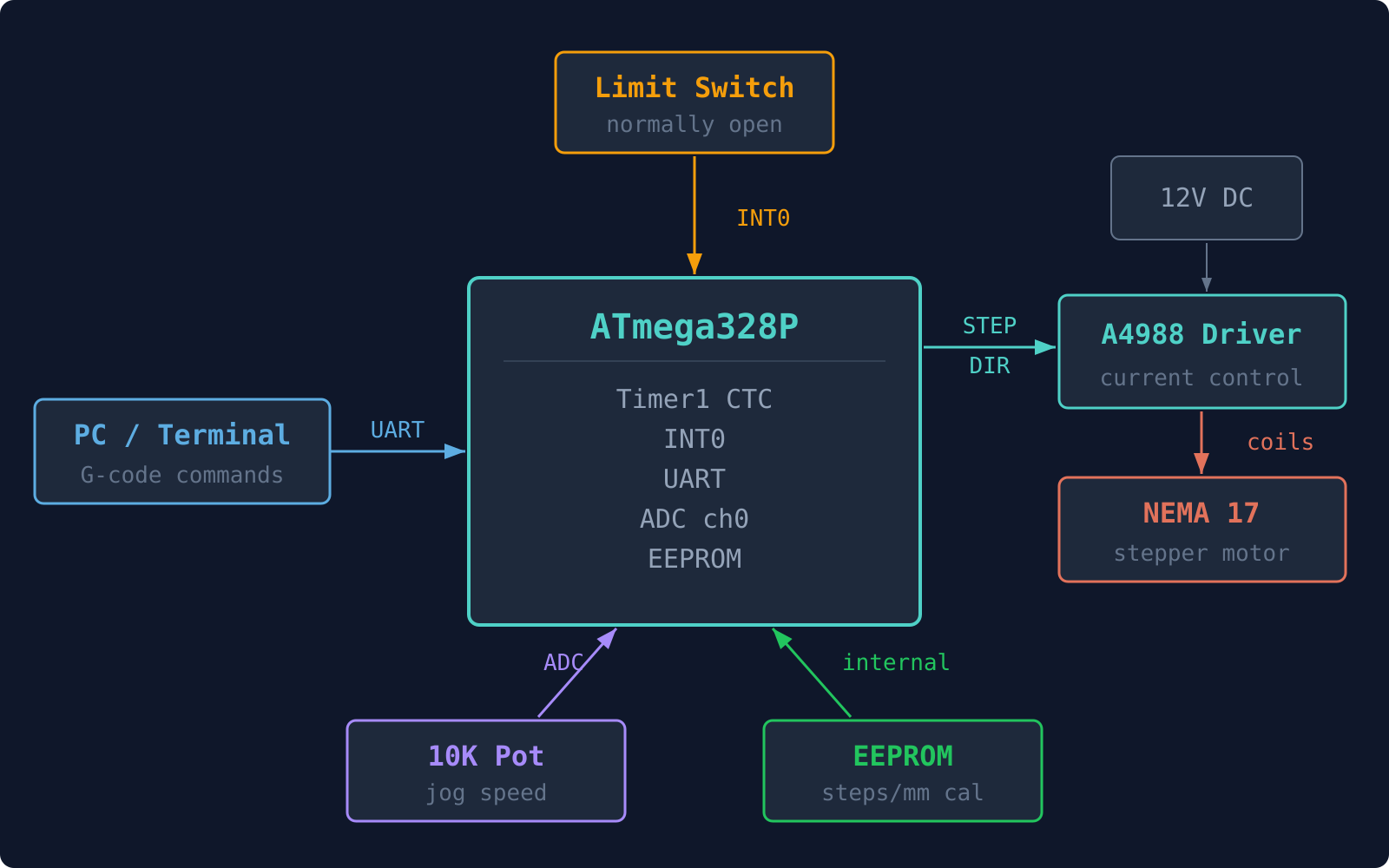
A CNC-style motion controller for one linear axis. The ATmega328P receives G-code movement commands over UART from a PC, generates precisely timed step pulses using Timer1 in CTC mode, and drives a NEMA 17 stepper motor through an A4988 driver module. A normally-open limit switch on INT0 provides a home reference position. A 10K potentiometer on ADC channel 0 allows manual jog control. Steps-per-millimeter calibration is stored in EEPROM so it survives power cycles. The controller handles rapid moves, feedrate moves, homing, position reporting, and jog mode.

Project specifications:

ParameterValue
MCUATmega328P on Arduino Nano (16 MHz)
MotorNEMA 17 bipolar stepper (200 steps/rev, 1.8 degrees/step)
DriverA4988 or DRV8825 (full step mode)
Motor supply12V external
Serial115200 baud (U2X mode for low error)
Default calibration25 steps/mm (8 mm pitch leadscrew)
Speed range1 to 3000+ mm/min
CommandsG0, G1, G28, M114, M500, M501, J1

Peripherals Used


This project ties together every major peripheral from Lessons 1 through 9:

PeripheralLessonRole in This Project
GPIO2STEP and DIR pins to A4988 driver
Timer1 (CTC)3Precise step pulse timing at variable frequency
INT04Limit switch interrupt for homing
UART5Receive G-code commands from PC
ADC8Read jog potentiometer for manual control
EEPROM9Store and recall steps-per-mm calibration

Hardware Setup


The stepper driver module (A4988 or DRV8825) simplifies wiring. It takes two logic signals from the ATmega328P (STEP and DIR) and handles the motor coil sequencing and current regulation internally.

ATmega328P A4988 Driver NEMA 17
+--------+ +----------+ +-------+
| PD4 |--[STEP]-->| STEP | 1A -->| Coil |
| PD5 |--[DIR]--->| DIR | 1B -->| A |
| | | | 2A -->| Coil |
| PD2 |<--[INT0]--| (limit) | 2B -->| B |
| PC0 |<--[ADC0]--| (pot) | +-------+
| | | VMOT |<-- 12V
| GND |---------->| GND |
+--------+ +----------+
MS1,MS2,MS3 = GND (full step)
Limit switch: NO between PD2 and GND (internal pull-up)
Jog pot: 10K between VCC and GND, wiper to PC0

Parts List

PartConnectionNotes
A4988 stepper driverSTEP to PD4, DIR to PD5Set current limit before powering motor
NEMA 17 stepper motor4 wires to A4988200 steps/rev (1.8 degrees/step)
Limit switch (NO)PD2 to GNDNormally open, closes at home position
10K potentiometerWiper to PC0VCC and GND on outer pins
12V power supplyA4988 VMOTSeparate from USB 5V

Step Pulse Timing


A stepper motor moves one step for each rising edge on the STEP pin. The step rate determines the motor speed. Timer1 in CTC mode generates these pulses at a precise frequency.

For a motor with 200 steps per revolution driving a leadscrew with 8 mm pitch (common on 3D printers), one revolution moves 8 mm. That gives 200/8 = 25 steps per mm.

To move at a feedrate of F mm/min:

steps_per_second = (F / 60) * steps_per_mm

For F = 300 mm/min with 25 steps/mm: steps_per_second = 5 * 25 = 125 Hz. Timer1 at 16 MHz with prescaler 64 gives:

OCR1A = (F_CPU / (2 * prescaler * steps_per_second)) - 1

For 125 Hz: OCR1A = (16000000 / (2 * 64 * 125)) - 1 = 999. The ISR toggles the STEP pin on each compare match.

At higher speeds (e.g., 3000 mm/min = 1250 Hz), OCR1A = 99. Timer1’s 16-bit range handles speeds from below 1 step/s up to tens of thousands of steps/s.

G-code Parser


Full CNC G-code is complex, but a single-axis controller needs only a handful of commands:

CommandMeaningExample
G0 XnnRapid move to position nn mmG0 X0 (go home fast)
G1 Xnn FnnnLinear move at feedrateG1 X50 F300
G28Home: move toward limit switchG28
M114Report current positionM114
M500Save steps/mm to EEPROMM500
M501Load steps/mm from EEPROMM501

The parser reads one line at a time from the UART ring buffer, extracts the command letter and numeric values, and calls the appropriate motion function.

Complete Firmware


#define F_CPU 16000000UL
#define BAUD 115200
#define UBRR_VAL ((F_CPU / (8UL * BAUD)) - 1) /* U2X mode */
#include <avr/io.h>
#include <avr/interrupt.h>
#include <avr/eeprom.h>
#include <util/atomic.h>
#include <stdlib.h>
#include <string.h>
#include <ctype.h>
/* --- Pin definitions --- */
#define STEP_PIN PD4
#define DIR_PIN PD5
#define LIMIT_PIN PD2 /* INT0 */
#define EE_STEPS_MM ((float *)0) /* EEPROM address for calibration */
/* --- Global state --- */
static volatile int32_t current_pos = 0; /* steps from home */
static volatile int32_t target_pos = 0;
static volatile uint8_t moving = 0;
static volatile uint8_t limit_hit = 0;
static volatile uint8_t homing = 0;
static float steps_per_mm = 25.0; /* default: 200 steps/rev, 8mm pitch */
static float feedrate = 300.0; /* mm/min */
static float rapid_rate = 1000.0; /* mm/min for G0 */
/* ================================
UART (with U2X for 115200 baud)
================================ */
static void uart_init(void)
{
UBRR0H = (uint8_t)(UBRR_VAL >> 8);
UBRR0L = (uint8_t)(UBRR_VAL);
UCSR0A = (1 << U2X0); /* Double speed for lower baud error */
UCSR0B = (1 << TXEN0) | (1 << RXEN0);
UCSR0C = (1 << UCSZ01) | (1 << UCSZ00); /* 8N1 */
}
static void uart_putc(char c)
{
while (!(UCSR0A & (1 << UDRE0)));
UDR0 = c;
}
static void uart_puts(const char *s)
{
while (*s) uart_putc(*s++);
}
static void uart_put_i32(int32_t val)
{
char buf[12];
ltoa(val, buf, 10);
uart_puts(buf);
}
static uint8_t uart_available(void)
{
return (UCSR0A & (1 << RXC0)) ? 1 : 0;
}
static char uart_getc(void)
{
while (!(UCSR0A & (1 << RXC0)));
return UDR0;
}
/* Read a full line (up to CR or LF) into buf. Returns length. */
static uint8_t uart_readline(char *buf, uint8_t maxlen)
{
uint8_t i = 0;
while (i < maxlen - 1) {
char c = uart_getc();
if (c == '\n' || c == '\r') {
if (i > 0) break; /* ignore leading newlines */
continue;
}
buf[i++] = toupper(c);
}
buf[i] = '\0';
return i;
}
/* ================================
ADC (jog potentiometer on PC0)
================================ */
static void adc_init(void)
{
ADMUX = (1 << REFS0); /* AVcc reference, channel 0 */
ADCSRA = (1 << ADEN) | (1 << ADPS2) | (1 << ADPS1) | (1 << ADPS0);
}
static uint16_t adc_read(void)
{
ADCSRA |= (1 << ADSC);
while (ADCSRA & (1 << ADSC));
return ADC;
}
/* ================================
Timer1: step pulse generation
================================ */
static void timer1_start(float steps_sec)
{
if (steps_sec < 1.0) steps_sec = 1.0;
uint16_t ocr = (uint16_t)(F_CPU / (2UL * 64 * (uint32_t)steps_sec) - 1);
if (ocr < 1) ocr = 1;
TCCR1A = 0;
TCCR1B = (1 << WGM12) | (1 << CS11) | (1 << CS10); /* CTC, prescaler 64 */
OCR1A = ocr;
TCNT1 = 0;
TIMSK1 = (1 << OCIE1A);
moving = 1;
}
static void timer1_stop(void)
{
TIMSK1 = 0;
TCCR1B = 0;
moving = 0;
}
/* Timer1 compare match: one step per interrupt */
ISR(TIMER1_COMPA_vect)
{
if (homing) {
if (limit_hit) {
timer1_stop();
current_pos = 0;
target_pos = 0;
homing = 0;
return;
}
/* Step toward home (negative direction) */
PORTD |= (1 << STEP_PIN);
PORTD &= ~(1 << STEP_PIN);
current_pos--;
return;
}
if (current_pos == target_pos) {
timer1_stop();
return;
}
/* Pulse the STEP pin */
PORTD |= (1 << STEP_PIN);
PORTD &= ~(1 << STEP_PIN);
if (current_pos < target_pos) current_pos++;
else current_pos--;
}
/* ================================
INT0: limit switch
================================ */
ISR(INT0_vect)
{
limit_hit = 1;
}
/* ================================
Motion commands
================================ */
static void move_to(float pos_mm, float rate_mm_min)
{
int32_t target = (int32_t)(pos_mm * steps_per_mm);
int32_t diff;
ATOMIC_BLOCK(ATOMIC_RESTORESTATE) {
target_pos = target;
diff = target_pos - current_pos;
}
if (diff == 0) return;
/* Set direction */
if (diff > 0) PORTD |= (1 << DIR_PIN);
else { PORTD &= ~(1 << DIR_PIN); diff = -diff; }
float steps_sec = (rate_mm_min / 60.0) * steps_per_mm;
timer1_start(steps_sec);
/* Wait for move to complete */
while (moving) {
/* Check for limit switch during move */
if (limit_hit && !homing) {
timer1_stop();
uart_puts("!! Limit hit during move\n");
break;
}
}
}
static void do_home(void)
{
uart_puts("Homing...\n");
limit_hit = 0;
homing = 1;
/* Move in negative direction toward limit switch */
PORTD &= ~(1 << DIR_PIN);
float home_speed = 200.0; /* mm/min */
float steps_sec = (home_speed / 60.0) * steps_per_mm;
timer1_start(steps_sec);
while (homing); /* Wait for limit switch or timeout */
uart_puts("Home found. Position reset to 0.\n");
}
/* ================================
Jog mode (potentiometer control)
================================ */
static void jog_check(void)
{
uint16_t adc = adc_read();
/* Dead zone in center (480-544): no movement */
if (adc > 480 && adc < 544) return;
/* Map ADC to speed: further from center = faster */
float speed;
if (adc >= 544) {
PORTD |= (1 << DIR_PIN); /* Forward */
speed = (float)(adc - 544) / 480.0 * 600.0; /* 0-600 mm/min */
} else {
PORTD &= ~(1 << DIR_PIN); /* Reverse */
speed = (float)(480 - adc) / 480.0 * 600.0;
}
if (speed < 10.0) return;
/* Single step at computed rate */
float steps_sec = (speed / 60.0) * steps_per_mm;
uint16_t delay_us = (uint16_t)(1000000.0 / steps_sec);
if (delay_us < 100) delay_us = 100;
PORTD |= (1 << STEP_PIN);
PORTD &= ~(1 << STEP_PIN);
if (PORTD & (1 << DIR_PIN)) current_pos++;
else current_pos--;
/* Simple delay for step rate */
for (uint16_t i = 0; i < delay_us / 10; i++) {
_delay_us(10);
}
}
/* ================================
G-code parser
================================ */
static float parse_value(const char *line, char letter)
{
const char *p = line;
while (*p) {
if (*p == letter) {
return atof(p + 1);
}
p++;
}
return -1.0;
}
static void process_line(const char *line)
{
if (line[0] == 'G') {
int cmd = atoi(line + 1);
float x, f;
switch (cmd) {
case 0: /* G0: rapid move */
x = parse_value(line, 'X');
if (x >= 0) move_to(x, rapid_rate);
break;
case 1: /* G1: linear move */
f = parse_value(line, 'F');
if (f > 0) feedrate = f;
x = parse_value(line, 'X');
if (x >= 0) move_to(x, feedrate);
break;
case 28: /* G28: home */
do_home();
break;
default:
uart_puts("Unknown G command\n");
}
} else if (line[0] == 'M') {
int cmd = atoi(line + 1);
switch (cmd) {
case 114: /* M114: report position */
uart_puts("X:");
uart_put_i32(current_pos);
uart_puts(" steps (");
{
int32_t um = (int32_t)(current_pos * 1000.0 / steps_per_mm);
uart_put_i32(um / 1000);
uart_putc('.');
int32_t frac = um % 1000;
if (frac < 0) frac = -frac;
if (frac < 100) uart_putc('0');
if (frac < 10) uart_putc('0');
uart_put_i32(frac);
}
uart_puts(" mm)\n");
break;
case 500: /* M500: save calibration */
eeprom_update_float(EE_STEPS_MM, steps_per_mm);
uart_puts("Saved steps/mm: ");
uart_put_i32((int32_t)steps_per_mm);
uart_putc('\n');
break;
case 501: /* M501: load calibration */
{
float val = eeprom_read_float(EE_STEPS_MM);
if (val > 0.0 && val < 10000.0) {
steps_per_mm = val;
uart_puts("Loaded steps/mm: ");
uart_put_i32((int32_t)steps_per_mm);
uart_putc('\n');
} else {
uart_puts("No valid calibration in EEPROM\n");
}
}
break;
default:
uart_puts("Unknown M command\n");
}
} else if (line[0] == 'J') {
/* J1: enter jog mode, J0: exit */
if (line[1] == '1') {
uart_puts("Jog mode (pot controls speed). Send J0 to exit.\n");
while (1) {
jog_check();
if (uart_available()) {
char c = uart_getc();
if (c == 'J' || c == 'j') break;
}
}
uart_puts("Jog mode exited.\n");
}
} else if (line[0] != '\0') {
uart_puts("? ");
uart_puts(line);
uart_putc('\n');
}
}
/* ================================
Main
================================ */
int main(void)
{
/* GPIO setup */
DDRD |= (1 << STEP_PIN) | (1 << DIR_PIN);
/* Limit switch on PD2 (INT0): input with pull-up */
DDRD &= ~(1 << LIMIT_PIN);
PORTD |= (1 << LIMIT_PIN);
/* INT0: falling edge (switch closes to GND) */
EICRA = (1 << ISC01);
EIMSK = (1 << INT0);
uart_init();
adc_init();
sei();
/* Load calibration from EEPROM */
float saved = eeprom_read_float(EE_STEPS_MM);
if (saved > 0.0 && saved < 10000.0) {
steps_per_mm = saved;
}
uart_puts("\n--- ATmega328P Stepper Controller ---\n");
uart_puts("Commands: G0 X50, G1 X25 F300, G28, M114, M500, M501, J1\n");
uart_puts("Steps/mm: ");
uart_put_i32((int32_t)steps_per_mm);
uart_puts("\n> ");
char line[64];
while (1) {
uart_readline(line, sizeof(line));

process_line(line);
uart_puts("> ");
}
}

How the Peripherals Work Together


Each peripheral handles one concern:

  • Timer1 owns the step timing. The ISR is short (toggle pin, update counter, check target) so it never misses a pulse.
  • INT0 provides instant limit switch response. Even if the main loop is blocked waiting for UART input, the interrupt fires and the ISR sets limit_hit.
  • UART handles the human interface. The main loop blocks on uart_readline(), which is acceptable because Timer1 and INT0 run independently in hardware.
  • ADC is polled only during jog mode. No interrupt needed since jog steps are generated in the main loop.
  • EEPROM stores calibration data that survives power cycles. The eeprom_update_float function only writes if the value changed, preserving write cycles.
  • GPIO sets direction before each move and generates the step pulse (high then low) inside the ISR.

Testing the Controller


Connect via a serial terminal at 115200 baud. Try these commands in order:

  1. Home the axis

    G28

    The motor moves toward the limit switch. When the switch triggers, position resets to 0.

  2. Move to a position

    G1 X20 F300

    Move to 20 mm at 300 mm/min. The motor should take 4 seconds (20mm at 5mm/s).

  3. Check position

    M114

    Should report X:500 steps (20.000 mm) with default 25 steps/mm.

  4. Rapid move back

    G0 X0

    Returns to home position at rapid speed.

  5. Try jog mode

    J1

    Turn the potentiometer. Center = stopped, left = reverse, right = forward. Speed increases with distance from center. Send J0 to exit.

Calibrating Steps Per Millimeter


The default 25 steps/mm assumes a 200-step motor with an 8 mm pitch leadscrew. Your setup may differ. To calibrate:

  1. Home the axis: G28
  2. Command a known distance: G1 X100 F200
  3. Measure the actual distance traveled with a ruler or calipers
  4. Calculate: new_steps_mm = 25.0 * (100.0 / actual_mm)
  5. Update in code and reflash, or implement an M92 command to set it at runtime
  6. Save to EEPROM: M500

Exercises


  1. Add trapezoidal acceleration: instead of starting at full speed, ramp up the step rate over the first portion of a move and ramp down at the end. This prevents the motor from stalling on fast moves and produces smoother motion. Hint: adjust OCR1A inside the ISR using a step counter and a precomputed acceleration table.
  2. Implement M92 Snn to set steps-per-mm at runtime without reflashing. Combined with M500, this lets you calibrate from the serial terminal.
  3. Add a second axis (Y) using Timer0 and two more GPIO pins. Parse G1 X20 Y30 F300 and coordinate the two axes so they finish at the same time (the slower axis runs at a proportionally lower step rate).
  4. Replace the blocking while (moving) wait in move_to() with a state machine in the main loop. This lets the controller receive and queue the next command while the current move is still executing, similar to how real CNC controllers work.

Summary


This project combined every peripheral from the course into a single working system. Timer1 generates step pulses at exact frequencies, GPIO drives the stepper driver, INT0 catches the limit switch, UART receives commands from a PC, ADC reads the jog potentiometer, and EEPROM stores calibration. The same architecture scales to multi-axis CNC controllers, 3D printer firmware, and laboratory positioning equipment. The key insight is separation of concerns: each peripheral handles one job, interrupts ensure nothing is missed, and the main loop ties everything together through a simple command parser. You now have the foundation to read and understand production firmware like Grbl, which runs on this same ATmega328P chip.

Comments

Loading comments...


© 2021-2026 SiliconWit®. All rights reserved.