Lesson 1: Pressure, Head and Hydrostatics
Why pump people speak in metres, and how a gauge reading becomes a level.
Find out what a pump system really delivers, what it uses for each cubic metre, and where the rest goes. Ten lessons on one water system: a borehole, a rising main, a tank and a booster pump.
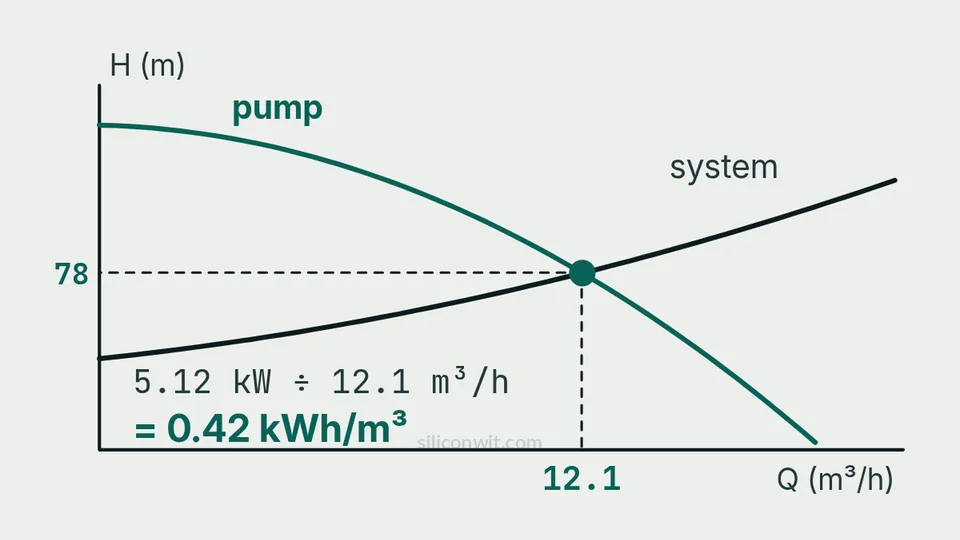
The gauge at the pump reads 3 bar, and nobody on site can say how high 3 bar will lift water. A pump ordered for 68 m of head delivers far less than the quotation, because the 520 m of pipe was left out. A second pump, identical to the first, adds 15 percent more water and 27 percent more electricity. A drive sold on "half the power at 80 percent speed" saves a few percent. And a pump that loses efficiency never stops: the water still arrives, and the bill rises a little every month.
In this course you follow one water system: a borehole pump 70 m below ground, a rising main of 520 m, a storage tank and a booster pump. You turn a gauge reading into a level, draw the curve the pipes ask for, find where the pump really runs, and see what slowing it saves. The last lesson audits the pump from four measurements: 0.4429 kWh for each cubic metre, and a worn pump that costs about 10,200 currency units a year.
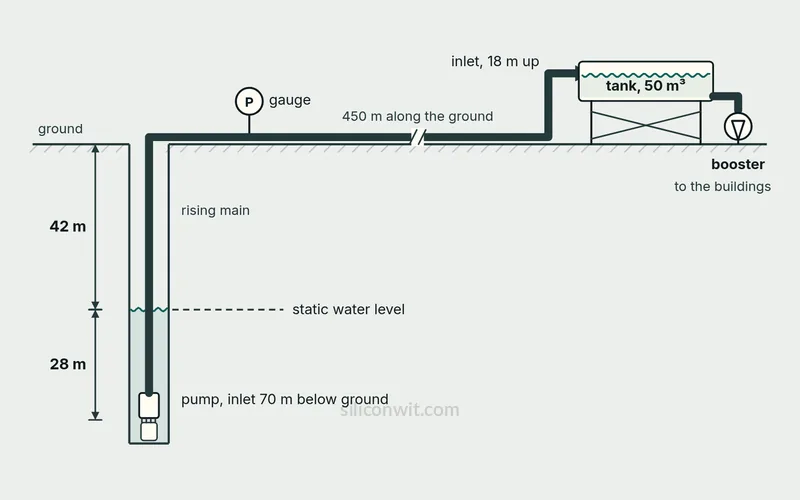 1Know the levelsWater 42 m below ground at rest, the pump 70 m down, the tank inlet 18 m up.
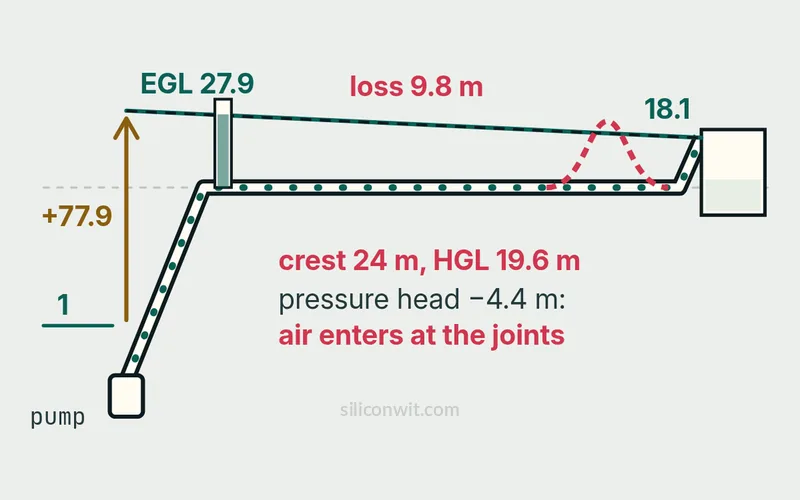 2Count the lossesThe pump must give 77.9 m: 68.0 m of lift and 9.8 m lost in the pipe.
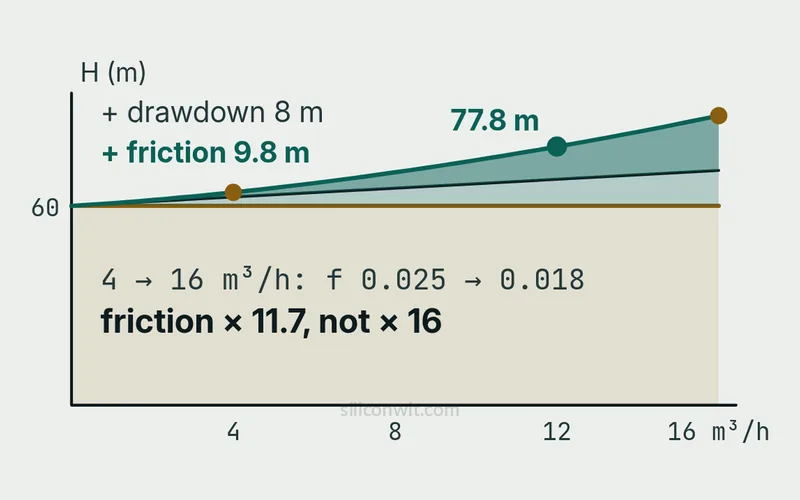 3Draw the system curve60 m of static head at every flow, then drawdown and friction on top.
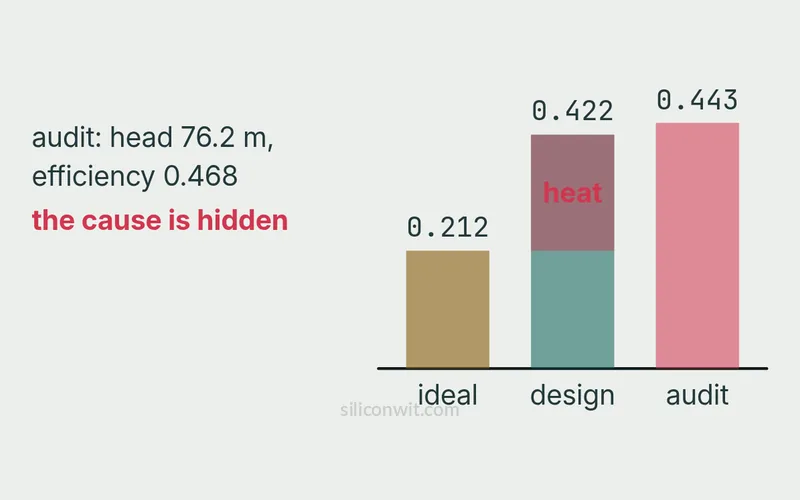 4Audit the pump0.443 kWh for each cubic metre against 0.422 in the design. The pump is worn.
New to this? New to pumps? Start with lesson 1: why pump people speak in metres, and how a gauge reading becomes a level.
You need A computer with Python, numpy, scipy and matplotlib. Every number is worked in the lessons.
Choose a pump, fix one that fails, or cut the power it uses. This is why a pump uses the energy it does, and how much of it is waste.
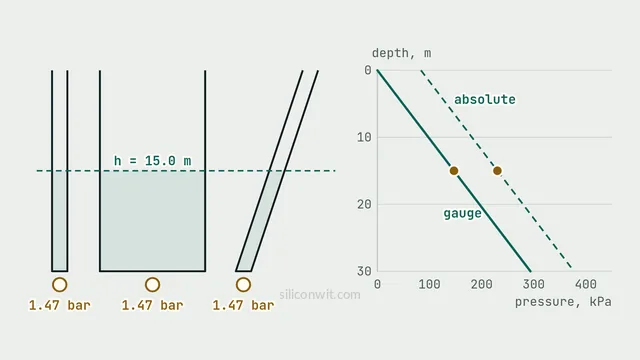 Lesson 1 · 23 minPressure, Head and HydrostaticsWhy pump people speak in metres, and how a gauge reading becomes a level.Pressure and headGauge and absoluteHydrostaticsLevel from pressure
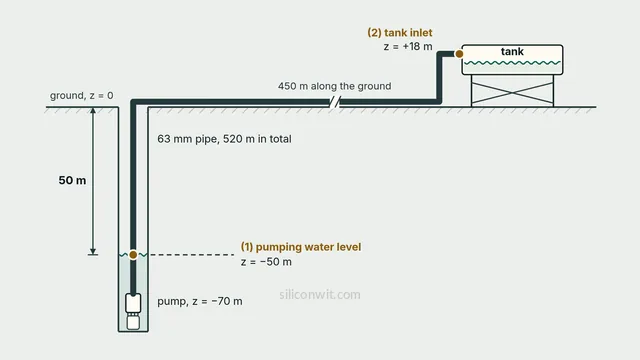 Lesson 2 · 24 minContinuity and the Energy EquationWhere the energy of flowing water goes, and why the borehole pump must give 77.9 m and not 68.ContinuityBernoulliEnergy equationGrade lines
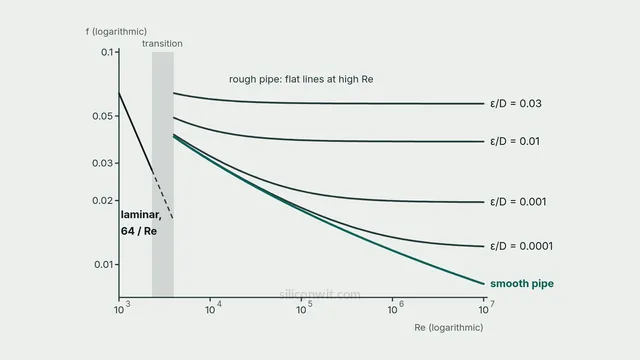 Lesson 3 · 21 minPipe Friction and Fitting LossesFind the head lost in a real pipe run, and what one pipe size too small costs every year.Reynolds numberFriction factorFitting lossesCost of friction
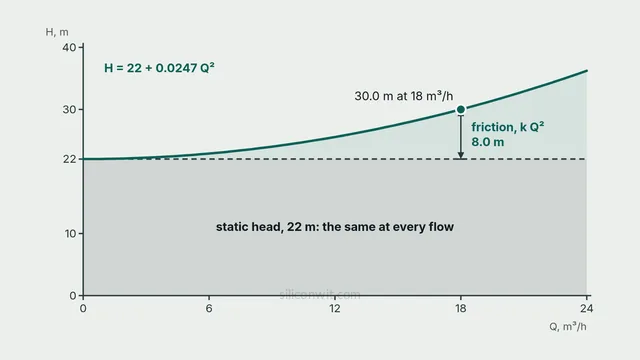 Lesson 4 · 22 minSystem Curves: Static and Friction HeadDraw the curve of head against flow that a pump must meet, and see what a valve or a blocked filter does to it.Static headFriction headDrawdownSystem curve
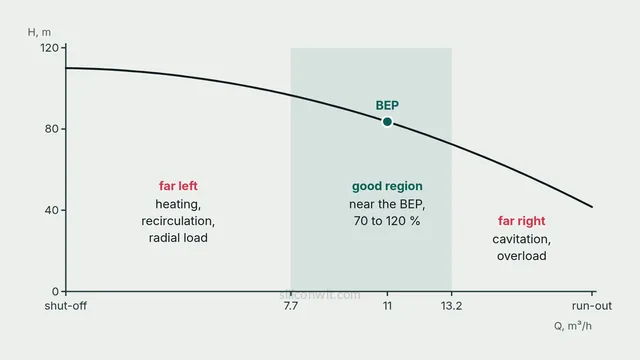 Lesson 5 · 22 minPump Curves and the Duty PointRead a maker's curve and find where the pump will really run, with its power and running hours.Pump curveDuty pointBest efficiency pointEnergy per day
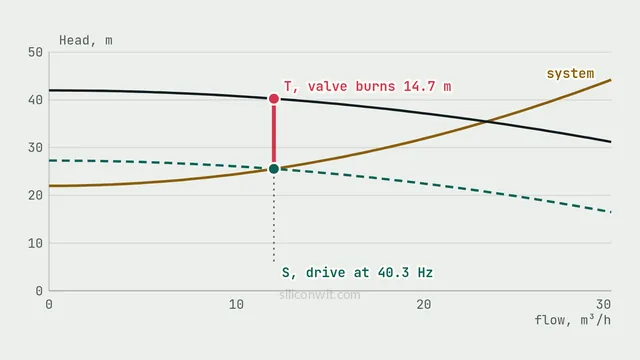 Lesson 6 · 21 minThe Affinity Laws and Speed ControlWhat slowing a pump saves, and why static head changes the answer.Affinity lawsSpeed controlThrottlingThe real saving
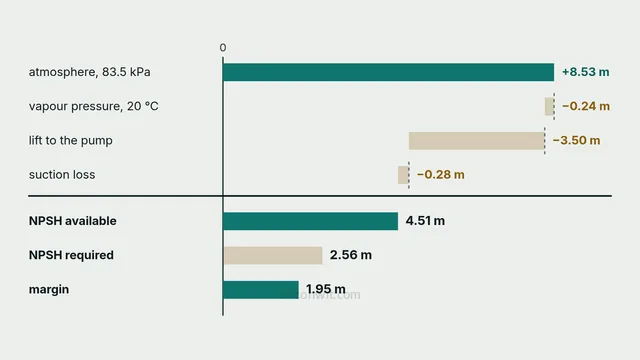 Lesson 7 · 23 minNPSH, Cavitation and the Suction SideWhy a pump that sounds like gravel is being destroyed, and how to lay out a suction line that prevents it.CavitationNPSH availableNPSH requiredSuction layout
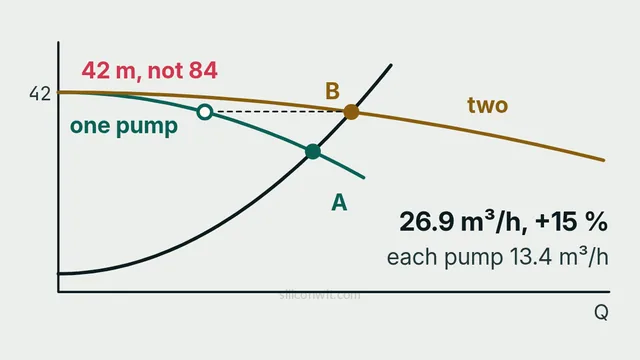 Lesson 8 · 23 minPumps in Parallel and in SeriesWhy two pumps never give twice the flow, and when the second one should run.Parallel pumpsSeries pumpsShared system curveWhen to start a pump
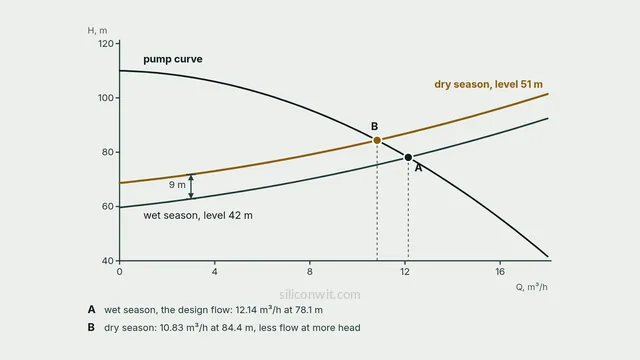 Lesson 9 · 23 minBorehole Pumps: Drawdown and YieldMatch a pump to what the borehole can give, and see a falling water table in the data.DrawdownSpecific capacityYieldSubmergence
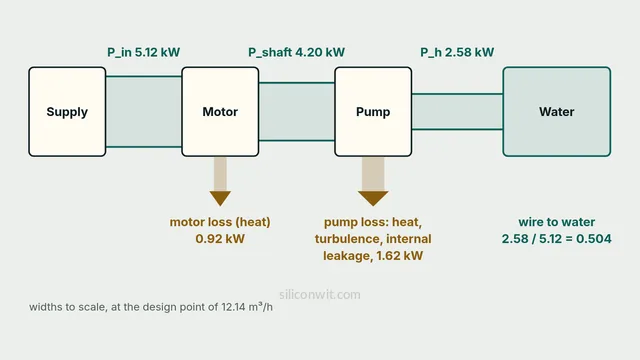 Lesson 10 · 23 minEnergy per Cubic Metre: Auditing a PumpMeasure flow, head and power, find the kWh for each cubic metre, and say what the pump system wastes.Wire-to-water efficiencySpecific energyPump or systemPayback
A pump is not right because the water arrives. Each number says what the water needs, and what the pipe and the pump take on the way.
The test: is head burned in a valve today?
The test: how much of the head is lift?
Honest limits. Pressure systems and electrical work are done by qualified people; the lessons explain how the system behaves and how to measure it. Dry-run and overpressure protection stay in the local controller; the long record and the alert are kept beyond it.
A borehole pump that is a little too big for its pipe can use a third more electricity for the same water, for twenty years, and nobody notices because the water still arrives. Pumping is one of the largest electrical loads on farms, estates and water schemes, and its losses are invisible without a little fluid mechanics. #Pumps #FluidMechanics #Boreholes
The course follows one water system: a borehole pump, a rising main, a storage tank and a booster pump. Each lesson works real numbers by hand and checks them in Python.
A computer with Python, and three libraries.
pip install numpy scipy matplotlibLesson 1: Pressure, Head and Hydrostatics
Why pump people speak in metres, and how a gauge reading becomes a level.
Lesson 2: Continuity and the Energy Equation
Where the energy in flowing water goes, with losses included.
Lesson 3: Pipe Friction and Fitting Losses
Find the head lost in a real pipe run, and what a size too small costs.
Lesson 4: System Curves: Static and Friction Head
Draw the curve that a pump must meet.
Lesson 5: Pump Curves and the Duty Point
Read a maker’s curve and find where the pump will really run.
Lesson 6: The Affinity Laws and Speed Control
What slowing a pump saves, and why static head changes the answer.
Lesson 7: NPSH, Cavitation and the Suction Side
Why a pump that sounds like gravel is being destroyed, and how to prevent it.
Lesson 8: Pumps in Parallel and in Series
Why two pumps never give twice the flow.
Lesson 9: Borehole Pumps: Drawdown and Yield
Match a pump to what the borehole can give, and see a falling water table in the data.
Lesson 10: Energy per Cubic Metre: Auditing a Pump
Measure flow, head and power, and say what the pump system wastes.
Pressure systems and electrical work are done by qualified people. The lessons explain how the system behaves and how to measure it.
Engineers and researchers who build what they teach.
SiliconWit makes these courses. We also run siliconwit.io, a monitoring service.