Lesson 1: AC, RMS and Phasors
What 240 V means, and how to add voltages that are not in step.
Read the electricity bill as the machines that make it: the energy, the highest half-hour and the power factor. Ten lessons on the equipment of ordinary sites.
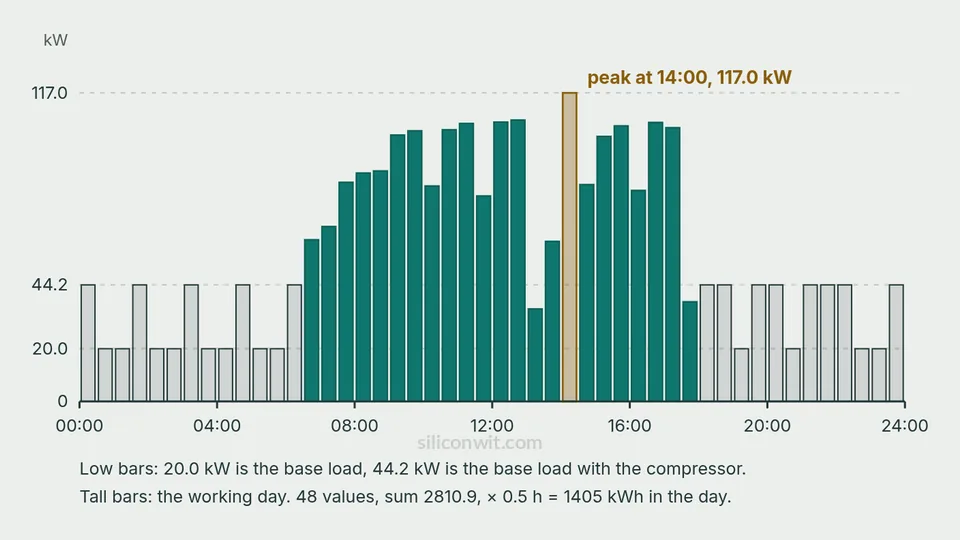
A capacitor rated for 250 V DC fails on a 240 V supply, because the supply reaches 339 V. A site pays almost a quarter more because its power factor was 0.78. A drive sold to halve the pumping bill saves less than half of what was promised. A manager switches lights off for a month and saves less than one percent, while one restart after lunch adds more to the bill than the lights saved.
In this course you follow a compressor motor, a borehole pump on a drive, a standby generator, a transformer and a three-phase meter. You add power the right way, size a capacitor bank, find the true saving of a drive, and rebuild a bill line by line to find the half-hour that sets it.
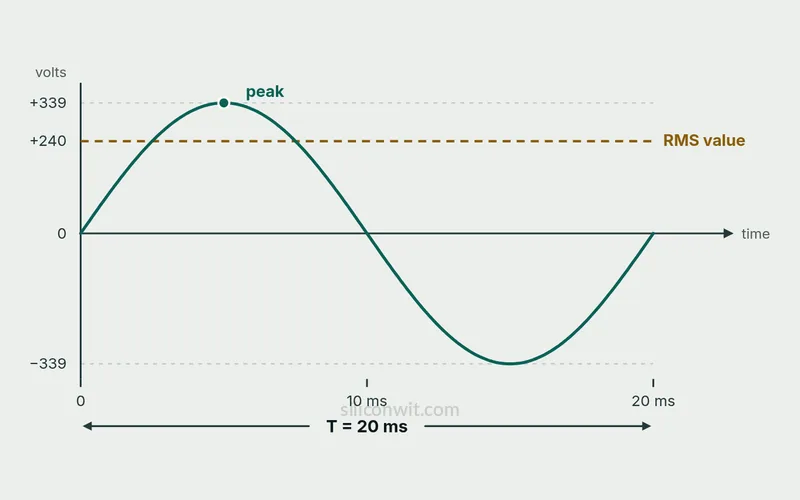 1Know what the meter saysA 240 V supply peaks at 339 V. RMS is the value that heats.
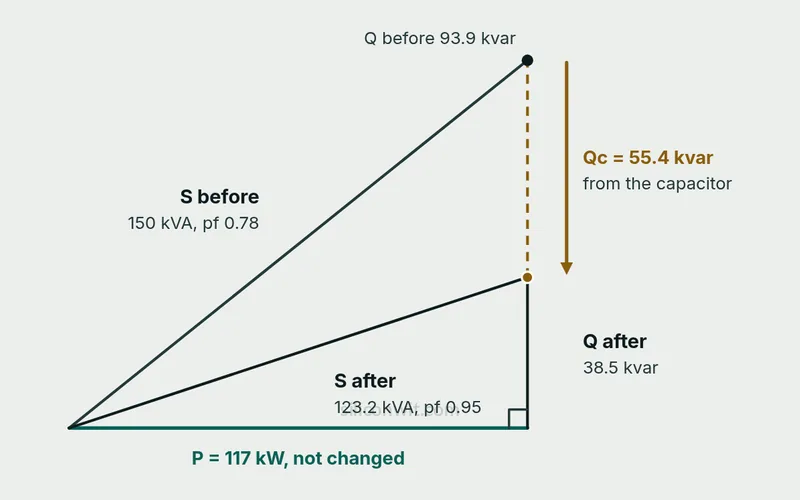 2Add power the right wayAdd kW and kvar. A capacitor lowers the kVA and leaves the kW as it was.
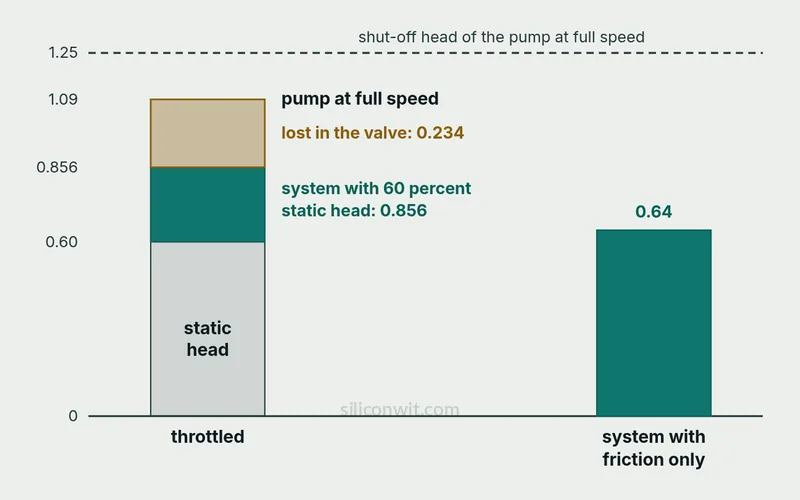 3Find the real savingOn a borehole the static head stays, so the cube law promises too much.
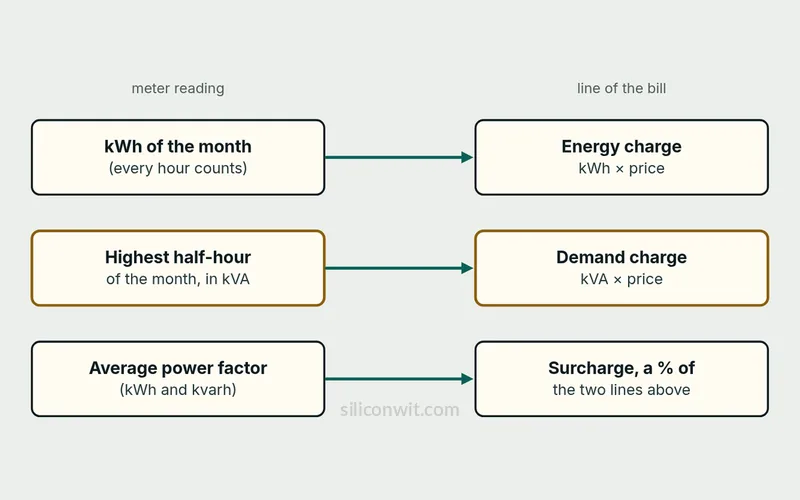 4Find what sets the billEvery kWh, one half-hour of the month, and the average power factor.
New to this? New to AC power? Start with lesson 1: what an AC meter really reports.
You need A computer with Python, numpy, scipy and matplotlib. The data of every machine and site are in the lessons.
Motors, drives, power factor and the bill: what the meter counts, and why the bill is the size it is.
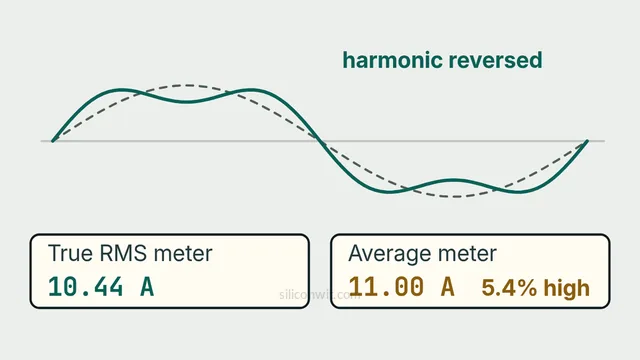 Lesson 1 · 24 minAC, RMS and PhasorsPeak, RMS and phasors: why 240 V peaks at 339 V, and why two meters disagree on one cable.RMSPhasorsImpedanceTrue-RMS meters
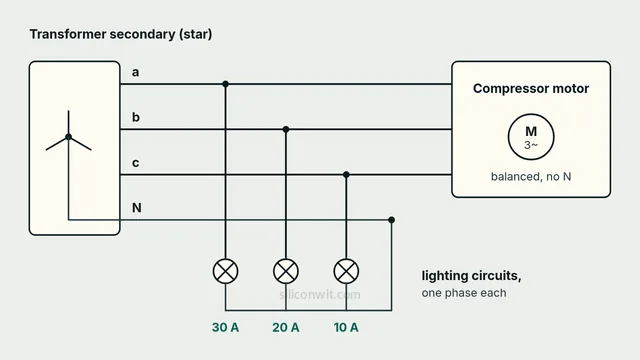 Lesson 2 · 24 minThree-Phase Systems: Star and DeltaStar and delta, what the neutral really carries, and why a few volts of unbalance overheat a motor.Star and deltaLine and phaseNeutral currentUnbalance
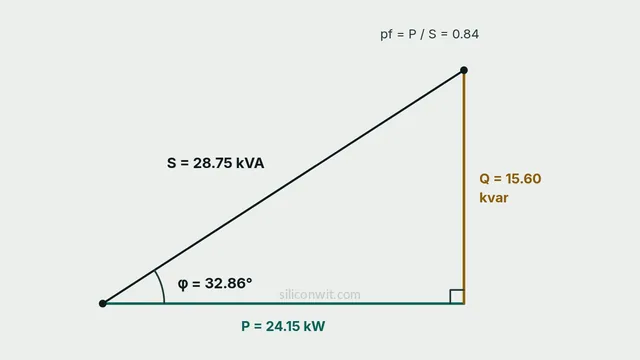 Lesson 3 · 25 minReal, Reactive and Apparent PowerThree kinds of power, and the right way to add the loads of a whole site.kW, kvar, kVAPower triangleSite totalsFour-quadrant meters
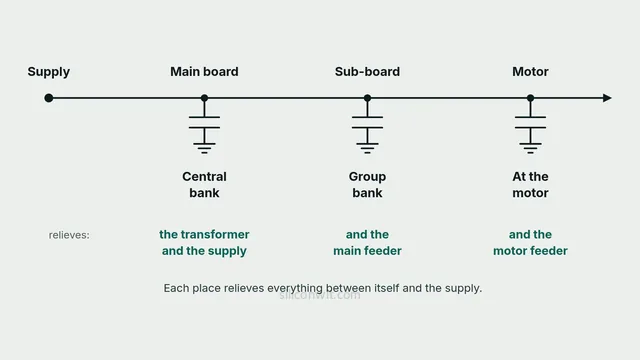 Lesson 4 · 26 minPower Factor and Its CorrectionSize a capacitor bank, and count honestly what it saves and what it leaves unchanged.Power factorCapacitor banksDemand chargeSurcharge
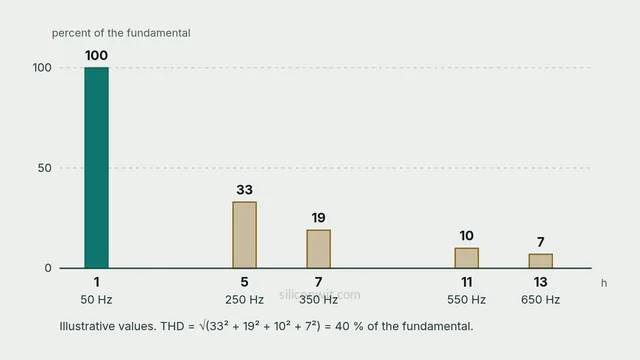 Lesson 5 · 25 minHarmonics and True Power FactorWhy a drive that shows 0.98 still draws more current than its power needs, and a neutral that carries more than a phase.THDTrue power factorNeutral currentResonance
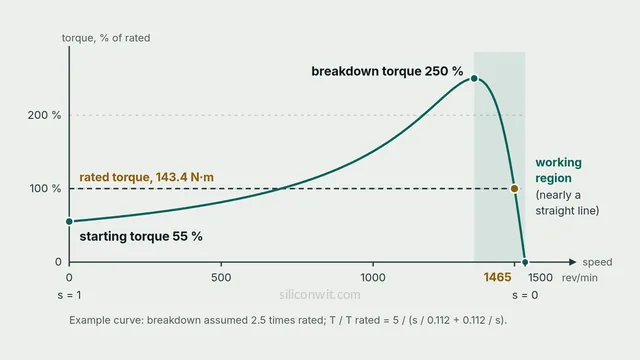 Lesson 6 · 26 minInduction Motors: Slip, Torque and the NameplateRead the nameplate, and find from one speed reading a motor twice as large as its work.SlipTorqueNameplateMotor load
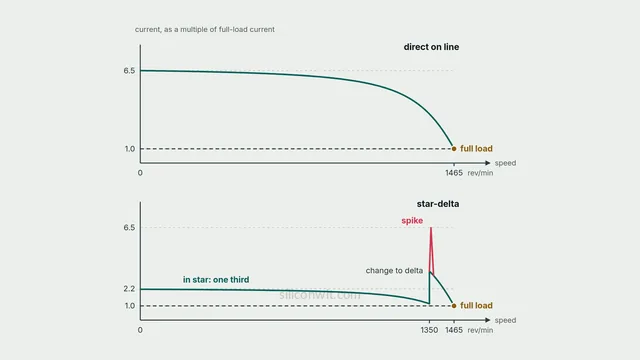 Lesson 7 · 26 minMotor Starting and ProtectionThe starting current, the dip it causes on the mains and on a generator, and what each protective device watches.Starting currentVoltage dipStarting methodsOverload relays
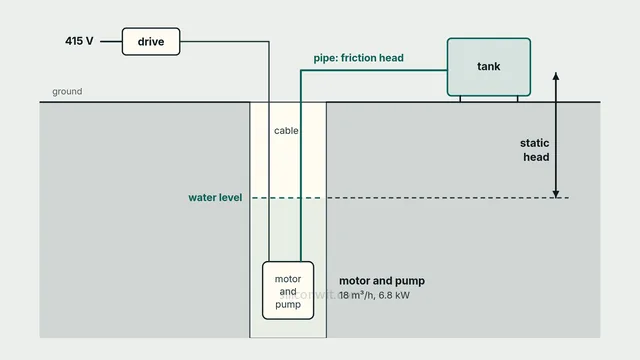 Lesson 8 · 26 minVariable Speed Drives and the Affinity LawsWhat a drive really saves on a borehole, where the cube law fails, and the payback.DrivesAffinity lawsStatic headPayback
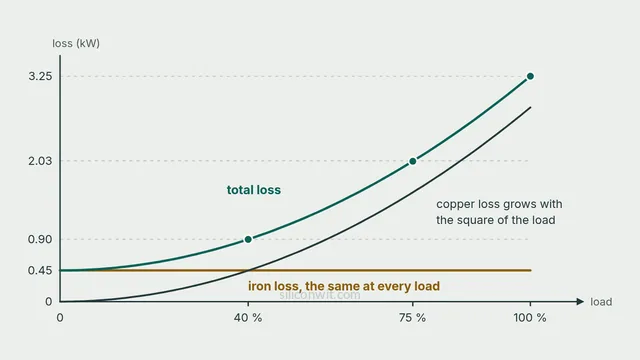 Lesson 9 · 27 minTransformers, Generators and Voltage DropWhat a transformer loses while it waits, the volts a long cable keeps, and the cost of a large generator on a small load.Transformer lossesFault levelVoltage dropGenerator fuel
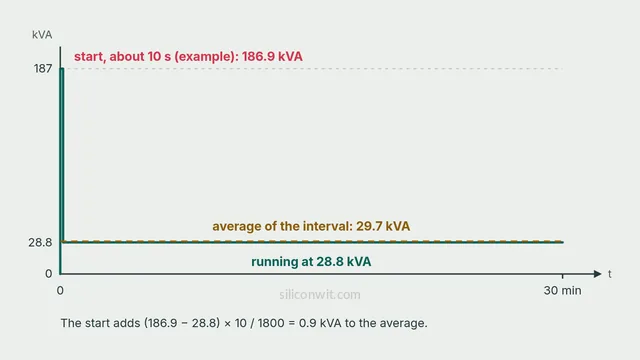 Lesson 10 · 25 minTariffs, Maximum Demand and the Load ProfileRebuild a bill line by line, and find the night waste and the peak in a day of half-hour readings.TariffsMaximum demandLoad factorLoad profile
A bill is not high because electricity is dear. Each number comes from a machine, a cable or the hour at which loads run together.
The test: how much energy was used?
The test: will the cable, the transformer and the bill take it?
Honest limits. Work inside a mains panel is for a licensed electrician, and the choice and setting of protective devices belong to a qualified person. Protection stays in local relays, fuses and breakers. A record kept over weeks shows at which hours unbalance or distortion appears, and proves what a change did.
The electricity bill is the largest number most sites never examine. It charges for energy, for the highest demand of the month and sometimes for poor power factor, and each of those is set by machines whose behaviour can be measured and understood. This course is the electrical engineering behind that bill. #ElectricalPower #EnergyMetering #Motors
It follows equipment found on ordinary sites: a compressor motor, a borehole pump on a variable speed drive, a standby generator, a distribution transformer and a three-phase energy meter. Each lesson works real numbers by hand and checks them in Python.
A computer with Python, and three libraries.
pip install numpy scipy matplotlibLesson 1: AC, RMS and Phasors
What 240 V means, and how to add voltages that are not in step.
Lesson 2: Three-Phase Systems: Star and Delta
Line and phase quantities, the neutral, and what imbalance does.
Lesson 3: Real, Reactive and Apparent Power
kW, kvar and kVA, and why a meter can show current that does no work.
Lesson 4: Power Factor and Its Correction
Size a capacitor bank, and know what it does and does not save.
Lesson 5: Harmonics and True Power Factor
What drives and inverters do to a waveform, and why the neutral runs hot.
Lesson 6: Induction Motors: Slip, Torque and the Nameplate
Read a nameplate, and find the load on a motor from its speed and current.
Lesson 7: Motor Starting and Protection
Starting current, voltage dip, and the settings that protect a motor.
Lesson 8: Variable Speed Drives and the Affinity Laws
Why slowing a pump by a fifth can halve its power, and when it does not.
Lesson 9: Transformers, Generators and Voltage Drop
Loading, losses, cable volt drop, and the fuel a generator burns per kilowatt-hour.
Lesson 10: Tariffs, Maximum Demand and the Load Profile
Read a bill line by line, and find base load, peaks and standing waste in a load curve.
Work inside a mains panel is for a licensed electrician, and this course does not teach it. The lessons explain what the quantities mean, how machines draw power, and how to read the measurements.
Engineers and researchers who build what they teach.
SiliconWit makes these courses. We also run siliconwit.io, a monitoring service.