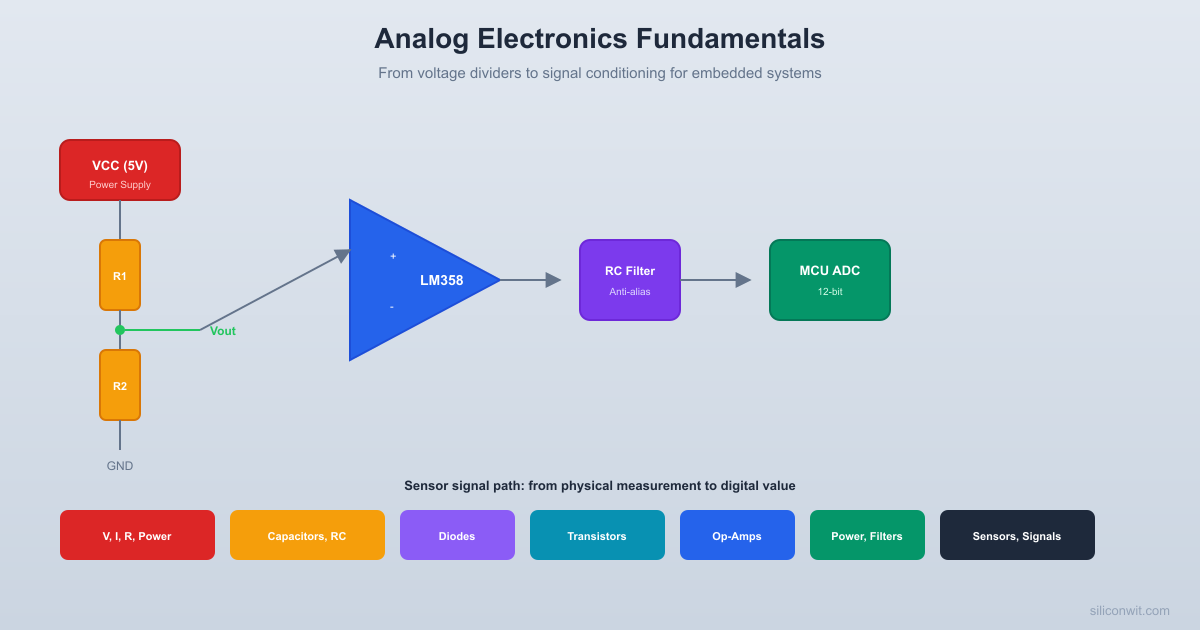
Analog electronics is the foundation beneath every digital system. Your microcontroller runs on a regulated power supply, reads sensor voltages through an ADC, and drives loads through transistor switches. This course gives you the practical knowledge to understand, design, and troubleshoot those analog building blocks. Whether you are just starting out or returning to fill in gaps, these nine lessons will make your embedded projects more reliable and your debugging faster. #AnalogElectronics #CircuitDesign #EmbeddedSystems
This Is Not a Prerequisite
Jump Into Any Course, Come Back When You Need To
You do not need to complete this course before starting the embedded programming, PCB design, or sensor interfacing courses. Those courses are fully self-contained. Think of Analog Electronics Fundamentals as helpful background that will make everything else easier, and as a reference you can return to whenever a circuit concept comes up in another lesson.
If you are already comfortable with Ohm’s law and basic components, skip ahead to the topics you need. If you are brand new to electronics, working through these lessons in order will give you a strong foundation.
Who This Course Is For
Complete Beginners
Never touched a breadboard? Start here. Every concept is explained from scratch with real-world analogies before the math appears.
Software Engineers Moving to Hardware
You can write firmware, but voltage dividers and decoupling capacitors feel like a foreign language. This course bridges that gap.
Experienced Engineers Filling Gaps
You know your way around a soldering iron but want a structured refresher on op-amp configurations, filter design, or power supply fundamentals.
Students Preparing for Lab Work
University electronics labs move fast. Working through these lessons ahead of time gives you the hands-on confidence to keep up.
Lessons
Lesson 1: Voltage, Current, and Resistance
Voltage, Current, and Resistance. Ohm’s law, Kirchhoff’s voltage and current laws, power dissipation, series and parallel resistors. Build voltage dividers, measure with a multimeter, and calculate LED current limiting resistors.
Build: Voltage divider network and LED circuits. Key parts: Resistors, LEDs, multimeter.
Lesson 2: Capacitors, Inductors, and RC/RL Circuits
Capacitors, Inductors, and RC/RL Circuits. Capacitor charging and discharging, time constants, energy storage. Build an RC filter, measure the time constant, and observe the effect on a square wave.
Build: RC low-pass filter. Key parts: Capacitors, resistors.
Lesson 3: Diodes, Rectifiers, and Protection Circuits
Diodes, Rectifiers, and Protection Circuits. Forward and reverse bias, rectifier circuits, Zener voltage regulation, flyback protection. Build a half-wave rectifier and test a flyback diode on a relay.
Build: Half-wave rectifier and flyback protection. Key parts: Diodes, Zener diodes.
Lesson 4: Transistors as Switches and Amplifiers
Transistors as Switches and Amplifiers. BJT and MOSFET fundamentals, saturation and cutoff regions, driving loads from MCU pins. Drive a motor or relay from a GPIO pin through a transistor.
Build: Transistor motor driver. Key parts: NPN transistor, N-channel MOSFET.
Lesson 5: Operational Amplifiers
Operational Amplifiers. Inverting, non-inverting, buffer, comparator, and differential amplifier configurations. Build a signal conditioning circuit that amplifies a thermistor signal for an ADC.
Build: Sensor signal amplifier. Key parts: LM358 op-amp.
Lesson 6: Power Supply Design
Power Supply Design. Linear vs switching regulators, LDO selection, voltage regulation, ripple, and decoupling strategies. Build a 3.3V regulated supply from a 9V battery using an LM1117.
Build: 3.3V regulated power supply. Key parts: LM1117, capacitors.
Lesson 7: Filters and Frequency Response
Filters and Frequency Response. Low-pass, high-pass, and band-pass filters. Cutoff frequency calculation and Bode plots. Build an RC low-pass filter and measure its frequency response.
Build: Audio-range RC filter. Key parts: Resistors, capacitors.
Lesson 8: Oscillators and Timing Circuits
Oscillators and Timing Circuits. 555 timer in astable and monostable modes, crystal oscillators, RC oscillators. Build a 555 astable oscillator and drive a buzzer at a specific frequency.
Build: 555 timer buzzer circuit. Key parts: 555 timer IC, passive buzzer.
Lesson 9: Sensors and Signal Conditioning
Sensors and Signal Conditioning. Thermistors, LDRs, strain gauges, Wheatstone bridge, instrumentation amplifier. Build a complete temperature measurement circuit with thermistor and op-amp conditioning.
Build: Temperature sensing circuit. Key parts: Thermistor, LM358 op-amp.
Parts Kit
You can complete every lesson in this course with a small kit of commonly available components. Most of these parts are reused across multiple lessons.
Capacitor assortment (100nF, 1uF, 10uF, 100uF, 470uF ceramic and electrolytic)
1 pack
Lessons 2, 6, 7, 8
1 to 2 USD
LEDs (red, green, assorted)
5+
Lessons 1, 3
1 USD
Digital multimeter
1
All lessons
3 to 8 USD
Potentiometer (10k ohm)
2
Lessons 1, 5, 9
1 USD
NPN transistor (2N2222 or BC547)
3
Lesson 4
1 USD
N-channel MOSFET (2N7000 or IRFZ44N)
2
Lesson 4
1 USD
Op-amp LM358 (dual)
2
Lessons 5, 9
1 USD
Voltage regulator LM1117-3.3 or 7805
2
Lesson 6
1 USD
Diodes 1N4007 (general purpose)
5
Lessons 3, 4
1 USD
Zener diode 5.1V
2
Lesson 3
1 USD
555 timer IC (NE555)
2
Lesson 8
1 USD
Passive buzzer
1
Lesson 8
1 USD
NTC thermistor (10k ohm)
2
Lessons 5, 9
1 USD
LDR (light dependent resistor)
2
Lesson 9
1 USD
9V battery + snap connector
1
Lesson 6
1 to 2 USD
Estimated total cost: 15 to 25 USD depending on where you source components. Online marketplaces and local electronics shops both carry these standard parts.
Where This Connects
Every lesson in this course maps directly to concepts you will encounter in embedded systems, PCB design, and sensor interfacing courses.
Analog Topic
Where It Shows Up
Voltage dividers, Ohm’s law
GPIO pin current limits, ADC reference voltages, level shifting
Capacitors and time constants
Decoupling capacitors on every MCU, debounce circuits, RC delay timing
Diodes and protection
Flyback diodes on relays and motors, reverse polarity protection, ESD clamping
Transistor switches
Driving motors, relays, and high-power LEDs from low-current GPIO pins
Op-amp signal conditioning
Amplifying weak sensor signals before ADC sampling, impedance buffering
Power supply design
Designing clean 3.3V and 5V rails for MCU boards, understanding LDO dropout
Filters
Anti-aliasing before ADC input, noise filtering on sensor lines, audio processing
Oscillators and timing
Crystal oscillator selection for MCU clocks, understanding jitter and stability
Sensor conditioning
Reading thermistors, strain gauges, and other analog sensors with full accuracy
Course Approach
Concept with Analogy
Every new idea starts with a real-world analogy and a plain English explanation. The math comes after you understand the intuition.
Formulas and Calculations
Key equations are presented with worked examples so you can verify your own calculations.
Build It on a Breadboard
Every lesson includes a practical circuit you can build and test with the parts kit listed above.
Measure and Verify
Use your multimeter (and optionally an oscilloscope) to confirm that theory matches reality.
Connect to Embedded Systems
Each lesson ends by showing exactly where these analog concepts appear in microcontroller projects and PCB design.