Skip to content

RFID, NFC, and Identification Systems

RFID, NFC, and Identification Systems hero image
Modified:
Published:

RFID identification is everywhere: office badges, transit cards, warehouse inventory tags, and hotel key cards. The RC522 module gives you a low-cost 13.56 MHz RFID reader that communicates over SPI, and MIFARE Classic 1K cards provide 1 KB of readable/writable memory organized into sectors and blocks. In this lesson you will build a complete door access control system that scans cards, checks UIDs against an authorized list, provides visual and audio feedback, and displays status on an OLED screen. A designated master card lets you add or remove authorized cards without reprogramming the firmware. #STM32 #RFID #AccessControl

What We Are Building

RFID Door Access Control System

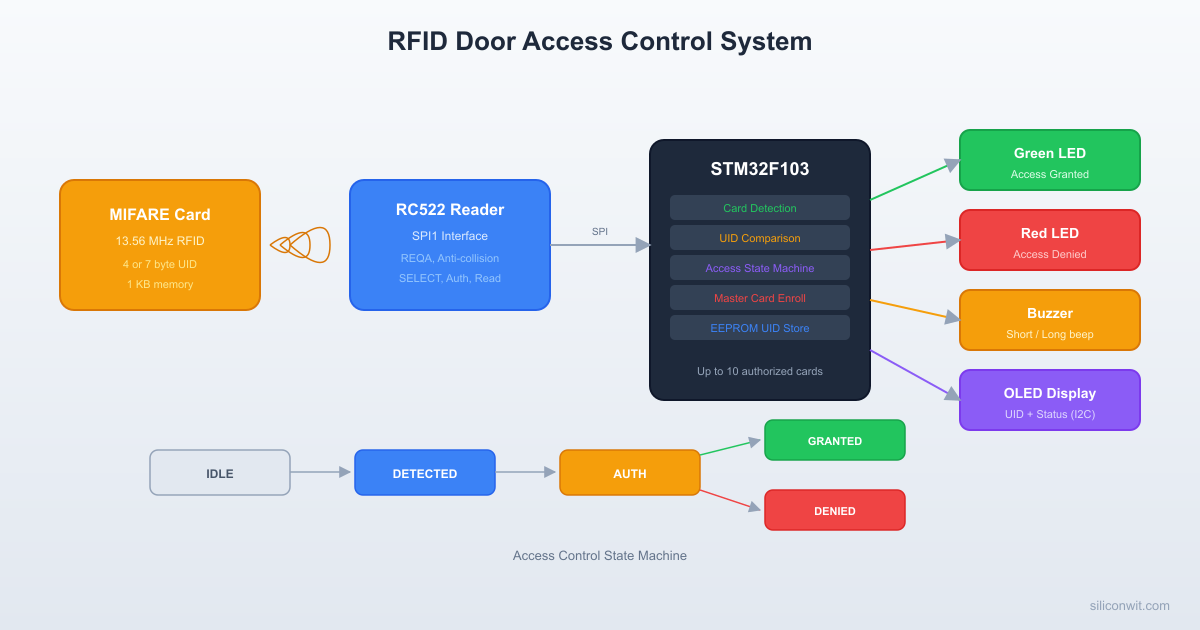
An access control system that continuously scans for RFID cards, reads the UID, checks it against a stored list of authorized cards, and responds with green LED plus short beep (granted) or red LED plus long beep (denied). An SSD1306 OLED displays the scanned UID and access status. The first card registered becomes the master card, which can add or remove other cards from the authorized list.

Project specifications:

ParameterValue
BoardBlue Pill (STM32F103C8T6)
RFID moduleRC522 (MFRC522), SPI interface
RFID cardsMIFARE Classic 1K, 13.56 MHz
DisplaySSD1306 OLED 128x64 (I2C, reused from Lesson 4)
SPI busSPI1 (PA5 SCK, PA6 MISO, PA7 MOSI)
I2C busI2C1 (PB6 SCL, PB7 SDA)
Max authorized cards10
UID length supported4-byte and 7-byte
FeedbackGreen LED, red LED, passive buzzer

RFID and NFC Fundamentals


The RC522 operates at 13.56 MHz, which falls in the High Frequency (HF) RFID band. At this frequency, communication happens through electromagnetic induction: the reader’s antenna coil generates an alternating magnetic field, and when a card enters the field (typically within 3 to 5 cm), the card’s coil picks up enough energy to power the chip and respond.

RFID Communication (13.56 MHz)
┌──────────┐ EM Field ┌──────────┐
│ RC522 │ ~3-5 cm │ MIFARE │
│ Reader │ ┌────────┐ │ Card │
│ │ │ Antenna │ │ │
│ SPI <───┤ │ Coil │ │ Powered │
│ to MCU │ │ (( (( )) │ │ by field │
│ │ │ │ │ │
│ Power: │ └────────┘ │ 1 KB mem │
│ 3.3V │ │ UID: 4B │
└──────────┘ └──────────┘
STM32 sends commands Card responds
via SPI to RC522 via load modulation

MIFARE Classic 1K memory layout:

StructureSizeDetails
Sectors16Numbered 0 to 15
Blocks per sector4Numbered 0 to 3 within each sector
Bytes per block1616 bytes of data
Total memory1024 bytes16 sectors x 4 blocks x 16 bytes
Sector trailerBlock 3 of each sectorContains Key A (6 bytes), access bits (4 bytes), Key B (6 bytes)
Manufacturer blockSector 0, Block 0Contains UID and manufacturer data (read-only)

The card’s UID (Unique Identifier) is stored in block 0 of sector 0. For MIFARE Classic 1K, the UID is typically 4 bytes (sometimes called NUID since it can repeat across manufacturers). Newer MIFARE cards use 7-byte or 10-byte UIDs.

MIFARE Classic 1K Memory Map
Sector Block Content
┌────── ────── ─────────────────────┐
│ 0 0 UID + Manufacturer │
│ 1 Data (16 bytes) │
│ 2 Data (16 bytes) │
│ 3 Key A | Access | Key B│
├────── ────── ─────────────────────┤
│ 1 4 Data (16 bytes) │
│ 5 Data (16 bytes) │
│ 6 Data (16 bytes) │
│ 7 Key A | Access | Key B│
├────── ────── ─────────────────────┤
│ ... ... (sectors 2-14) │
├────── ────── ─────────────────────┤
│ 15 60 Data (16 bytes) │
│ 61 Data (16 bytes) │
│ 62 Data (16 bytes) │
│ 63 Key A | Access | Key B│
└────── ────── ─────────────────────┘
16 sectors x 4 blocks x 16 bytes
= 1024 bytes total

Default keys: Factory-fresh MIFARE Classic cards ship with Key A and Key B both set to 0xFF 0xFF 0xFF 0xFF 0xFF 0xFF. Authentication with either key is required before reading or writing any block in that sector.

RC522 Module and SPI Interface


The MFRC522 chip communicates over SPI at up to 10 MHz. The module typically comes on a breakout board with an onboard antenna, voltage regulator, and header pins.

SPI communication protocol:

To write a register, send the address byte with bit 7 clear (address shifted left by 1, with bit 0 = 0), followed by the data byte. To read a register, send the address byte with bit 7 set (address shifted left by 1, OR with 0x80, with bit 0 = 0), and the chip returns the register value on the next byte.

Key MFRC522 registers:

RegisterAddressPurpose
CommandReg0x01Start/stop commands
ComIrqReg0x04Interrupt request bits
FIFODataReg0x09Read/write FIFO buffer
FIFOLevelReg0x0ANumber of bytes in FIFO
BitFramingReg0x0DBit-oriented framing adjustments
ModeReg0x11General mode settings
TxControlReg0x14Antenna driver control
TxASKReg0x15100% ASK modulation setting
TModeReg0x2ATimer mode settings
TPrescalerReg0x2BTimer prescaler

Wiring


RC522 to Blue Pill (SPI1)

RC522 PinBlue Pill PinFunction
SDA (SS)PA4SPI chip select (active low)
SCKPA5SPI clock
MOSIPA7Master out, slave in
MISOPA6Master in, slave out
IRQNot connectedOptional interrupt
GNDGNDGround
RSTPB0Hardware reset (active low)
3.3V3.3VPower supply

SSD1306 OLED (I2C1, reused from Lesson 4)

OLED PinBlue Pill PinFunction
SDAPB7I2C data
SCLPB6I2C clock
VCC3.3VPower
GNDGNDGround

Indicators

ComponentBlue Pill PinNotes
Green LED (anode)PB12330 ohm resistor to GND
Red LED (anode)PB13330 ohm resistor to GND
Buzzer (+)PB1Passive buzzer, driven by GPIO
Buzzer (-)GNDGround

CubeMX Configuration


  1. Create a new STM32CubeIDE project for STM32F103C8Tx. Select the Blue Pill board or the chip directly.

  2. SPI1 configuration. In Connectivity, enable SPI1 as Full-Duplex Master. Set prescaler to 16 (giving 4.5 MHz SPI clock from the 72 MHz APB2). Set CPOL = Low, CPHA = 1 Edge, Data Size = 8 bit, MSB First. Do not enable the hardware NSS pin (we control PA4 manually as GPIO output).

  3. I2C1 configuration. In Connectivity, enable I2C1 in Standard Mode (100 kHz). PB6 = SCL, PB7 = SDA.

  4. GPIO outputs. Configure PA4 as GPIO_Output (RC522 chip select), PB0 as GPIO_Output (RC522 reset), PB12 as GPIO_Output (green LED), PB13 as GPIO_Output (red LED), PB1 as GPIO_Output (buzzer).

  5. Clock configuration. Set HSE to 8 MHz crystal, PLL to 72 MHz SYSCLK. APB1 = 36 MHz, APB2 = 72 MHz.

  6. Generate code and open the project.

RC522 Driver Implementation


The driver handles low-level SPI communication, register access, card detection, and MIFARE authentication.

rc522.h
#ifndef RC522_H
#define RC522_H
#include "stm32f1xx_hal.h"
#include <stdint.h>
/* MFRC522 Commands */
#define PCD_IDLE 0x00
#define PCD_AUTHENT 0x0E
#define PCD_RECEIVE 0x08
#define PCD_TRANSMIT 0x04
#define PCD_TRANSCEIVE 0x0C
#define PCD_RESETPHASE 0x0F
#define PCD_CALCCRC 0x03
/* MIFARE Commands */
#define PICC_REQIDL 0x26
#define PICC_REQALL 0x52
#define PICC_ANTICOLL1 0x93
#define PICC_ANTICOLL2 0x95
#define PICC_SELECTTAG 0x93
#define PICC_AUTHENT1A 0x60
#define PICC_AUTHENT1B 0x61
#define PICC_READ 0x30
#define PICC_WRITE 0xA0
#define PICC_HALT 0x50
/* MFRC522 Registers */
#define CommandReg 0x01
#define ComIEnReg 0x02
#define DivIEnReg 0x03
#define ComIrqReg 0x04
#define DivIrqReg 0x05
#define ErrorReg 0x06
#define Status1Reg 0x07
#define Status2Reg 0x08
#define FIFODataReg 0x09
#define FIFOLevelReg 0x0A
#define WaterLevelReg 0x0B
#define ControlReg 0x0C
#define BitFramingReg 0x0D
#define CollReg 0x0E
#define ModeReg 0x11
#define TxModeReg 0x12
#define RxModeReg 0x13
#define TxControlReg 0x14
#define TxASKReg 0x15
#define TModeReg 0x2A
#define TPrescalerReg 0x2B
#define TReloadRegH 0x2C
#define TReloadRegL 0x2D
#define AutoTestReg 0x36
#define VersionReg 0x37
/* Status codes */
#define MI_OK 0
#define MI_NOTAGERR 1
#define MI_ERR 2
/* Card info structure */
typedef struct {
uint8_t uid[10];
uint8_t uid_len;
uint8_t sak;
} RFID_Card_t;
void RC522_Init(SPI_HandleTypeDef *hspi);
void RC522_Reset(void);
void RC522_AntennaOn(void);
void RC522_AntennaOff(void);
uint8_t RC522_Request(uint8_t reqMode, uint8_t *tagType);
uint8_t RC522_Anticoll(uint8_t *serNum);
uint8_t RC522_SelectTag(uint8_t *serNum);
uint8_t RC522_Auth(uint8_t authMode, uint8_t blockAddr, uint8_t *key, uint8_t *serNum);
uint8_t RC522_ReadBlock(uint8_t blockAddr, uint8_t *recvData);
uint8_t RC522_WriteBlock(uint8_t blockAddr, uint8_t *sendData);
void RC522_Halt(void);
#endif
rc522.c
#include "rc522.h"
static SPI_HandleTypeDef *rc522_spi;
/* Low-level SPI helpers */
static void RC522_CS_Low(void) { HAL_GPIO_WritePin(GPIOA, GPIO_PIN_4, GPIO_PIN_RESET); }
static void RC522_CS_High(void) { HAL_GPIO_WritePin(GPIOA, GPIO_PIN_4, GPIO_PIN_SET); }
static void RC522_RST_Low(void) { HAL_GPIO_WritePin(GPIOB, GPIO_PIN_0, GPIO_PIN_RESET); }
static void RC522_RST_High(void){ HAL_GPIO_WritePin(GPIOB, GPIO_PIN_0, GPIO_PIN_SET); }
static void RC522_WriteReg(uint8_t addr, uint8_t val)
{
uint8_t tx[2];
tx[0] = (addr << 1) & 0x7E; /* bit 7 = 0 for write */
tx[1] = val;
RC522_CS_Low();
HAL_SPI_Transmit(rc522_spi, tx, 2, 50);
RC522_CS_High();
}
static uint8_t RC522_ReadReg(uint8_t addr)
{
uint8_t tx[2], rx[2];
tx[0] = ((addr << 1) & 0x7E) | 0x80; /* bit 7 = 1 for read */
tx[1] = 0x00;
RC522_CS_Low();
HAL_SPI_TransmitReceive(rc522_spi, tx, rx, 2, 50);
RC522_CS_High();
return rx[1];
}
static void RC522_SetBitMask(uint8_t reg, uint8_t mask)
{
uint8_t tmp = RC522_ReadReg(reg);
RC522_WriteReg(reg, tmp | mask);
}
static void RC522_ClearBitMask(uint8_t reg, uint8_t mask)
{
uint8_t tmp = RC522_ReadReg(reg);
RC522_WriteReg(reg, tmp & (~mask));
}
void RC522_Init(SPI_HandleTypeDef *hspi)
{
rc522_spi = hspi;
RC522_CS_High();
RC522_RST_High();
HAL_Delay(50);
RC522_Reset();
RC522_WriteReg(TModeReg, 0x8D); /* Timer auto, prescaler high nibble */
RC522_WriteReg(TPrescalerReg, 0x3E); /* Prescaler low byte */
RC522_WriteReg(TReloadRegL, 30); /* Timer reload value */
RC522_WriteReg(TReloadRegH, 0);
RC522_WriteReg(TxASKReg, 0x40); /* 100% ASK modulation */
RC522_WriteReg(ModeReg, 0x3D); /* CRC preset value 0x6363 */
RC522_AntennaOn();
}
void RC522_Reset(void)
{
RC522_WriteReg(CommandReg, PCD_RESETPHASE);
HAL_Delay(50);
}
void RC522_AntennaOn(void)
{
uint8_t val = RC522_ReadReg(TxControlReg);
if (!(val & 0x03)) {
RC522_SetBitMask(TxControlReg, 0x03);
}
}
void RC522_AntennaOff(void)
{
RC522_ClearBitMask(TxControlReg, 0x03);
}
static uint8_t RC522_ToCard(uint8_t command, uint8_t *sendData, uint8_t sendLen,
uint8_t *backData, uint16_t *backLen)
{
uint8_t status = MI_ERR;
uint8_t irqEn = 0x00, waitIRq = 0x00;
uint8_t n, lastBits;
uint16_t i;
if (command == PCD_AUTHENT) {
irqEn = 0x12;
waitIRq = 0x10;
} else if (command == PCD_TRANSCEIVE) {
irqEn = 0x77;
waitIRq = 0x30;
}
RC522_WriteReg(ComIEnReg, irqEn | 0x80);
RC522_ClearBitMask(ComIrqReg, 0x80);
RC522_SetBitMask(FIFOLevelReg, 0x80); /* Flush FIFO */
RC522_WriteReg(CommandReg, PCD_IDLE);
/* Write data to FIFO */
for (i = 0; i < sendLen; i++) {
RC522_WriteReg(FIFODataReg, sendData[i]);
}
RC522_WriteReg(CommandReg, command);
if (command == PCD_TRANSCEIVE) {
RC522_SetBitMask(BitFramingReg, 0x80); /* Start send */
}
/* Wait for completion */
i = 2000;
do {
n = RC522_ReadReg(ComIrqReg);
i--;
} while (i && !(n & 0x01) && !(n & waitIRq));
RC522_ClearBitMask(BitFramingReg, 0x80);
if (i != 0) {
if (!(RC522_ReadReg(ErrorReg) & 0x1B)) {
status = MI_OK;
if (command == PCD_TRANSCEIVE) {
n = RC522_ReadReg(FIFOLevelReg);
lastBits = RC522_ReadReg(ControlReg) & 0x07;
if (lastBits) {
*backLen = (n - 1) * 8 + lastBits;
} else {
*backLen = n * 8;
}
if (n == 0) n = 1;
if (n > 16) n = 16;
for (i = 0; i < n; i++) {
backData[i] = RC522_ReadReg(FIFODataReg);
}
}
} else {
status = MI_ERR;
}
}
return status;
}
uint8_t RC522_Request(uint8_t reqMode, uint8_t *tagType)
{
uint8_t status;
uint16_t backBits;
RC522_WriteReg(BitFramingReg, 0x07); /* 7 bits for short frame */
tagType[0] = reqMode;
status = RC522_ToCard(PCD_TRANSCEIVE, tagType, 1, tagType, &backBits);
if ((status != MI_OK) || (backBits != 0x10)) {
status = MI_ERR;
}
return status;
}
uint8_t RC522_Anticoll(uint8_t *serNum)
{
uint8_t status;
uint8_t i, serNumCheck = 0;
uint16_t unLen;
RC522_WriteReg(BitFramingReg, 0x00);
serNum[0] = PICC_ANTICOLL1;
serNum[1] = 0x20;
status = RC522_ToCard(PCD_TRANSCEIVE, serNum, 2, serNum, &unLen);
if (status == MI_OK) {
for (i = 0; i < 4; i++) {
serNumCheck ^= serNum[i];
}
if (serNumCheck != serNum[4]) {
status = MI_ERR;
}
}
return status;
}
uint8_t RC522_SelectTag(uint8_t *serNum)
{
uint8_t i, status;
uint8_t size;
uint16_t recvBits;
uint8_t buffer[9];
buffer[0] = PICC_SELECTTAG;
buffer[1] = 0x70;
for (i = 0; i < 5; i++) {
buffer[i + 2] = serNum[i];
}
/* Calculate CRC for the select command */
RC522_WriteReg(CommandReg, PCD_IDLE);
RC522_ClearBitMask(DivIrqReg, 0x04);
RC522_SetBitMask(FIFOLevelReg, 0x80);
for (i = 0; i < 7; i++) {
RC522_WriteReg(FIFODataReg, buffer[i]);
}
RC522_WriteReg(CommandReg, PCD_CALCCRC);
i = 255;
uint8_t n;
do {
n = RC522_ReadReg(DivIrqReg);
i--;
} while (i && !(n & 0x04));
buffer[7] = RC522_ReadReg(0x22); /* CRC result low */
buffer[8] = RC522_ReadReg(0x21); /* CRC result high */
status = RC522_ToCard(PCD_TRANSCEIVE, buffer, 9, buffer, &recvBits);
if ((status == MI_OK) && (recvBits == 0x18)) {
size = buffer[0];
} else {
size = 0;
}
return size;
}
uint8_t RC522_Auth(uint8_t authMode, uint8_t blockAddr, uint8_t *key, uint8_t *serNum)
{
uint8_t status;
uint16_t recvBits;
uint8_t i, buff[12];
buff[0] = authMode;
buff[1] = blockAddr;
for (i = 0; i < 6; i++) {
buff[i + 2] = key[i];
}
for (i = 0; i < 4; i++) {
buff[i + 8] = serNum[i];
}
status = RC522_ToCard(PCD_AUTHENT, buff, 12, buff, &recvBits);
if (status != MI_OK) return MI_ERR;
if (!(RC522_ReadReg(Status2Reg) & 0x08)) return MI_ERR;
return MI_OK;
}
uint8_t RC522_ReadBlock(uint8_t blockAddr, uint8_t *recvData)
{
uint8_t status;
uint16_t unLen;
recvData[0] = PICC_READ;
recvData[1] = blockAddr;
/* CRC calculation */
RC522_WriteReg(CommandReg, PCD_IDLE);
RC522_ClearBitMask(DivIrqReg, 0x04);
RC522_SetBitMask(FIFOLevelReg, 0x80);
RC522_WriteReg(FIFODataReg, recvData[0]);
RC522_WriteReg(FIFODataReg, recvData[1]);
RC522_WriteReg(CommandReg, PCD_CALCCRC);
uint8_t i = 255, n;
do { n = RC522_ReadReg(DivIrqReg); i--; } while (i && !(n & 0x04));
recvData[2] = RC522_ReadReg(0x22);
recvData[3] = RC522_ReadReg(0x21);
status = RC522_ToCard(PCD_TRANSCEIVE, recvData, 4, recvData, &unLen);
if ((status != MI_OK) || (unLen != 0x90)) {
status = MI_ERR;
}
return status;
}
uint8_t RC522_WriteBlock(uint8_t blockAddr, uint8_t *sendData)
{
uint8_t status;
uint16_t recvBits;
uint8_t i, buff[18];
buff[0] = PICC_WRITE;
buff[1] = blockAddr;
/* CRC for write command */
RC522_WriteReg(CommandReg, PCD_IDLE);
RC522_ClearBitMask(DivIrqReg, 0x04);
RC522_SetBitMask(FIFOLevelReg, 0x80);
RC522_WriteReg(FIFODataReg, buff[0]);
RC522_WriteReg(FIFODataReg, buff[1]);
RC522_WriteReg(CommandReg, PCD_CALCCRC);
i = 255;
uint8_t n;
do { n = RC522_ReadReg(DivIrqReg); i--; } while (i && !(n & 0x04));
buff[2] = RC522_ReadReg(0x22);
buff[3] = RC522_ReadReg(0x21);
status = RC522_ToCard(PCD_TRANSCEIVE, buff, 4, buff, &recvBits);
if ((status != MI_OK) || (recvBits != 4) || ((buff[0] & 0x0F) != 0x0A)) {
return MI_ERR;
}
/* Send 16 bytes of data + CRC */
for (i = 0; i < 16; i++) {
buff[i] = sendData[i];
}
RC522_WriteReg(CommandReg, PCD_IDLE);
RC522_ClearBitMask(DivIrqReg, 0x04);
RC522_SetBitMask(FIFOLevelReg, 0x80);
for (i = 0; i < 16; i++) {
RC522_WriteReg(FIFODataReg, buff[i]);
}
RC522_WriteReg(CommandReg, PCD_CALCCRC);
i = 255;
do { n = RC522_ReadReg(DivIrqReg); i--; } while (i && !(n & 0x04));
buff[16] = RC522_ReadReg(0x22);
buff[17] = RC522_ReadReg(0x21);
status = RC522_ToCard(PCD_TRANSCEIVE, buff, 18, buff, &recvBits);
if ((status != MI_OK) || (recvBits != 4) || ((buff[0] & 0x0F) != 0x0A)) {
status = MI_ERR;
}
return status;
}
void RC522_Halt(void)
{
uint16_t unLen;
uint8_t buff[4];
buff[0] = PICC_HALT;
buff[1] = 0;
RC522_WriteReg(CommandReg, PCD_IDLE);
RC522_ClearBitMask(DivIrqReg, 0x04);
RC522_SetBitMask(FIFOLevelReg, 0x80);
RC522_WriteReg(FIFODataReg, buff[0]);
RC522_WriteReg(FIFODataReg, buff[1]);
RC522_WriteReg(CommandReg, PCD_CALCCRC);
uint8_t i = 255, n;
do { n = RC522_ReadReg(DivIrqReg); i--; } while (i && !(n & 0x04));
buff[2] = RC522_ReadReg(0x22);
buff[3] = RC522_ReadReg(0x21);
RC522_ToCard(PCD_TRANSCEIVE, buff, 4, buff, &unLen);
}

Card Detection and Anti-Collision


The card detection sequence follows the ISO 14443A protocol:

  1. REQA (Request command A). The reader broadcasts a 7-bit short frame (0x26). Any card in the field responds with a 2-byte ATQA (Answer To Request A), indicating the card type.

  2. Anti-collision loop. Multiple cards may respond simultaneously. The anti-collision protocol resolves collisions by progressively narrowing down to a single card’s UID. For a single card scenario (most common in access control), one round of anti-collision retrieves the full 4-byte UID plus a BCC (Block Check Character) byte.

  3. SELECT. The reader sends the UID back to the card with a SELECT command. The card responds with its SAK (Select Acknowledge) byte, confirming selection and indicating whether the UID is complete (for 4-byte UIDs) or whether further anti-collision cascades are needed (for 7-byte or 10-byte UIDs).

  4. Authentication. Once selected, the reader must authenticate with Key A or Key B for the target sector before any read or write operations. The MFRC522 handles the Crypto-1 mutual authentication internally.

Access Control State Machine


The system uses five states to manage card scanning and authorization:

StateDescriptionTransitions
IDLEScanning for cards, OLED shows “Scan Card”Card detected: go to CARD_DETECTED
CARD_DETECTEDUID read successfullyUID valid: go to AUTHENTICATING
AUTHENTICATINGChecking UID against authorized listMatch: ACCESS_GRANTED. No match: ACCESS_DENIED
ACCESS_GRANTEDGreen LED on, short beep, OLED shows “Access Granted”After 2 seconds: return to IDLE
ACCESS_DENIEDRed LED on, long beep, OLED shows “Access Denied”After 2 seconds: return to IDLE

Master card behavior: The first card ever scanned when the authorized list is empty becomes the master card. When the master card is presented later, the system enters “enroll mode” for 10 seconds. During enroll mode, scanning a new card adds it to the authorized list (if not already present) or removes it (if already present). This toggling lets you manage cards without firmware changes.

Complete Project Code


main.c
/* Includes */
#include "main.h"
#include "rc522.h"
#include <string.h>
#include <stdio.h>
/* --- SSD1306 OLED Driver (simplified, reuse from Lesson 4) --- */
#define SSD1306_ADDR 0x78
static I2C_HandleTypeDef hi2c1;
static SPI_HandleTypeDef hspi1;
/* 5x7 font subset for hex digits and common characters */
static const uint8_t Font5x7[][5] = {
{0x3E,0x51,0x49,0x45,0x3E}, /* 0 */
{0x00,0x42,0x7F,0x40,0x00}, /* 1 */
{0x42,0x61,0x51,0x49,0x46}, /* 2 */
{0x21,0x41,0x45,0x4B,0x31}, /* 3 */
{0x18,0x14,0x12,0x7F,0x10}, /* 4 */
{0x27,0x45,0x45,0x45,0x39}, /* 5 */
{0x3C,0x4A,0x49,0x49,0x30}, /* 6 */
{0x01,0x71,0x09,0x05,0x03}, /* 7 */
{0x36,0x49,0x49,0x49,0x36}, /* 8 */
{0x06,0x49,0x49,0x29,0x1E}, /* 9 */
{0x7C,0x12,0x11,0x12,0x7C}, /* A */
{0x7F,0x49,0x49,0x49,0x36}, /* B */
{0x3E,0x41,0x41,0x41,0x22}, /* C */
{0x7F,0x41,0x41,0x22,0x1C}, /* D */
{0x7F,0x49,0x49,0x49,0x41}, /* E */
{0x7F,0x09,0x09,0x09,0x01}, /* F */
};
static uint8_t oled_buffer[1024]; /* 128x64 / 8 = 1024 bytes */
static void SSD1306_Command(uint8_t cmd)
{
uint8_t data[2] = {0x00, cmd};
HAL_I2C_Master_Transmit(&hi2c1, SSD1306_ADDR, data, 2, 50);
}
static void SSD1306_Init(void)
{
HAL_Delay(100);
SSD1306_Command(0xAE); /* Display off */
SSD1306_Command(0xD5); SSD1306_Command(0x80); /* Clock divide */
SSD1306_Command(0xA8); SSD1306_Command(0x3F); /* Multiplex 64 */
SSD1306_Command(0xD3); SSD1306_Command(0x00); /* Display offset */
SSD1306_Command(0x40); /* Start line */
SSD1306_Command(0x8D); SSD1306_Command(0x14); /* Charge pump on */
SSD1306_Command(0x20); SSD1306_Command(0x00); /* Horizontal addressing */
SSD1306_Command(0xA1); /* Segment remap */
SSD1306_Command(0xC8); /* COM scan direction */
SSD1306_Command(0xDA); SSD1306_Command(0x12); /* COM pins */
SSD1306_Command(0x81); SSD1306_Command(0xCF); /* Contrast */
SSD1306_Command(0xD9); SSD1306_Command(0xF1); /* Pre-charge */
SSD1306_Command(0xDB); SSD1306_Command(0x40); /* VCOMH deselect */
SSD1306_Command(0xA4); /* Resume from RAM */
SSD1306_Command(0xA6); /* Normal display */
SSD1306_Command(0xAF); /* Display on */
}
static void SSD1306_Clear(void)
{
memset(oled_buffer, 0, sizeof(oled_buffer));
}
static void SSD1306_Update(void)
{
SSD1306_Command(0x21); SSD1306_Command(0); SSD1306_Command(127);
SSD1306_Command(0x22); SSD1306_Command(0); SSD1306_Command(7);
for (uint16_t i = 0; i < 1024; i += 16) {
uint8_t buf[17];
buf[0] = 0x40;
memcpy(&buf[1], &oled_buffer[i], 16);
HAL_I2C_Master_Transmit(&hi2c1, SSD1306_ADDR, buf, 17, 50);
}
}
static void SSD1306_SetPixel(uint8_t x, uint8_t y, uint8_t on)
{
if (x >= 128 || y >= 64) return;
if (on) oled_buffer[x + (y / 8) * 128] |= (1 << (y % 8));
else oled_buffer[x + (y / 8) * 128] &= ~(1 << (y % 8));
}
static void SSD1306_DrawChar(uint8_t x, uint8_t y, char c)
{
int idx = -1;
if (c >= '0' && c <= '9') idx = c - '0';
else if (c >= 'A' && c <= 'F') idx = c - 'A' + 10;
else if (c >= 'a' && c <= 'f') idx = c - 'a' + 10;
if (idx < 0) return;
for (uint8_t col = 0; col < 5; col++) {
uint8_t line = Font5x7[idx][col];
for (uint8_t row = 0; row < 7; row++) {
SSD1306_SetPixel(x + col, y + row, (line >> row) & 1);
}
}
}
static void SSD1306_DrawString(uint8_t x, uint8_t y, const char *str)
{
while (*str) {
if (*str == ' ') { x += 6; str++; continue; }
if (*str == ':') { x += 6; str++; continue; }
SSD1306_DrawChar(x, y, *str);
x += 6;
str++;
}
}
/* For messages using a minimal ASCII font approach, we draw raw text.
For hex UID display, SSD1306_DrawString handles 0-9, A-F. */
/* --- Indicator control --- */
static void LED_Green(uint8_t on) {
HAL_GPIO_WritePin(GPIOB, GPIO_PIN_12, on ? GPIO_PIN_SET : GPIO_PIN_RESET);
}
static void LED_Red(uint8_t on) {
HAL_GPIO_WritePin(GPIOB, GPIO_PIN_13, on ? GPIO_PIN_SET : GPIO_PIN_RESET);
}
static void Buzzer(uint8_t on) {
HAL_GPIO_WritePin(GPIOB, GPIO_PIN_1, on ? GPIO_PIN_SET : GPIO_PIN_RESET);
}
static void Beep_Short(void) { Buzzer(1); HAL_Delay(100); Buzzer(0); }
static void Beep_Long(void) { Buzzer(1); HAL_Delay(500); Buzzer(0); }
static void Beep_Double(void){ Beep_Short(); HAL_Delay(50); Beep_Short(); }
/* --- Access control data --- */
#define MAX_CARDS 10
#define UID_SIZE 4
typedef enum {
STATE_IDLE,
STATE_CARD_DETECTED,
STATE_AUTHENTICATING,
STATE_ACCESS_GRANTED,
STATE_ACCESS_DENIED,
STATE_ENROLL_MODE
} AccessState_t;
static uint8_t master_uid[UID_SIZE];
static uint8_t authorized_uids[MAX_CARDS][UID_SIZE];
static uint8_t num_authorized = 0;
static uint8_t master_registered = 0;
static AccessState_t state = STATE_IDLE;
static uint8_t UID_Match(uint8_t *uid1, uint8_t *uid2)
{
return (memcmp(uid1, uid2, UID_SIZE) == 0);
}
static int8_t Find_UID(uint8_t *uid)
{
for (uint8_t i = 0; i < num_authorized; i++) {
if (UID_Match(uid, authorized_uids[i])) return i;
}
return -1;
}
static uint8_t Add_UID(uint8_t *uid)
{
if (num_authorized >= MAX_CARDS) return 0;
if (Find_UID(uid) >= 0) return 0; /* Already exists */
memcpy(authorized_uids[num_authorized], uid, UID_SIZE);
num_authorized++;
return 1;
}
static uint8_t Remove_UID(uint8_t *uid)
{
int8_t idx = Find_UID(uid);
if (idx < 0) return 0;
/* Shift remaining entries down */
for (uint8_t i = idx; i < num_authorized - 1; i++) {
memcpy(authorized_uids[i], authorized_uids[i + 1], UID_SIZE);
}
num_authorized--;
return 1;
}
static void UID_ToHexStr(uint8_t *uid, char *str)
{
const char hex[] = "0123456789ABCDEF";
for (int i = 0; i < UID_SIZE; i++) {
str[i * 3] = hex[(uid[i] >> 4) & 0x0F];
str[i * 3 + 1] = hex[uid[i] & 0x0F];
str[i * 3 + 2] = (i < UID_SIZE - 1) ? ' ' : '\0';
}
str[UID_SIZE * 3 - 1] = '\0';
}
/* --- Display helpers --- */
static void Display_Idle(void)
{
SSD1306_Clear();
/* Row 0: title area (we skip fancy text, just show UID area) */
/* Row 3: "SCAN CARD" in hex-drawable chars is limited,
so we draw nothing or a simple indicator */
SSD1306_Update();
}
static void Display_UID(uint8_t *uid, const char *status_hex)
{
char hex_str[16];
SSD1306_Clear();
UID_ToHexStr(uid, hex_str);
SSD1306_DrawString(10, 20, hex_str);
/* Status drawn below */
if (status_hex) {
SSD1306_DrawString(10, 40, status_hex);
}
SSD1306_Update();
}
/* --- System clock and peripheral init (generated by CubeMX) --- */
static void SystemClock_Config(void)
{
RCC_OscInitTypeDef RCC_OscInitStruct = {0};
RCC_ClkInitTypeDef RCC_ClkInitStruct = {0};
RCC_OscInitStruct.OscillatorType = RCC_OSCILLATORTYPE_HSE;
RCC_OscInitStruct.HSEState = RCC_HSE_ON;
RCC_OscInitStruct.HSEPredivValue = RCC_HSE_PREDIV_DIV1;
RCC_OscInitStruct.PLL.PLLState = RCC_PLL_ON;
RCC_OscInitStruct.PLL.PLLSource = RCC_PLLSOURCE_HSE;
RCC_OscInitStruct.PLL.PLLMUL = RCC_PLL_MUL9;
HAL_RCC_OscConfig(&RCC_OscInitStruct);
RCC_ClkInitStruct.ClockType = RCC_CLOCKTYPE_HCLK | RCC_CLOCKTYPE_SYSCLK
| RCC_CLOCKTYPE_PCLK1 | RCC_CLOCKTYPE_PCLK2;
RCC_ClkInitStruct.SYSCLKSource = RCC_SYSCLKSOURCE_PLLCLK;
RCC_ClkInitStruct.AHBCLKDivider = RCC_SYSCLK_DIV1;
RCC_ClkInitStruct.APB1CLKDivider = RCC_HCLK_DIV2;
RCC_ClkInitStruct.APB2CLKDivider = RCC_HCLK_DIV1;
HAL_RCC_ClockConfig(&RCC_ClkInitStruct, FLASH_LATENCY_2);
}
static void MX_GPIO_Init(void)
{
GPIO_InitTypeDef GPIO_InitStruct = {0};
__HAL_RCC_GPIOA_CLK_ENABLE();
__HAL_RCC_GPIOB_CLK_ENABLE();
/* PA4: RC522 CS (output, high by default) */
GPIO_InitStruct.Pin = GPIO_PIN_4;
GPIO_InitStruct.Mode = GPIO_MODE_OUTPUT_PP;
GPIO_InitStruct.Speed = GPIO_SPEED_FREQ_HIGH;
HAL_GPIO_Init(GPIOA, &GPIO_InitStruct);
HAL_GPIO_WritePin(GPIOA, GPIO_PIN_4, GPIO_PIN_SET);
/* PB0: RC522 RST, PB1: Buzzer, PB12: Green LED, PB13: Red LED */
GPIO_InitStruct.Pin = GPIO_PIN_0 | GPIO_PIN_1 | GPIO_PIN_12 | GPIO_PIN_13;
GPIO_InitStruct.Mode = GPIO_MODE_OUTPUT_PP;
GPIO_InitStruct.Speed = GPIO_SPEED_FREQ_LOW;
HAL_GPIO_Init(GPIOB, &GPIO_InitStruct);
HAL_GPIO_WritePin(GPIOB, GPIO_PIN_0, GPIO_PIN_SET); /* RST high (active) */
HAL_GPIO_WritePin(GPIOB, GPIO_PIN_1, GPIO_PIN_RESET);
HAL_GPIO_WritePin(GPIOB, GPIO_PIN_12, GPIO_PIN_RESET);
HAL_GPIO_WritePin(GPIOB, GPIO_PIN_13, GPIO_PIN_RESET);
}
static void MX_SPI1_Init(void)
{
__HAL_RCC_SPI1_CLK_ENABLE();
GPIO_InitTypeDef GPIO_InitStruct = {0};
/* PA5: SCK, PA7: MOSI (AF push-pull) */
GPIO_InitStruct.Pin = GPIO_PIN_5 | GPIO_PIN_7;
GPIO_InitStruct.Mode = GPIO_MODE_AF_PP;
GPIO_InitStruct.Speed = GPIO_SPEED_FREQ_HIGH;
HAL_GPIO_Init(GPIOA, &GPIO_InitStruct);
/* PA6: MISO (input floating) */
GPIO_InitStruct.Pin = GPIO_PIN_6;
GPIO_InitStruct.Mode = GPIO_MODE_INPUT;
GPIO_InitStruct.Pull = GPIO_NOPULL;
HAL_GPIO_Init(GPIOA, &GPIO_InitStruct);
hspi1.Instance = SPI1;
hspi1.Init.Mode = SPI_MODE_MASTER;
hspi1.Init.Direction = SPI_DIRECTION_2LINES;
hspi1.Init.DataSize = SPI_DATASIZE_8BIT;
hspi1.Init.CLKPolarity = SPI_POLARITY_LOW;
hspi1.Init.CLKPhase = SPI_PHASE_1EDGE;
hspi1.Init.NSS = SPI_NSS_SOFT;
hspi1.Init.BaudRatePrescaler = SPI_BAUDRATEPRESCALER_16; /* 72/16 = 4.5 MHz */
hspi1.Init.FirstBit = SPI_FIRSTBIT_MSB;
hspi1.Init.CRCCalculation = SPI_CRCCALCULATION_DISABLE;
HAL_SPI_Init(&hspi1);
}
static void MX_I2C1_Init(void)
{
__HAL_RCC_I2C1_CLK_ENABLE();
GPIO_InitTypeDef GPIO_InitStruct = {0};
/* PB6: SCL, PB7: SDA (AF open-drain) */
GPIO_InitStruct.Pin = GPIO_PIN_6 | GPIO_PIN_7;
GPIO_InitStruct.Mode = GPIO_MODE_AF_OD;
GPIO_InitStruct.Speed = GPIO_SPEED_FREQ_HIGH;
HAL_GPIO_Init(GPIOB, &GPIO_InitStruct);
hi2c1.Instance = I2C1;
hi2c1.Init.ClockSpeed = 400000;
hi2c1.Init.DutyCycle = I2C_DUTYCYCLE_2;
hi2c1.Init.OwnAddress1 = 0;
hi2c1.Init.AddressingMode = I2C_ADDRESSINGMODE_7BIT;
hi2c1.Init.DualAddressMode = I2C_DUALADDRESS_DISABLE;
hi2c1.Init.GeneralCallMode = I2C_GENERALCALL_DISABLE;
hi2c1.Init.NoStretchMode = I2C_NOSTRETCH_DISABLE;
HAL_I2C_Init(&hi2c1);
}
/* --- Main application --- */
int main(void)
{
HAL_Init();
SystemClock_Config();
MX_GPIO_Init();
MX_SPI1_Init();
MX_I2C1_Init();
SSD1306_Init();
RC522_Init(&hspi1);
Display_Idle();
uint8_t card_uid[5];
uint8_t tagType[2];
uint32_t enroll_timeout = 0;
uint8_t enroll_active = 0;
while (1)
{
switch (state)
{
case STATE_IDLE:
/* Attempt to detect a card */
if (RC522_Request(PICC_REQIDL, tagType) == MI_OK) {
state = STATE_CARD_DETECTED;
}
HAL_Delay(100);
break;
case STATE_CARD_DETECTED:
/* Run anti-collision to get UID */
if (RC522_Anticoll(card_uid) == MI_OK) {
state = STATE_AUTHENTICATING;
} else {
state = STATE_IDLE;
}
break;
case STATE_AUTHENTICATING:
/* First card ever becomes master */
if (!master_registered) {
memcpy(master_uid, card_uid, UID_SIZE);
master_registered = 1;
Add_UID(card_uid);
Display_UID(card_uid, "1"); /* "1" = first card */
Beep_Double();
LED_Green(1);
HAL_Delay(1500);
LED_Green(0);
RC522_Halt();
state = STATE_IDLE;
break;
}
/* Check if this is the master card */
if (UID_Match(card_uid, master_uid)) {
/* Toggle enroll mode */
enroll_active = !enroll_active;
if (enroll_active) {
enroll_timeout = HAL_GetTick() + 10000; /* 10 seconds */
Beep_Double();
Display_UID(card_uid, "E"); /* E = enroll mode */
} else {
Beep_Short();
Display_UID(card_uid, "0"); /* 0 = enroll off */
}
HAL_Delay(1000);
RC522_Halt();
state = STATE_IDLE;
break;
}
/* If in enroll mode, add or remove card */
if (enroll_active && HAL_GetTick() < enroll_timeout) {
if (Find_UID(card_uid) >= 0) {
Remove_UID(card_uid);
Display_UID(card_uid, "D"); /* D = deleted */
LED_Red(1);
Beep_Long();
HAL_Delay(1500);
LED_Red(0);
} else {
if (Add_UID(card_uid)) {
Display_UID(card_uid, "A"); /* A = added */
LED_Green(1);
Beep_Double();
HAL_Delay(1500);
LED_Green(0);
} else {
Display_UID(card_uid, "F"); /* F = full */
Beep_Long();
HAL_Delay(1500);
}
}
RC522_Halt();
state = STATE_IDLE;
break;
}
/* Normal access check */
if (Find_UID(card_uid) >= 0) {
state = STATE_ACCESS_GRANTED;
} else {
state = STATE_ACCESS_DENIED;
}
break;
case STATE_ACCESS_GRANTED:
Display_UID(card_uid, "ACC");
LED_Green(1);
Beep_Short();
HAL_Delay(2000);
LED_Green(0);
RC522_Halt();
state = STATE_IDLE;
Display_Idle();
break;
case STATE_ACCESS_DENIED:
Display_UID(card_uid, "DEN");
LED_Red(1);
Beep_Long();
HAL_Delay(2000);
LED_Red(0);
RC522_Halt();
state = STATE_IDLE;
Display_Idle();
break;
default:
state = STATE_IDLE;
break;
}
/* Auto-exit enroll mode after timeout */
if (enroll_active && HAL_GetTick() >= enroll_timeout) {
enroll_active = 0;
}
}
}
void SysTick_Handler(void)
{
HAL_IncTick();
}

CubeMX Project Structure


After generating code from CubeMX, your project folder should look like this:

  • DirectoryRFID_Access_Control/
    • DirectoryCore/
      • DirectoryInc/
        • main.h
        • rc522.h
        • stm32f1xx_hal_conf.h
        • stm32f1xx_it.h
      • DirectorySrc/
        • main.c
        • rc522.c
        • stm32f1xx_hal_msp.c
        • stm32f1xx_it.c
        • system_stm32f1xx.c
    • DirectoryDrivers/
      • DirectoryCMSIS/
      • DirectorySTM32F1xx_HAL_Driver/
    • RFID_Access_Control.ioc

Reading and Writing MIFARE Blocks


Beyond UID-based access, you can store data on the card itself. Each sector (except sector 0) has three data blocks (blocks 0, 1, 2) and one sector trailer (block 3). The sector trailer holds Key A, access bits, and Key B.

To read a block after authentication:

read_example.c
uint8_t key[6] = {0xFF, 0xFF, 0xFF, 0xFF, 0xFF, 0xFF}; /* Default key */
uint8_t block_data[18]; /* 16 bytes data + 2 bytes CRC */
uint8_t block_addr = 4; /* First block of sector 1 */
/* Authenticate sector 1 with Key A */
if (RC522_Auth(PICC_AUTHENT1A, block_addr, key, card_uid) == MI_OK) {
/* Read block 4 (sector 1, block 0) */
if (RC522_ReadBlock(block_addr, block_data) == MI_OK) {
/* block_data[0..15] contains the 16 bytes */
}
}

To write data to a block:

write_example.c
uint8_t write_data[16] = "Access:Employee"; /* 16 bytes of data */
uint8_t block_addr = 5; /* Sector 1, block 1 */
/* Authenticate first */
if (RC522_Auth(PICC_AUTHENT1A, block_addr, key, card_uid) == MI_OK) {
if (RC522_WriteBlock(block_addr, write_data) == MI_OK) {
/* Write successful */
}
}

Access Bits and Sector Trailer Structure


The sector trailer (block 3 of each sector) has this 16-byte layout:

BytesContent
0 to 5Key A (6 bytes, always reads as 0x00 for security)
6 to 9Access bits (4 bytes: 3 access bytes + 1 user byte)
10 to 15Key B (6 bytes, readable if not used for authentication)

Access bits control read/write permissions for each block in the sector. The default access bits (0xFF 0x07 0x80 0x69) allow read and write with Key A or Key B on all data blocks.

Testing the System


  1. Flash the firmware to the Blue Pill using ST-Link and STM32CubeIDE.

  2. Power up and scan the first card. This card becomes the master. The green LED blinks and the buzzer gives a double beep. The OLED shows the UID.

  3. Present the master card again to enter enroll mode. You have 10 seconds to scan additional cards to add them to the authorized list.

  4. Scan a new card during enroll mode. The green LED lights up with a double beep, confirming the card was added.

  5. Exit enroll mode by waiting for the timeout or presenting the master card again.

  6. Test access. Present an authorized card (green LED, short beep, “ACC” on OLED). Present an unknown card (red LED, long beep, “DEN” on OLED).

  7. Remove a card. Enter enroll mode and scan an already-authorized card. It will be removed from the list (red LED, long beep, “D” indicator).

Production Notes


Antenna positioning. The RC522 module’s PCB antenna provides roughly 3 to 5 cm of read range in open air. Mounting behind plastic or wood is fine. Metal surfaces reflect the 13.56 MHz signal and drastically reduce range. Keep the antenna at least 3 cm away from any metal panel.

Metal interference. If you mount the reader behind a metal door, you need an antenna extension cable or a remote-mount antenna. Some commercial readers use a ferrite backing layer to isolate the antenna from metal surfaces.

Security limitations. MIFARE Classic’s Crypto-1 cipher was broken publicly in 2008 (see the “Wirelessly Pickpocketing a MIFARE Classic Card” paper by Garcia et al.). The key recovery attack needs only a few card interactions. For learning and low-security applications (like a workshop door or a tool checkout system), Classic is perfectly adequate. For anything involving money, personal data, or physical security, use MIFARE DESFire EV2/EV3 (AES-128) or MIFARE Plus in security level 3.

Power consumption. The RC522 draws about 20 mA during active scanning. If you run the system on battery, enable the RC522’s soft power-down mode between scans and wake it periodically (for example, every 500 ms) to check for cards.

ESD protection. The antenna is directly exposed to the outside world in a door-mount scenario. Add TVS diodes on the SPI lines and antenna connections if the reader is accessible to the public.

Comments

Loading comments...


© 2021-2026 SiliconWit®. All rights reserved.