import matplotlib.pyplot as plt
# ============================================================
# Monte Carlo Tolerance Stackup Analyzer
# ============================================================
# Analyzes how component tolerances affect system performance
# and predicts manufacturing yield.
N_TRIALS = 50000 # Number of Monte Carlo trials
# ============================================================
# Example 1: Voltage Divider Tolerance Analysis
# ============================================================
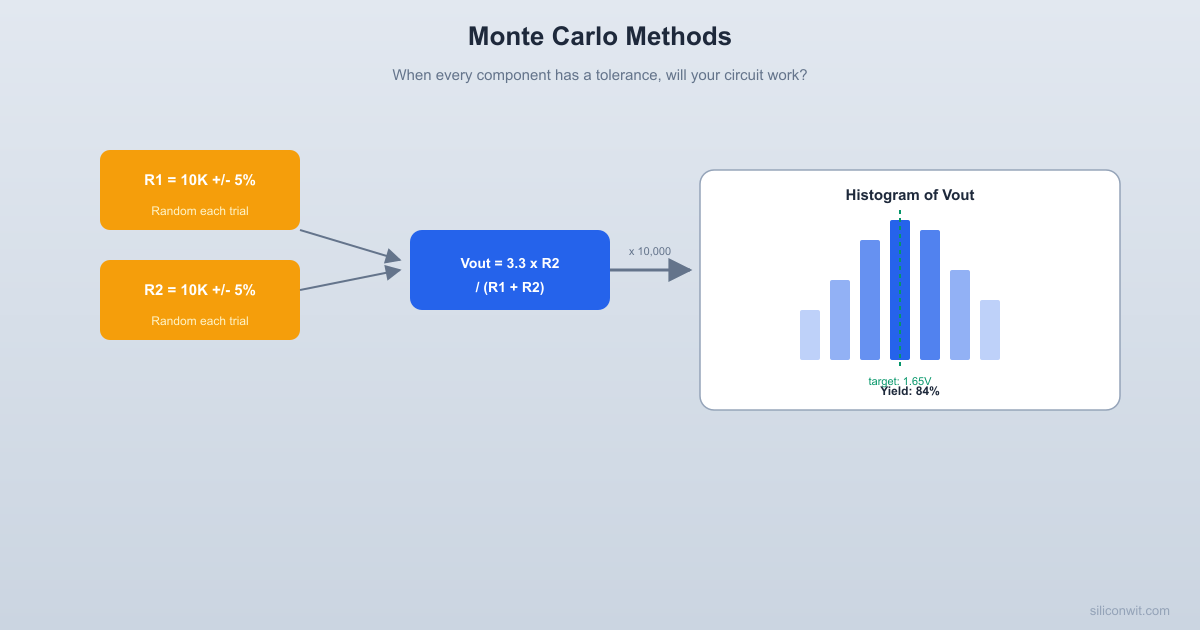
# Circuit: Vin ---[R1]---+---[R2]--- GND
# Vout = Vin * R2 / (R1 + R2)
# Nominal design: Vin = 5.0V, R1 = 10k, R2 = 20k
# Target Vout = 5.0 * 20k / (10k + 20k) = 3.333 V
# Specification: 3.3 V +/- 0.1 V (3.2 to 3.4 V)
R1_nominal = 10e3 # 10 kohm
R2_nominal = 20e3 # 20 kohm
Vout_target = Vin_nominal * R2_nominal / (R1_nominal + R2_nominal)
print(" Monte Carlo Tolerance Stackup Analysis")
print(f" Voltage divider: Vin={Vin_nominal}V, R1={R1_nominal/1e3:.0f}k, R2={R2_nominal/1e3:.0f}k")
print(f" Nominal Vout: {Vout_target:.4f} V")
print(f" Specification: {Vout_spec_low:.1f} V to {Vout_spec_high:.1f} V")
print(f" Trials: {N_TRIALS:,}")
def voltage_divider_mc(R1_nom, R2_nom, Vin, tolerance_pct, n_trials):
Run Monte Carlo simulation for a voltage divider.
Components are assumed to have uniform distribution within tolerance.
(Uniform is conservative; real resistors often follow truncated Gaussian.)
tol = tolerance_pct / 100.0
# Sample R1 and R2 from uniform distribution within tolerance
R1_samples = R1_nom * (1 + tol * (2 * np.random.rand(n_trials) - 1))
R2_samples = R2_nom * (1 + tol * (2 * np.random.rand(n_trials) - 1))
# Compute Vout for each trial
Vout_samples = Vin * R2_samples / (R1_samples + R2_samples)
# Run for different tolerance grades
tolerances = [1, 2, 5, 10]
vout = voltage_divider_mc(R1_nominal, R2_nominal, Vin_nominal, tol, N_TRIALS)
in_spec = np.sum((vout >= Vout_spec_low) & (vout <= Vout_spec_high))
yield_pct = 100.0 * in_spec / N_TRIALS
print(f" {tol:2d}% tolerance: mean={np.mean(vout):.4f}V, "
f"std={np.std(vout):.4f}V, "
f"range=[{np.min(vout):.3f}, {np.max(vout):.3f}]V, "
f"yield={yield_pct:.1f}%")
# ============================================================
# Example 2: Mechanical Tolerance Stackup
# ============================================================
# Assembly: shaft inserted into bearing, bearing pressed into housing
# | |<-- Bearing OD ->| |
# | | |<- Bearing ID ->| |
# | | | |<- Shaft OD ->| |
# Clearance = Bearing_ID - Shaft_OD
# Interference = Bearing_OD - Housing_bore (press fit)
# We need: clearance > 0.01 mm (shaft must spin freely)
# interference > 0.005 mm (bearing must not fall out)
print(" Mechanical Tolerance Stackup: Shaft + Bearing + Housing")
# Nominal dimensions (mm)
bearing_id_nom = 25.030 # 30 um nominal clearance
housing_bore_nom = 46.985 # 15 um nominal interference
# Manufacturing tolerances (mm), assumed Gaussian (3-sigma = tolerance)
shaft_tol = 0.010 # +/- 10 um
bearing_id_tol = 0.008 # +/- 8 um
bearing_od_tol = 0.008 # +/- 8 um
housing_tol = 0.012 # +/- 12 um
# Sample dimensions (Gaussian, 3-sigma = tolerance)
shaft_od = np.random.normal(shaft_od_nom, shaft_tol / 3, N_TRIALS)
bearing_id = np.random.normal(bearing_id_nom, bearing_id_tol / 3, N_TRIALS)
bearing_od = np.random.normal(bearing_od_nom, bearing_od_tol / 3, N_TRIALS)
housing_bore = np.random.normal(housing_bore_nom, housing_tol / 3, N_TRIALS)
# Compute clearance and interference
clearance = bearing_id - shaft_od # must be > 0.01 mm
interference = bearing_od - housing_bore # must be > 0.005 mm
clearance_ok = clearance > 0.01
interference_ok = interference > 0.005
both_ok = clearance_ok & interference_ok
mech_yield = 100.0 * np.sum(both_ok) / N_TRIALS
print(f" Shaft OD: {shaft_od_nom:.3f} +/- {shaft_tol:.3f} mm")
print(f" Bearing ID: {bearing_id_nom:.3f} +/- {bearing_id_tol:.3f} mm")
print(f" Bearing OD: {bearing_od_nom:.3f} +/- {bearing_od_tol:.3f} mm")
print(f" Housing bore: {housing_bore_nom:.3f} +/- {housing_tol:.3f} mm")
print(f" Clearance: mean={np.mean(clearance):.4f} mm, "
f"std={np.std(clearance):.4f} mm")
print(f" Interference: mean={np.mean(interference):.4f} mm, "
f"std={np.std(interference):.4f} mm")
print(f" Clearance OK: {100*np.mean(clearance_ok):.1f}%")
print(f" Interference OK:{100*np.mean(interference_ok):.1f}%")
print(f" Both OK (yield):{mech_yield:.1f}%")
# ============================================================
# Sensitivity analysis: which component matters most?
# ============================================================
print("\n--- Sensitivity Analysis (Voltage Divider, 5% tolerance) ---")
baseline_std = results[5]['std']
vout_tight_r1 = voltage_divider_mc(R1_nominal, R2_nominal, Vin_nominal, 1, N_TRIALS)
# Keep R1 at 5%, measured as if R2 is tight
R1_5pct = R1_nominal * (1 + 0.05 * (2 * np.random.rand(N_TRIALS) - 1))
R2_1pct = R2_nominal * (1 + 0.01 * (2 * np.random.rand(N_TRIALS) - 1))
vout_tight_r2 = Vin_nominal * R2_1pct / (R1_5pct + R2_1pct)
R1_5pct2 = R1_nominal * (1 + 0.05 * (2 * np.random.rand(N_TRIALS) - 1))
R2_1pct2 = R2_nominal * (1 + 0.01 * (2 * np.random.rand(N_TRIALS) - 1))
vout_tight_r2_only = Vin_nominal * R2_1pct2 / (R1_5pct2 + R2_1pct2)
print(f" Both at 5%: std = {baseline_std:.5f} V")
print(f" Both at 1%: std = {np.std(vout_tight_r1):.5f} V")
print(f" R1=5%, R2=1%: std = {np.std(vout_tight_r2):.5f} V")
print(f" R1=5%, R2=1%: std = {np.std(vout_tight_r2_only):.5f} V")
print(f" -> Tightening R2 alone reduces variation because R2 is larger")
print(f" and contributes more to the output voltage sensitivity.")
# ============================================================
# ============================================================
fig, axes = plt.subplots(2, 2, figsize=(14, 10))
# Plot 1: Voltage divider histograms for each tolerance
colors = ['green', 'blue', 'orange', 'red']
for tol, color in zip(tolerances, colors):
ax.hist(r['vout'], bins=80, alpha=0.5, color=color, density=True,
label=f'{tol}% tol (yield={r["yield"]:.1f}%)')
ax.axvline(Vout_spec_low, color='black', linestyle='--', linewidth=2, label='Spec limits')
ax.axvline(Vout_spec_high, color='black', linestyle='--', linewidth=2)
ax.axvline(Vout_target, color='black', linestyle='-', linewidth=1, alpha=0.5)
ax.set_xlabel('Output Voltage (V)')
ax.set_ylabel('Probability Density')
ax.set_title('Voltage Divider: Output Distribution by Tolerance Grade')
# Plot 2: Yield vs tolerance
yields = [results[t]['yield'] for t in tolerances]
ax.bar([str(t) + '%' for t in tolerances], yields, color=colors, alpha=0.7,
ax.axhline(y=99.0, color='green', linestyle='--', alpha=0.7, label='99% target')
ax.axhline(y=95.0, color='orange', linestyle='--', alpha=0.7, label='95% target')
ax.set_xlabel('Component Tolerance')
ax.set_ylabel('Yield (%)')
ax.set_title('Manufacturing Yield vs Component Tolerance')
ax.grid(True, alpha=0.3, axis='y')
for i, (tol, y) in enumerate(zip(tolerances, yields)):
ax.text(i, y + 0.5, f'{y:.1f}%', ha='center', fontsize=10, fontweight='bold')
# Plot 3: Mechanical clearance histogram
ax.hist(clearance * 1000, bins=80, alpha=0.6, color='steelblue', density=True,
label=f'Clearance (yield={100*np.mean(clearance_ok):.1f}%)')
ax.axvline(10, color='red', linestyle='--', linewidth=2, label='Min clearance (10 um)')
ax.axvline(0, color='black', linestyle='-', linewidth=1, alpha=0.5)
ax.set_xlabel('Clearance (um)')
ax.set_ylabel('Probability Density')
ax.set_title('Shaft-Bearing Clearance Distribution')
# Plot 4: Mechanical interference histogram
ax.hist(interference * 1000, bins=80, alpha=0.6, color='coral', density=True,
label=f'Interference (yield={100*np.mean(interference_ok):.1f}%)')
ax.axvline(5, color='red', linestyle='--', linewidth=2, label='Min interference (5 um)')
ax.axvline(0, color='black', linestyle='-', linewidth=1, alpha=0.5)
ax.set_xlabel('Interference (um)')
ax.set_ylabel('Probability Density')
ax.set_title('Bearing-Housing Interference Distribution')
plt.savefig('monte_carlo_tolerance.png', dpi=150, bbox_inches='tight')
print("\nPlot saved: monte_carlo_tolerance.png")



Comments