


Core Principle
Engineering ethics is not abstract philosophy. It is the practical discipline of ensuring that technical decisions protect human welfare. When engineers get it wrong, people die.
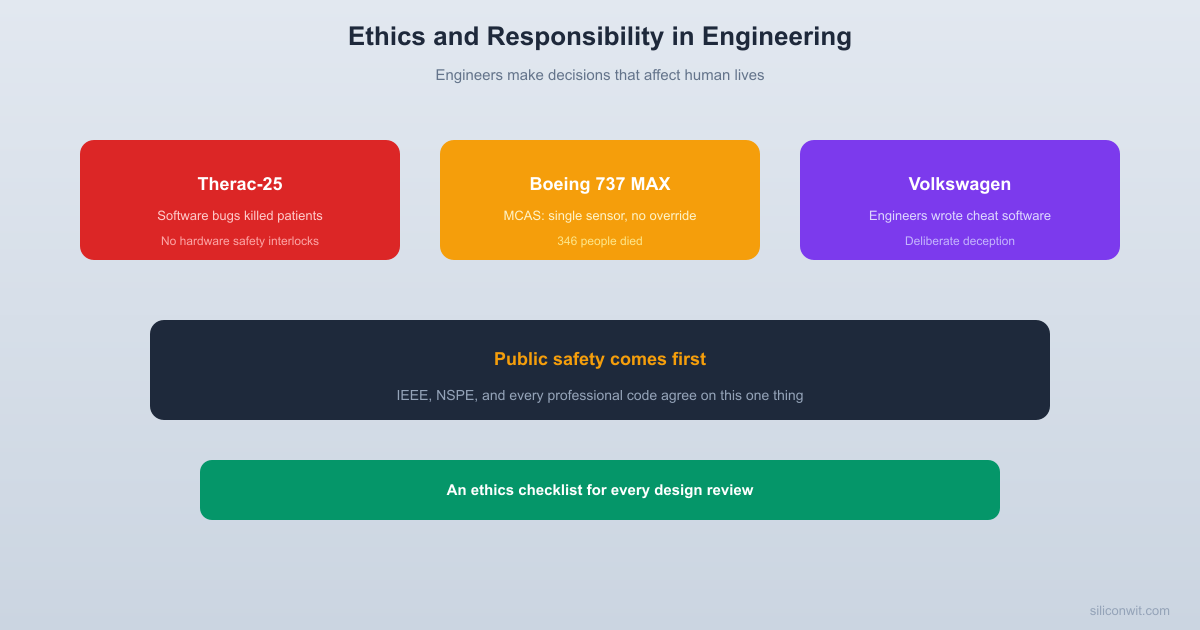
Engineers do not just solve technical problems. They make decisions that determine whether bridges stand or fall, whether medical devices heal or harm, whether software protects or endangers. That power comes with moral obligations that no amount of technical skill can replace. This lesson examines real engineering disasters, the ethical failures behind them, and the professional frameworks designed to keep the public safe. #EngineeringEthics #Responsibility #SafetyFirst
Every time you select a material, write a control algorithm, or sign off on a design, you are making a decision that may affect people who will never know your name. The bridge you design will carry thousands of commuters. The firmware you write may control a device that a patient depends on. The sensor system you deploy may generate data that shapes decisions about people’s lives.
Core Principle
Engineering ethics is not abstract philosophy. It is the practical discipline of ensuring that technical decisions protect human welfare. When engineers get it wrong, people die.
This is not hypothetical. The following case studies are real, documented, and deeply instructive.
Between 1985 and 1987, the Therac-25 radiation therapy machine delivered massive radiation overdoses to at least six patients. Three of them died. The cause was a combination of software bugs, hardware design choices, and organizational failures.
The Therac-25 was a linear accelerator used to treat cancer patients with targeted radiation. It had two modes: a low-power electron beam for direct treatment and a high-power X-ray mode that used a metal target to convert the electron beam into X-rays.
In previous models (Therac-6 and Therac-20), hardware interlocks physically prevented the high-power beam from firing without the metal target in place. The Therac-25 removed these hardware interlocks and relied entirely on software to ensure the correct configuration.
The software had a race condition. If an operator typed commands fast enough (changing from X-ray mode to electron mode), the software could set the beam energy to the high-power level while the metal target was retracted. The result was a full-power electron beam hitting the patient directly, delivering doses hundreds of times higher than intended.
| Technical Failure | Description |
|---|---|
| Race condition | Software did not properly synchronize mode selection with beam energy setting |
| No hardware interlocks | Safety-critical function delegated entirely to software |
| Inadequate error messages | Machine displayed “MALFUNCTION” with a number that operators could not interpret |
| No dose monitoring | No independent hardware check on actual delivered dose |
| Code reuse without review | Software was carried over from earlier models without full analysis of the changed hardware context |
The technical bugs were serious, but the ethical failures were worse:
The manufacturer dismissed reports. When hospitals reported overdoses, AECL (the manufacturer) initially insisted the machine could not deliver an overdose. They trusted their software more than the evidence from patients.
Operators were blamed. Early incident reports attributed the overdoses to operator error, not machine malfunction. The operators knew something was wrong but lacked the information to prove it.
No independent safety review. The software was never subjected to an independent safety analysis. The same team that wrote it reviewed it.
No regulatory requirement for software safety. At the time, the FDA did not have a clear framework for evaluating software in medical devices. The Therac-25 incidents directly led to changes in FDA regulation.
Lesson
Software can kill. When software controls safety-critical functions, it must be treated with the same rigor as hardware safety systems. Removing hardware interlocks and relying solely on software is a design decision with ethical weight.
In October 2018 and March 2019, two Boeing 737 MAX aircraft crashed, killing 346 people. The crashes were caused by a software system called MCAS (Maneuvering Characteristics Augmentation System) that repeatedly pushed the nose of the aircraft down based on a single faulty sensor reading.
The 737 MAX had larger, more fuel-efficient engines than the previous 737 NG. These engines were mounted further forward and higher on the wing, changing the aircraft’s aerodynamic behavior. At high angles of attack, the new engine position created a nose-up pitching moment that could surprise pilots accustomed to the 737 NG.
Boeing’s solution was MCAS: a software system that automatically pushed the nose down when a single angle-of-attack (AoA) sensor indicated a high angle. The system was designed to make the 737 MAX feel like the 737 NG to pilots, avoiding the need for expensive retraining in a full simulator.
The contrast with Airbus’s design philosophy is instructive. Airbus fly-by-wire systems use multiple redundant computers with dissimilar software (different teams write code for the same function independently). The systems cross-check each other continuously. When sensors disagree, the system alerts the pilot rather than silently acting on one sensor’s data.
Airbus A320 family aircraft use three AoA sensors. The flight control computers compare all three and use a voting scheme to reject faulty readings. The Boeing 737 MAX used two AoA sensors but fed only one to MCAS. The cost difference between using one sensor input and three was trivial compared to the aircraft’s total cost, but the safety difference was enormous.
Engineers raised concerns and were ignored. Internal communications released during investigations showed that Boeing engineers and test pilots had serious concerns about MCAS. One test pilot described the system as “egregious” in a 2016 message. These concerns did not reach decision-makers, or when they did, they were overridden by schedule pressure.
Financial incentives distorted safety decisions. The 737 MAX existed because Boeing needed to compete with the Airbus A320neo quickly. Designing a new aircraft would have taken years and cost billions. Modifying the existing 737 was faster and cheaper but introduced the aerodynamic problems that MCAS was designed to mask.
Transparency was sacrificed. Boeing did not fully disclose MCAS to airlines, pilots, or regulators. The system was buried in documentation. When the first crash occurred (Lion Air 610), Boeing issued a bulletin but did not ground the fleet. The second crash (Ethiopian Airlines 302) happened five months later.
Lesson
When organizational pressure to meet schedules and reduce costs conflicts with safety, safety must win. Engineers have a professional obligation to escalate safety concerns through every available channel. “I raised it but was overruled” is not sufficient if lives are at stake.
In September 2015, the U.S. Environmental Protection Agency revealed that Volkswagen had installed software in 11 million diesel vehicles worldwide that detected when the vehicle was undergoing emissions testing and reduced nitrogen oxide emissions during the test. Under normal driving conditions, the vehicles emitted up to 40 times the legal limit of NOx.
The “defeat device” was software running on the engine control unit (ECU). It monitored steering wheel position, vehicle speed, engine operation duration, and barometric pressure. When the pattern matched the profile of a standardized emissions test (the vehicle was stationary on a dynamometer, wheels turning but steering wheel fixed), the software activated a low-emissions mode. In all other driving conditions, the software prioritized performance and fuel economy over emissions compliance.
This was not a bug. It was not an oversight. Engineers deliberately wrote software to deceive regulators and the public. The code was designed, reviewed, tested, and deployed with full knowledge of its purpose.
“I was told to” is not an excuse. Several VW engineers claimed they were following orders from management. Professional engineering ethics codes are explicit: the engineer’s primary obligation is to the public, not to their employer. When an employer asks you to do something that endangers public health, you are obligated to refuse.
The harm was real and quantifiable. Researchers at MIT estimated that the excess emissions from VW diesel vehicles in the United States alone contributed to approximately 1,200 premature deaths in Europe and 59 in the United States. These are not abstract numbers. They represent people who died from respiratory and cardiovascular disease caused by air pollution that should not have existed.
The cover-up was sustained. VW continued to deny the existence of defeat device software for over a year after researchers at West Virginia University detected the discrepancy between test results and real-world emissions. Internal communications show that engineers and managers discussed how to handle the situation without admitting the truth.
| Aspect | Detail |
|---|---|
| Vehicles affected | ~11 million worldwide |
| Duration of deception | 2009 to 2015 (at least 6 years) |
| Financial penalties | Over 30 billion USD in fines and settlements |
| Criminal convictions | Several engineers and executives sentenced to prison |
| Health impact | Estimated 1,200+ premature deaths from excess NOx |
Lesson
There is no version of “the company told me to” that justifies writing software designed to deceive regulators and endanger public health. Professional ethics exist precisely for situations where your employer’s interests conflict with the public interest.
Engineering professional societies have developed codes of ethics that provide explicit guidance. While the specific wording varies, the core principles are consistent.
The IEEE Code of Ethics requires members to:
The National Society of Professional Engineers states:
Every major engineering ethics code puts the same principle first: public safety comes before employer loyalty, personal gain, or professional convenience.
This is not a suggestion. In jurisdictions where engineering is a licensed profession, violating this principle can result in loss of licensure, legal liability, and criminal prosecution.
Ethics codes are clear on paper. In practice, following them can be difficult:
The codes are unambiguous: safety comes first. But engineers who follow this principle often face professional consequences. This is why whistleblower protections and strong professional communities matter.
Whistleblowing is the act of reporting safety concerns, illegal activity, or ethical violations to authorities, regulators, or the public when internal channels have failed.
Most ethics frameworks agree that whistleblowing is justified when:
Whistleblowers face real consequences. Roger Boisjoly, a Morton Thiokol engineer, warned against launching the Space Shuttle Challenger in cold weather because the O-ring seals had not been tested at low temperatures. Management overruled him. The shuttle broke apart 73 seconds after launch, killing all seven crew members.
After the disaster, Boisjoly testified before a presidential commission. He was praised publicly but effectively blacklisted within the aerospace industry. He suffered depression and PTSD. He spent the rest of his career advocating for engineering ethics education.
The 737 MAX case included similar dynamics. Engineers who raised MCAS concerns were sidelined or ignored. The organizational culture at Boeing had shifted from engineering-led to finance-led, and voices that contradicted the business case were unwelcome.
Many countries have legal protections for whistleblowers, though enforcement varies:
| Jurisdiction | Key Legislation |
|---|---|
| United States | Whistleblower Protection Act, Sarbanes-Oxley (for publicly traded companies) |
| European Union | EU Whistleblower Directive (2019) |
| United Kingdom | Public Interest Disclosure Act |
| Kenya | Witness Protection Act |
Legal protection helps, but it does not eliminate the personal cost. Building a professional network, documenting everything, and seeking legal advice early are practical steps.
Ethics is not just about reacting to problems. It is about designing systems that minimize the chance of harm in the first place.
Fail-Safe
On failure, the system enters a state that minimizes harm. A railroad crossing gate drops if power fails. A chemical valve closes if control signals are lost. The priority is preventing damage.
Fail-Secure
On failure, the system maintains security. A secure door locks if power fails. An encrypted channel drops the connection rather than transmitting unencrypted data. The priority is preventing unauthorized access.
Fail-Operational
On failure, the system continues operating at reduced capability. A dual-engine aircraft flies on one engine. A RAID array serves data after a disk failure. The priority is maintaining function.
The choice between these modes is itself an ethical decision. A fire exit must fail-open (anyone can exit), not fail-secure (door locks). A nuclear reactor must fail-safe (control rods insert automatically), not fail-operational (keep running despite anomalies).
When you design a structure to withstand 100 kN but the calculation shows it only needs to handle 50 kN, the extra capacity is not waste. It absorbs:
Cutting safety margins to save cost is a decision with ethical implications. If a failure will endanger human life, the margin must be there regardless of budget pressure.
James Reason’s Swiss cheese model of accident causation describes how catastrophic failures occur when multiple layers of defense all have holes, and those holes happen to align. Each layer (design review, testing, quality control, operational procedures, safety monitoring) has imperfections. Most of the time, a hole in one layer is covered by the next layer. Accidents happen when the holes line up.
  The Swiss Cheese Model (James Reason)
  Hazard                             Accident  =====>  |   |    |   |    |   |    =====>          | o |    |   |    | o |  =====>  |   |    | o |    |   |    =====>          |   |    |   |    |   |  =====>  | o-|----|-o-|----|-o-|->  FAILURE          |   |    |   |    |   |  =====>  |   |    |   |    | o |    =====>          |   |    |   |    |   |         Layer 1  Layer 2  Layer 3         Design   Testing  Operations         Review   & QC     & Monitoring
  Each layer has holes (imperfections).  Accidents happen when holes align.
Every case study in this lesson fits the Swiss cheese model:
| Case | Layer 1 Failure | Layer 2 Failure | Layer 3 Failure |
|---|---|---|---|
| Therac-25 | Software race condition | No hardware interlocks | Manufacturer dismissed incident reports |
| 737 MAX | Single-sensor MCAS design | Inadequate pilot training | FAA delegated oversight to Boeing |
| VW Emissions | Engineers wrote defeat device | Internal compliance failed to catch it | Regulators relied on lab tests only |
The model shows that safety is not about preventing individual errors. It is about ensuring that no single error can propagate through all layers of defense to cause harm. This is a design problem, an organizational problem, and an ethical problem all at once.
Philosophy courses often discuss the trolley problem: should you divert a runaway trolley to kill one person instead of five? This thought experiment is fascinating for moral philosophers but largely irrelevant for practicing engineers.
Real engineering ethics is not about choosing who dies. It is about:
If your engineering practice includes these elements, the trolley problem never arises. Catastrophic failures happen when one or more of these elements is missing.
Modern engineering increasingly involves systems that operate autonomously, collect personal data, and make decisions without human oversight. These systems raise ethical questions that traditional engineering ethics did not anticipate.
When an autonomous vehicle strikes a pedestrian, who is responsible? The software engineer who wrote the perception algorithm? The project manager who approved the release? The company that marketed the vehicle? The regulatory body that approved it for road use?
Traditional product liability focuses on the manufacturer. But when a system’s behavior emerges from machine learning trained on data collected from millions of users, the chain of responsibility is less clear.
IoT sensors collect vast amounts of data about people, places, and activities. A temperature sensor in an office building seems innocuous. But combined with occupancy sensors, access logs, and network activity, the same system becomes a surveillance infrastructure that tracks when each employee arrives, where they spend their time, and who they meet with.
Engineers who design these systems have an obligation to consider not just the intended use but the potential for misuse.
Machine learning systems trained on historical data can perpetuate and amplify existing biases. A hiring algorithm trained on past hiring decisions will learn whatever biases existed in those decisions. A predictive policing algorithm trained on arrest data will reflect the biases in policing patterns.
Engineers building these systems cannot claim neutrality. The choice of training data, the definition of the objective function, and the selection of features all embed values and assumptions that affect people’s lives.
A traditional engineering failure has a traceable chain of causation: the bolt was underspecified, the weld was flawed, the calculation was wrong. Someone made a specific decision that can be identified and evaluated.
With autonomous systems, the chain of causation passes through layers of abstraction:
At step 5, the system may produce outcomes that nobody intended, predicted, or even understands. This is the responsibility gap: there may be no single person whose decision caused the harm, yet the harm is real.
Closing this responsibility gap requires new approaches: mandatory logging of decision processes, human-in-the-loop requirements for high-stakes decisions, regular auditing of system outputs for bias and errors, and clear organizational accountability structures that assign responsibility even when causation is diffuse.
The most effective approach to data ethics is not to add privacy protections after the system is built but to embed them from the start:
| Principle | Implementation |
|---|---|
| Data minimization | Collect only what is strictly necessary for the function |
| Purpose limitation | Use data only for the stated purpose |
| Storage limitation | Delete data when it is no longer needed |
| Anonymization | Remove identifying information whenever possible |
| Access control | Limit who can see what data, with audit logs |
| Transparency | Tell users what data is collected and why |
These are not just good engineering practices. In many jurisdictions (EU’s GDPR, Kenya’s Data Protection Act, California’s CCPA), they are legal requirements.
Practical ethics requires practical tools. The following checklist can be used during any design review:
No checklist replaces good judgment. But a checklist ensures that important questions are at least asked, even under time pressure.
A checklist is a starting point, but lasting ethical practice requires organizational culture. Individual engineers can influence culture even without authority:
Organizations where ethical concerns are routinely dismissed eventually produce a Therac-25, a 737 MAX, or a VW emissions scandal. Organizations where ethical concerns are routinely heard and addressed avoid these catastrophes, not because their engineers are smarter, but because their culture supports doing the right thing.
Read the full Nancy Leveson report on the Therac-25 incidents (available online as “Medical Devices: The Therac-25”). Identify three specific points where a different technical decision would have prevented patient harm. For each, explain the organizational or economic pressure that led to the actual decision.
Research the Challenger disaster and Roger Boisjoly’s role. Write a one-page analysis of the decision-making process on the night before launch. Who made the final decision? What information was available? What was the organizational pressure? Would you have done what Boisjoly did?
Choose an IoT product you own or use (smart speaker, fitness tracker, connected thermostat). List every type of data it collects. For each data type, identify at least one use beyond the product’s stated purpose that could affect users negatively.
Using the ethics checklist from this lesson, conduct a review of a project you are working on or have recently completed. Document your answers. Were there questions you had not considered before?
Engineering ethics is not a theoretical exercise. It is the practical discipline of ensuring that the enormous power engineers hold over public safety, health, and welfare is exercised responsibly. The Therac-25 showed what happens when software safety is not taken seriously. The 737 MAX showed what happens when organizational pressure overrides engineering judgment. The Volkswagen scandal showed what happens when engineers deliberately betray the public trust. Professional codes of ethics exist to provide clear guidance: public safety comes first, always. Whistleblowing, though personally costly, is sometimes the only ethical option. And proactive design for safety, through fail-safe mechanisms, safety margins, and independent oversight, is the best way to ensure that ethical failures never reach the point where someone must choose between their career and the public good.
Comments