


det(A) != 0
Unique solution exists. The matrix is invertible. The system has exactly one answer. This is the usual case in well-posed engineering problems.
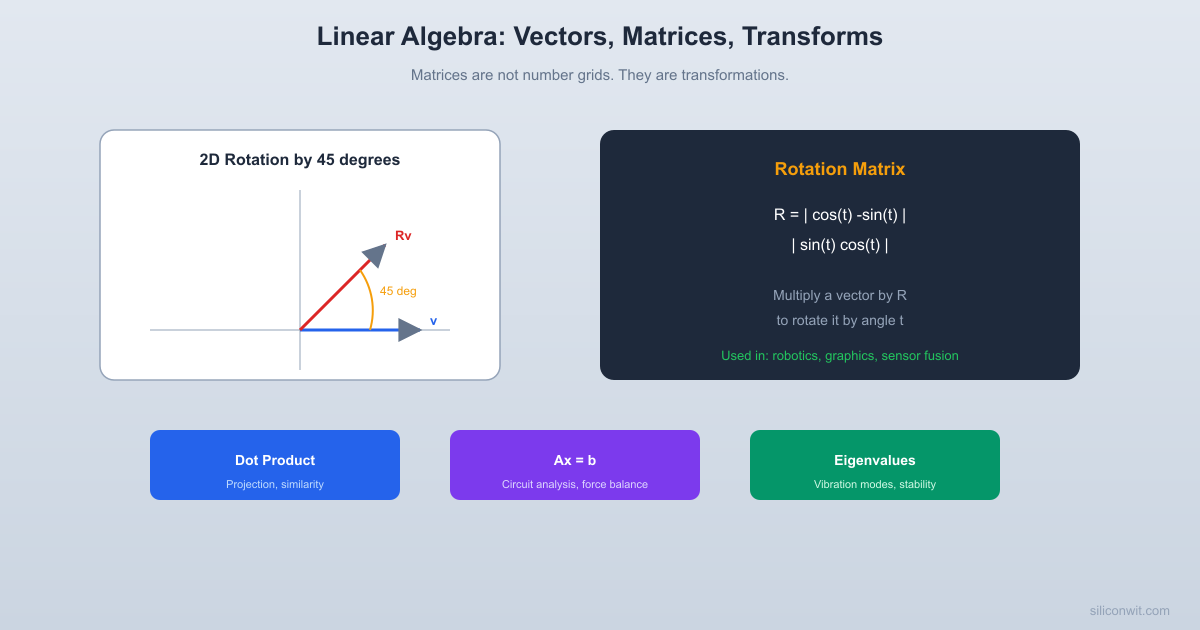
Linear algebra is the most useful branch of mathematics you will ever learn. That is not an exaggeration. Every time an engineer analyzes a circuit, a roboticist programs a joint, a graphics programmer renders a scene, or a data scientist trains a model, they are using linear algebra. It is the common language of applied mathematics, and once you speak it, entire fields open up. #LinearAlgebra #Engineering #AppliedMath
A vector is a quantity that has both magnitude and direction. Your phone’s accelerometer, for example, outputs a 3D vector: it measures gravity (always pointing down) plus the phone’s own acceleration. Subtracting the gravity vector from the reading gives you just the phone’s motion, which is how your phone knows the difference between “tilted” and “shaken.”
Forces, velocities, electric fields, and displacements are all vectors. Think of a vector in 2D as an instruction: “go 3 steps east and 4 steps north.” We write this as:
The magnitude (length) is
When two forces act on an object, the result is their vector sum. If a wind pushes a boat east at 3 m/s and a current pushes it north at 4 m/s, the boat moves northeast at 5 m/s.
         4 |     /|           |    / |           |   /  | b = (0, 4)           |  /   |           | / a+b|           |/     |         0 +------+---           0   a=(3,0)   3
     a + b = (3, 4), magnitude = 5
Algebraically, you just add the components:
This is why vectors are so powerful: complex combinations of forces, velocities, or fields reduce to simple component-wise arithmetic.
The dot product of two vectors
The dot product measures how much two vectors point in the same direction.
Engineering use: Work. When you push a box with force
Engineering use: Projection. The projection of vector
This is how you decompose a force into components along and perpendicular to a surface, which is the first step in most structural analysis problems.
The cross product of two 3D vectors gives a new vector perpendicular to both inputs:
The magnitude is
Engineering use: Torque. Torque is the cross product of the position vector and the force vector:
Engineering use: Surface normals. In 3D graphics and finite element analysis, you find the normal to a surface by taking the cross product of two vectors that lie in that surface.
A matrix is not just a grid of numbers. A matrix is a machine that takes a vector as input and produces a new vector as output. When you multiply a matrix by a vector, you are applying a transformation: rotation, scaling, reflection, shearing, or projection.
The matrix
A diagonal matrix scales each component independently:
This stretches the x-component by 2 and the y-component by 3. In engineering, this is how you apply different gains to different channels.
The 2D rotation matrix rotates a vector by angle
This is used everywhere: robotics (joint rotations), computer graphics (camera orientation), and navigation (coordinate transforms between reference frames).
Reflection across the x-axis:
This flips the y-component. In signal processing, this is equivalent to inverting a signal.
Projection onto the x-axis:
This throws away the y-component, keeping only the x-component. Projections are lossy: information is destroyed, and the operation is not reversible.
Rotate the point
The point has been rotated. Its distance from the origin is preserved (
If matrix
Note the order:
In robotics, this is how you chain joint transformations. Each joint has a rotation matrix, and the total transformation from base to end-effector is the product of all the individual matrices.
The most common use of linear algebra in engineering is solving systems of linear equations. Consider a circuit with two loops analyzed using Kirchhoff’s voltage law:
Rearranging:
In matrix form:
This is
If the matrix
For our circuit example:
The determinant is nonzero, so a unique solution exists.
So
det(A) != 0
Unique solution exists. The matrix is invertible. The system has exactly one answer. This is the usual case in well-posed engineering problems.
det(A) = 0
No unique solution. Either there are infinitely many solutions (the equations are redundant) or no solution (the equations are contradictory). Physically, this means your system is under-constrained or over-constrained.
An eigenvector of a matrix
The scalar
Google’s PageRank algorithm, which decides the order of your search results, is fundamentally an eigenvalue problem. The “importance” of each webpage is the dominant eigenvector of a matrix representing the link structure of the entire web.
Eigenvalues appear everywhere in engineering because they describe the natural behavior of systems:
Vibration modes. A bridge, a guitar string, and an electronic circuit all have natural frequencies. These are the eigenvalues of the system’s dynamic matrix. Each eigenvalue gives a frequency, and its eigenvector gives the shape of the vibration at that frequency.
Stability analysis. A control system is stable if all eigenvalues of its state matrix have negative real parts. If any eigenvalue has a positive real part, the system is unstable and will blow up. This is the single most important test in control theory.
Principal stress directions. In structural analysis, the eigenvalues of the stress tensor give the principal stresses, and the eigenvectors give the directions they act in. This tells you where a structure is most likely to fail.
Eigenvalues satisfy
The eigenvalues are
For
For
NumPy makes all of this practical. Here is a complete example that covers the key operations.
import numpy as np
# --- Vectors ---a = np.array([3, 4])b = np.array([1, 2])
print("Vector addition:", a + b)print("Dot product:", np.dot(a, b))print("Magnitude of a:", np.linalg.norm(a))
# Cross product (3D)a3 = np.array([1, 0, 0])b3 = np.array([0, 1, 0])print("Cross product:", np.cross(a3, b3))
# --- 2D Rotation ---theta = np.radians(45)R = np.array([    [np.cos(theta), -np.sin(theta)],    [np.sin(theta),  np.cos(theta)]])point = np.array([3, 1])rotated = R @ pointprint(f"\n({point[0]}, {point[1]}) rotated 45 degrees: ({rotated[0]:.3f}, {rotated[1]:.3f})")
# --- Solving Ax = b (circuit example) ---A = np.array([    [5, -2],    [-2, 7]])b_vec = np.array([10, 0])x = np.linalg.solve(A, b_vec)print(f"\nCircuit currents: I1 = {x[0]:.3f} A, I2 = {x[1]:.3f} A")print(f"Determinant: {np.linalg.det(A):.1f}")
# --- Eigenvalues ---M = np.array([    [4, 1],    [2, 3]])eigenvalues, eigenvectors = np.linalg.eig(M)print(f"\nEigenvalues: {eigenvalues}")print(f"Eigenvectors (columns):\n{eigenvectors}")
# Verify: A @ v = lambda * vfor i in range(len(eigenvalues)): v = eigenvectors[:, i] lam = eigenvalues[i] Av = M @ v lam_v = lam * v print(f" A @ v{i+1} = {Av}, lambda * v{i+1} = {lam_v}")Always use np.linalg.solve(A, b) instead of np.linalg.inv(A) @ b. The solve function is faster, more numerically stable, and works even for large, poorly conditioned systems. Computing the inverse explicitly is almost never necessary in practice.
Consider a simple truss with two members meeting at a pin joint, with an external load
P (pin joint) /|\ / | \ / | \ / F | \ / (down) \ / | \ A------+------B (ground supports)The equilibrium condition at point P gives two equations (horizontal and vertical force balance):
In matrix form:
This is just
import numpy as np
# Truss with members at 60 and 120 degrees from horizontalalpha = np.radians(60)beta = np.radians(120)F = 1000  # Newtons (downward load)
A = np.array([    [np.cos(alpha), np.cos(beta)],    [np.sin(alpha), np.sin(beta)]])b = np.array([0, F])
T = np.linalg.solve(A, b)print(f"Member 1 tension: {T[0]:.1f} N")print(f"Member 2 tension: {T[1]:.1f} N")Linear algebra gives you a unified framework for problems that might look very different on the surface.
| Concept | What it means | Where it appears |
|---|---|---|
| Vector addition | Combining effects | Forces, velocities, fields |
| Dot product | Alignment, projection | Work, signal correlation |
| Cross product | Perpendicular result | Torque, surface normals |
| Matrix-vector product | Transformation | Rotation, scaling, coordinate change |
| Ax = b | System of equations | Circuit analysis, force balance |
| Determinant | Invertibility test | Does a unique solution exist? |
| Eigenvalues | Natural modes | Vibration, stability, principal stress |
The next lesson on complex numbers and phasors will use vectors in the complex plane, building directly on the vector intuition developed here.
Comments