


The core discipline of science
In science you change your beliefs to fit the evidence, rather than bending the evidence to fit your beliefs. Every hallmark above is a way of enforcing that one rule.
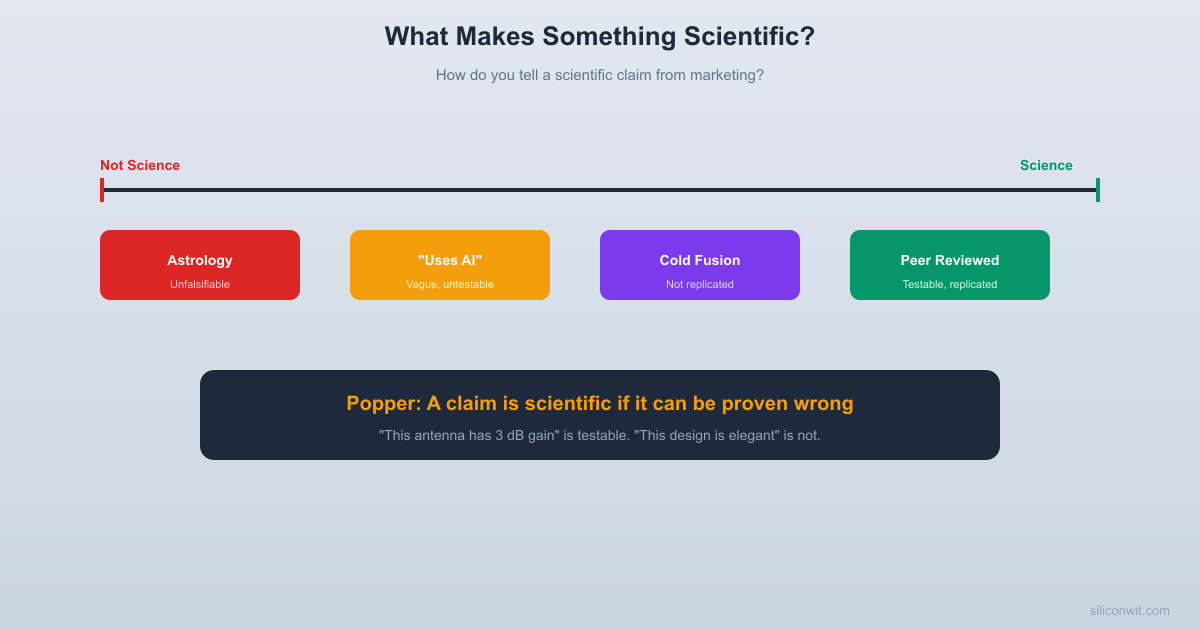
A vendor tells you their new chip “uses AI for predictive maintenance.” A colleague claims their debugging technique “always works.” A research paper reports a breakthrough in room-temperature superconductors. How do you know which of these claims to take seriously? The answer has been debated for centuries, and it starts with a deceptively simple question: what makes something scientific? #PhilosophyOfScience #Falsifiability #CriticalThinking
Before you can judge whether a claim is scientific, it helps to be clear about what science actually is. Science is two things at once: a process for working out how nature behaves, and the body of knowledge that process builds up. The two feed each other. You run experiments, the trustworthy results become established knowledge, and that knowledge shapes the next questions you ask.
This loop is why science is never truly finished. The body of knowledge is the best current account of how nature works, not a final one. A result stays in good standing only as long as the evidence keeps supporting it.
Science is not a single activity. It splits into branches that ask different kinds of questions and accept different kinds of evidence.
| Branch | Examples | What it studies | How it checks a claim |
|---|---|---|---|
| Formal | Mathematics, Logic, Computer Science | Abstract structures and rules | Proof and internal consistency |
| Natural | Physics, Chemistry, Biology | The physical world | Observation and controlled experiment |
| Applied | Engineering, Medicine | Solving real problems with natural-science knowledge | Whether it works, measurably and repeatably |
| Social | Psychology, Economics, Political Science | Human behavior and societies | Data, statistics, and controlled studies |
Engineering lives in the applied branch. It borrows the methods of the natural sciences and is held to the same standard of evidence: a design either meets its measured specification or it does not. The formal sciences are a useful edge case. A mathematical theorem is not overturned by an experiment; it is established or refuted by logic. That is a reminder that “testable by experiment,” the criterion we are about to examine, captures most of science but not quite all of it.
Across all of these branches, scientific knowledge shares a recognizable profile. No single trait defines science on its own, but together they form a checklist worth running whenever you are deciding if something deserves the name.
| Hallmark | What it means | What it looks like in engineering |
|---|---|---|
| Empirical | Claims rest on observation and measurement, not authority or intuition | A specification backed by test data, not by “trust me” |
| Falsifiable | Some possible result would prove the claim wrong | A timing requirement that names the value counting as a failure |
| Reproducible | Independent people, in other places, get the same result | If only your bench reproduces it, it is not established |
| Objective | The result does not depend on who is doing the looking | A calibrated meter reading over “it feels better to me” |
| Rational | The claim is logically consistent and does not contradict itself | A model whose assumptions hold together under scrutiny |
| Tentative | Conclusions are provisional and yield to better evidence | A new datasheet revision supersedes the old one |
| Predictive | The claim forecasts outcomes you have not yet observed | A thermal model that predicts junction temperature before the board exists |
The core discipline of science
In science you change your beliefs to fit the evidence, rather than bending the evidence to fit your beliefs. Every hallmark above is a way of enforcing that one rule.
Two practices keep these hallmarks honest. Peer review means a claim is scrutinized by independent people before it is trusted; in engineering, the design review plays the same role. Prediction is the sharpest test of all. A claim that reliably forecasts a measurement you have not yet taken is hard to fake, because nature gets the final vote. Anyone can explain yesterday after the fact; a working theory tells you what tomorrow’s instrument will read.
The demarcation problem is philosophy’s name for a practical question: where do you draw the line between science and non-science? This is not an abstract concern. Engineers encounter the boundary every day.
Consider three claims:
Astronomy
“Mars will be at opposition on January 16, 2027, appearing at magnitude -1.4 in the constellation Gemini.” This is specific, testable, and could be wrong. It is a scientific claim.
Astrology
“Mars in Gemini means communication will be challenging this week.” This is vague, unfalsifiable, and reinterpreted after the fact to fit any outcome. It is not a scientific claim.
The difference is not about the subject matter. Both involve Mars. The difference is about the structure of the claim itself.
  The Demarcation Spectrum
  Pseudoscience         Gray Area           Science  |-------|-------------|---------|----------|  ^       ^             ^         ^          ^  Astro-  "Quantum      Nutrition Antenna    Orbital  logy    healing"      claims    gain specs mechanics
Less falsifiable -----> More falsifiable Vague claims ---------> Specific, testable Reinterpreted after --> Predictions stated the fact in advanceYou might think this is a problem for philosophers, not engineers. But consider these engineering-adjacent claims:
| Claim | Scientific? | Why? |
|---|---|---|
| ”This antenna design achieves 3 dB gain at 2.4 GHz” | Yes | Measurable, specific, could be wrong |
| ”This is an elegant design” | No | Subjective, no test can refute it |
| ”Our product uses AI” | Depends | If they mean a specific ML model with measurable accuracy, maybe. If they mean “we have some if-else logic,” no. |
| ”This capacitor improves audio quality” | Depends | Measurable with distortion tests, or is it audiophile mysticism? |
The demarcation problem is not academic. It determines whether you can trust a datasheet, evaluate a research paper, or assess a technology claim.
Karl Popper (1902-1994) proposed the most influential answer to the demarcation problem. His criterion is elegant and practical: a claim is scientific if and only if it is falsifiable.
Falsifiable does not mean false. It means there exists some possible observation or experiment that could prove the claim wrong. If no conceivable evidence could refute a claim, it is not a scientific claim.
Start with a claim. “This voltage regulator maintains 3.3V output within 1% tolerance for input voltages between 4.5V and 12V.”
Ask: what observation would prove this wrong? Measuring an output of 3.4V at an input of 6V would falsify it. The claim is specific enough that we know exactly what would count as a failure.
If no observation could prove it wrong, the claim is not scientific. “This is a good design” cannot be falsified because “good” has no agreed-upon measurement. It may be a valuable aesthetic judgment, but it is not a scientific one.
Consider how this plays out in engineering:
Falsifiable Claims (Scientific):  "The system responds within 10 ms to any input"  "Mean time between failures exceeds 50,000 hours"  "Power consumption is under 100 mW in active mode"  "The error rate is below 1 in 10^6 bits transmitted"
Unfalsifiable Claims (Not Scientific):  "The code is clean and maintainable"  "This architecture is future-proof"  "Our platform is enterprise-grade"  "This solution is best-in-class"
Notice that unfalsifiable claims are not necessarily wrong or useless. “The code is clean” might be a valuable professional judgment. But it is not a testable, scientific statement. The problem arises when unfalsifiable claims are dressed up as if they were testable.
Pseudoscience is not simply “wrong science.” Wrong science can be corrected. Pseudoscience has a deeper problem: it is structured so that it cannot be corrected, because it is not falsifiable in practice.
The Pseudoscience Checklist
These patterns appear in pseudoscience, cargo cult engineering, and vendor hype alike. Any single red flag warrants caution. Multiple red flags together are a strong warning signal.
1. Unfalsifiable core claims. The central claim is stated in a way that no evidence could possibly refute it. “Our product improves wellness” cannot be tested because “wellness” is undefined.
2. Moving goalposts. When evidence contradicts the claim, the claim is reinterpreted rather than abandoned. “The test failed because the environment was not properly controlled.” “The prototype did not work because the components were not high enough quality.”
3. Appeal to testimonials instead of data. “Five customers love it” replaces controlled testing. Testimonials are selection-biased by definition: you never hear from the people for whom it did not work.
4. Conspiracy against the establishment. “Mainstream science rejects this because they are protecting their funding.” Sometimes mainstream science is wrong. But the appropriate response is better evidence, not conspiracy theories.
5. Excessive precision without calibration. “Our sensor achieves 0.001 degree accuracy” but no calibration certificate, no measurement uncertainty analysis, no traceability to a reference standard.
6. Irrelevant jargon. Using technical-sounding language that does not actually mean anything in context. “Quantum-enhanced blockchain AI synergy” is six buzzwords and zero content.
| Domain | Pseudoscientific Claim | What Real Science Looks Like |
|---|---|---|
| Audio | ”Oxygen-free copper cables produce warmer sound” | Blind A/B tests show no audible difference above a basic quality threshold |
| Networking | ”Our proprietary protocol is unhackable” | No system is provably secure; responsible claims specify threat models and known limitations |
| IoT | ”Our platform uses AI” (meaning: a lookup table with thresholds) | Specify the model architecture, training data, accuracy metrics on a test set |
| Power | ”Green energy harvesting powers the device indefinitely” | Specify the energy budget, harvesting conditions, duty cycle, and worst-case scenario |
On March 23, 1989, Martin Fleischmann and Stanley Pons held a press conference at the University of Utah. They claimed to have achieved nuclear fusion at room temperature in a tabletop electrochemistry experiment. If true, it would have solved the world’s energy problems.
The claim. Fleischmann and Pons reported excess heat from a palladium electrode immersed in heavy water (deuterium oxide). They attributed this excess heat to nuclear fusion occurring at room temperature inside the palladium lattice.
The announcement. Instead of publishing in a peer-reviewed journal and waiting for replication, they held a press conference. The University of Utah pressured them to announce quickly, partly to secure patents and funding priority.
The replication attempts. Laboratories around the world tried to reproduce the results. Most failed. A few reported positive results, but these were inconsistent and could not be reliably repeated.
The verdict. Within months, major laboratories (MIT, Caltech, Harwell) reported negative results. A Department of Energy panel found no convincing evidence for cold fusion. Fleischmann and Pons’s calorimetry was found to have significant errors.
The aftermath. Fleischmann and Pons left the United States. A small community of researchers continued cold fusion work under the name “Low Energy Nuclear Reactions” (LENR), but the field has never produced reproducible, independently verified results.
The cold fusion episode is instructive not because Fleischmann and Pons were frauds (most historians believe they were sincere but mistaken). It matters because it illustrates several critical principles:
Reproducibility is non-negotiable. A result that cannot be independently reproduced is not established science. In engineering terms: if only one team can make the prototype work, you do not have a product.
Press conferences are not peer review. Announcing results before they have been independently verified creates pressure to defend the claim rather than test it. In engineering: shipping before testing is the same mistake.
Extraordinary claims require extraordinary evidence. Room-temperature fusion would violate well-established physics. That does not make it impossible, but it does mean the evidence must be proportionally strong. A single experiment with possible calorimetry errors is not sufficient.
The Engineering Parallel
Every time a vendor claims performance numbers that seem too good to be true, apply the cold fusion test: Can the results be independently reproduced? Have they been reviewed by people with no financial stake in the outcome? Are the measurement methods sound?
Armed with Popper’s criterion and the pseudoscience red flags, you can build a practical framework for evaluating the claims you encounter in engineering work.
Is the claim falsifiable? Can you identify a specific observation or measurement that would prove it wrong? If not, it is not a scientific or engineering claim, regardless of how technical it sounds.
Is the evidence appropriate? Testimonials, case studies, and demos are not sufficient for strong claims. Look for controlled tests, independent replication, and measurement uncertainty.
Are the conditions specified? “Works in the lab” and “works in production” are different claims. What are the operating conditions, tolerances, and edge cases? A datasheet that only specifies typical values without min/max ranges is hiding information.
Who benefits? This is not about cynicism; it is about understanding incentives. A vendor’s benchmark of their own product is less trustworthy than an independent review. An internal test report is less trustworthy than an external audit.
What would change your mind? Ask the claimant what evidence would cause them to abandon their position. If nothing would change their mind, they are not doing science; they are doing advocacy.
Datasheets are engineering’s most common source of technical claims. Here is how to read them with a philosopher’s eye:
| Datasheet Section | What to Look For | Red Flag |
|---|---|---|
| Absolute Maximum Ratings | These are destruction limits, not operating conditions | Confusing absolute max with recommended operating range |
| Electrical Characteristics | Conditions column (temperature, voltage, load) | Values given without specifying conditions |
| Typical vs Min/Max | ”Typical” means “what we measured on a few samples” | Only typical values, no guaranteed min/max |
| Application Circuit | Reference design, not a guaranteed working circuit | ”Guaranteed to work” claims for reference designs |
| Test Conditions | Temperature, humidity, load, measurement setup | Unspecified or unrealistic test conditions |
The Five-Question Paper Review
For any research paper or technical report, ask these five questions before accepting the conclusions:
What is the hypothesis, and is it falsifiable? Can you state in one sentence what the paper claims, and what evidence would refute it?
What are the controls? Did they compare against a baseline? Against existing solutions? Against doing nothing?
Sample size and statistical significance. “We tested three samples” is not enough for a strong conclusion. What is the confidence interval?
Conflicts of interest. Is the study funded by the company whose product is being tested? This does not invalidate the results, but it changes how much independent verification you should require.
Replication. Have other groups reproduced the results? If the paper is new, has the methodology been described in enough detail for replication to be possible?
Science is the most reliable process we have for understanding nature, but it is not finished, and being honest about its limits is part of what makes it scientific. Some questions remain open, and a few may stay open for a long time:
These are not dead ends, and they are not invitations to fill the gap with guesswork. Each one is an active field of research. Cosmology, origin-of-life chemistry, neuroscience, and astrobiology all attack these questions with real experiments and real data. The discipline is in resisting the urge to claim more than the evidence supports. A field that announced a complete, settled answer to every one of these would be making a far stronger claim than its evidence could carry, and that overreach is itself one of the red flags from the checklist earlier in this lesson.
Admitting the unknown is also how science makes progress. Much of what looks irreducibly complex turns out to emerge from simple rules applied at scale, the way the temperature of a gas emerges from the motion of countless individual molecules. Every answered question tends to expose new ones, and the body of knowledge grows precisely because it stays honest about its own edges. Where measurement itself runs into hard limits, the lesson on the limits of knowledge takes this further.
The demarcation problem is not just a philosophical puzzle. It is a daily engineering skill. Every time you write a specification, you are making a falsifiable claim (or you should be). Every time you run a test, you are attempting falsification. Every time you read a datasheet or a research paper, you are evaluating someone else’s claims against the evidence.
Popper did not invent testing. Engineers were testing things long before Popper was born. But Popper articulated why testing works and what makes it scientific, providing a framework that makes you a more rigorous thinker.
Falsifiability Is the Criterion
A claim is scientific if it can be proven wrong by some observation. Claims that cannot be tested are not scientific, no matter how technical they sound.
Watch for Red Flags
Unfalsifiable claims, moving goalposts, testimonials instead of data, and irrelevant jargon are warning signs. They appear in pseudoscience, vendor marketing, and sloppy engineering alike.
Reproducibility Is Non-Negotiable
If only one person can get the result, it is not established. This applies equally to scientific experiments and engineering prototypes.
Ask What Would Change Your Mind
If no evidence would cause someone to abandon a claim, they are not doing science. Apply this test to others and to yourself.
In the next lesson, we will look at the scientific method itself, not the textbook version, but the messy, iterative process that engineers actually use. You will see that debugging is hypothesis testing, design reviews are peer review, and every test plan is an experiment, whether you think of it that way or not.
Classify claims. Take three claims from a recent datasheet or product page you have encountered. For each one, determine whether it is falsifiable. If it is, describe the experiment that would refute it. If it is not, rewrite it so that it becomes falsifiable.
Red flag audit. Find a product marketing page (any product in your domain). Count the number of pseudoscience red flags from the checklist in this lesson. How many did you find?
The cold fusion test. Pick a recent “breakthrough” announcement in your field. Apply the cold fusion analysis: Was it peer-reviewed before announcement? Has it been independently replicated? Are the measurement methods sound?
Personal falsification. Think of a technical opinion you hold strongly (“language X is better than language Y,” “framework A is superior to framework B”). State it as a falsifiable claim. What evidence would cause you to change your mind?
Comments