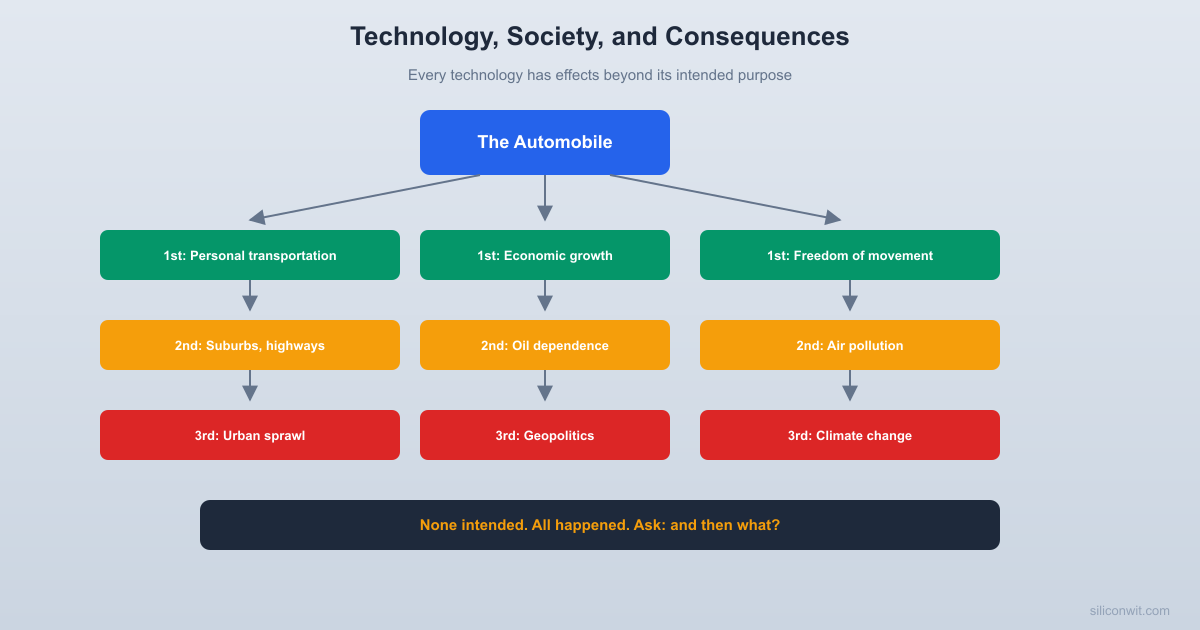
Every technology solves a problem. And every technology creates new problems that its inventors did not foresee. The automobile gave us personal mobility; it also gave us suburban sprawl, oil dependence, and air pollution. Understanding how technologies ripple through society is not just a historian’s concern. It is a responsibility that belongs to everyone who builds things. #Technology #UnintendedConsequences #ResponsibleInnovation
The Cascade of Consequences
When a new technology enters the world, it produces effects at multiple levels. The first-order effects are the intended ones. The second-order effects follow logically but are often unanticipated. The third-order effects are emergent, arising from complex interactions between the technology, human behavior, institutions, and the environment.
Orders of Effect
First-order effects are what the technology is designed to do. Second-order effects are direct consequences of widespread adoption. Third-order effects are systemic changes that reshape society, economics, or the environment. Engineers are typically responsible for the first order and need to think seriously about the second and third.
Each order is harder to predict and harder to reverse.
The Automobile: A Complete Case Study
The automobile is perhaps the best illustration of cascading consequences because it has had over a century to play out.
Order
Effect
Timeline
First
Personal transportation: go where you want, when you want
1900s onward
Second
Suburbs: people can live far from work
1920s onward
Second
Highway systems: massive public infrastructure investment
1950s onward
Second
Oil dependence: transportation fueled by petroleum
1920s onward
Second
Air pollution: vehicle exhaust degrades urban air quality
1940s onward
Third
Urban sprawl: low-density development consumes farmland
1950s onward
Third
Climate change: CO2 from billions of vehicles warms the planet
1970s onward (recognized)
Third
Geopolitical conflict: nations compete for oil reserves
1940s onward
Third
Public health: sedentary lifestyles, pedestrian fatalities
1950s onward
Third
Social isolation: car-dependent communities lack walkable public spaces
1960s onward
Karl Benz and Henry Ford did not intend any of the effects from the second order onward. They were solving a transportation problem. But the technology they created reshaped the physical landscape, the economy, international relations, public health, and the global climate.
The Path Dependence Problem
Once a technology is widely adopted, it creates infrastructure, industries, habits, and regulations that make it difficult to switch to alternatives. This is path dependence: early decisions constrain future options.
The QWERTY keyboard layout was designed in the 1870s partly to prevent jamming on mechanical typewriters. Mechanical typewriters are gone, but QWERTY persists because billions of people have learned to type on it, and the cost of switching exceeds the benefit of any alternative layout. The same pattern applies to electrical grid standards (50 Hz vs 60 Hz), railroad gauge widths, and the internal combustion engine’s dominance over electric vehicles for a century.
Path dependence means that the decisions engineers make during a technology’s early adoption phase have outsized long-term consequences. Once the path is set, changing it requires overcoming enormous inertia.
For modern technologies, path dependence operates through network effects: the more people use a platform, the more valuable it becomes, making it harder for alternatives to compete. Social media platforms, operating systems, and messaging apps all exhibit strong network effects that lock users in long after better alternatives exist.
Could It Have Been Different?
This is not a story about bad engineers making bad decisions. It is a story about how technologies interact with economic incentives, political decisions, and human behavior in ways that are genuinely difficult to predict.
Could early automobile engineers have anticipated climate change? Almost certainly not; the science of greenhouse gases was barely understood in the early 1900s. Could they have anticipated urban sprawl? Possibly, but the suburban expansion was driven as much by government policy (highway funding, mortgage subsidies) as by the automobile itself.
The point is not that engineers should have stopped the automobile. The point is that technologies have consequences far beyond their intended purpose, and engineers should cultivate the habit of asking “and then what?” even when the answer is uncertain.
Modern Examples
The automobile’s story played out over a century. Modern technologies produce cascading effects much faster because adoption is global and nearly instantaneous.
Social media platforms were designed to connect people. Facebook’s original mission was to “make the world more open and connected.” Twitter (now X) was designed for short-form public communication. Instagram was built for sharing photographs.
These are genuine goods. People reconnect with old friends, share experiences across continents, and find communities of interest that would never have formed in the physical world.
Filter bubbles. Recommendation algorithms optimize for engagement, which means showing people content they agree with. Over time, users see an increasingly narrow slice of information, reinforcing existing beliefs and reducing exposure to different perspectives.
Addiction mechanics. Variable-ratio reinforcement (the same mechanism that makes slot machines addictive) is built into social media through likes, notifications, and infinite scroll. Usage patterns that began as recreational become compulsive.
Attention economy. When the product is free, the user is the product. Social media companies sell attention to advertisers, creating an incentive to maximize time spent on the platform regardless of whether that time is beneficial for the user.
Political polarization. Filter bubbles and engagement-optimized algorithms amplify extreme content because it generates stronger reactions. Studies have linked social media use to increased political polarization in multiple countries.
Mental health impact. Research, particularly on adolescents, has found correlations between heavy social media use and increased rates of anxiety, depression, and body image issues. The causal mechanisms are debated, but the patterns are consistent.
Information ecosystem disruption. Traditional journalism, which had established (if imperfect) standards for accuracy, has been financially undermined by social media’s capture of advertising revenue. The replacement ecosystem has far fewer quality controls.
Election interference. Social media platforms have been used as tools for targeted disinformation campaigns by state and non-state actors. The same tools that enable grassroots organizing also enable coordinated manipulation.
IoT Sensors
Intended Purpose
IoT sensors are designed for efficiency, monitoring, and automation. Smart thermostats reduce energy consumption. Industrial sensors enable predictive maintenance. Agricultural sensors optimize irrigation.
Unintended Consequence
The same sensor infrastructure that optimizes building energy use also tracks occupant behavior. A network of temperature, motion, and access sensors in an office building creates a detailed record of when each person arrives, where they go, how long they stay, and who they meet. This is surveillance infrastructure, even if that was not the design intent.
The data from IoT deployments accumulates over time, and its value (and risk) increases as more data is collected. A single day of occupancy data is mundane. A year of occupancy data reveals patterns that could be used for performance evaluation, insurance decisions, or legal proceedings.
Engineers who deploy IoT systems should ask: what could this data be used for beyond our intended purpose? Who might want access to it? What happens if it is breached?
The concept of “function creep” describes how systems designed for one purpose gradually expand to serve other purposes. Security cameras installed for crime prevention get used for traffic monitoring, then for tracking individual movements, then for facial recognition. Each incremental expansion seems reasonable in isolation. The cumulative result is something nobody originally approved.
AI Recommendation Engines
Recommendation algorithms power YouTube suggestions, Amazon product recommendations, Spotify playlists, and news feeds. They are designed to increase engagement by predicting what users want to see next.
The optimization target matters enormously. An algorithm optimized for “time spent on platform” will recommend content that keeps people watching, which often means emotionally arousing content: outrage, fear, conspiracy theories. An algorithm optimized for “user satisfaction after 24 hours” might recommend very different content. An algorithm optimized for “long-term user wellbeing” might recommend still different content, perhaps less of it.
The choice of metric is not a neutral technical decision. It is a value judgment embedded in code. When an engineer selects an optimization target, they are making a decision about what matters, and that decision propagates to every user of the platform.
The engineers who design these algorithms choose the optimization target. That choice is a technical decision with profound social consequences. YouTube’s recommendation algorithm has been linked to radicalization pathways where users who start with mainstream content are gradually recommended increasingly extreme material.
Cheap Microcontrollers
The plummeting cost of microcontrollers (you can buy an ESP32 for 2 to 3 USD) has been transformative:
Positive effects:
The maker movement: millions of people can now build electronic projects that would have required expensive equipment a generation ago
Embedded systems education: students learn on real hardware instead of just simulators
Rapid prototyping: startups can build hardware products with minimal capital
Agricultural technology: low-cost sensors enable precision farming in developing countries
Negative effects:
E-waste: billions of cheap electronic devices are manufactured with short lifespans and no recycling pathway
Planned obsolescence: when components cost almost nothing, there is no economic incentive to make them repairable
Security vulnerabilities: cheap IoT devices often ship with minimal security (default passwords, no encryption, no update mechanism), creating a vast attack surface
Resource extraction: the minerals in microcontrollers (tin, tantalum, tungsten, gold) are sourced from mining operations with significant environmental and human rights concerns
The same technology that enables a Kenyan farmer to monitor soil moisture with a 3 USD sensor also contributes to a growing mountain of electronic waste and a global supply chain with serious ethical issues.
The Rebound Effect
The rebound effect (sometimes called the Jevons paradox) describes a pattern where efficiency improvements lead to increased total consumption rather than decreased consumption.
When LED lighting replaced incandescent bulbs, the cost of light dropped dramatically. Economic theory predicted that cheaper lighting would lead to more lighting, and that is exactly what happened. Cities are now far more brightly lit than they were in the incandescent era. The per-unit energy consumption dropped, but the total energy consumed for lighting has not decreased proportionally.
The same pattern appears throughout engineering:
Technology
Efficiency Gain
Rebound Effect
Fuel-efficient engines
Less fuel per kilometer
People drive more; vehicles get larger
Data compression
Less storage per file
People store more data; file sizes grow
Faster processors
More computation per watt
Software bloats to consume available resources
Energy-efficient buildings
Less energy per square meter
Buildings get larger; more amenities consume the savings
For engineers, the rebound effect is a reminder that technical efficiency alone does not solve resource consumption problems. The system response includes human behavior, economic incentives, and market dynamics that can counteract or even reverse the intended benefit.
Technology Transfer and Context
A technology designed for one context often behaves differently in another. Agricultural drones developed for large-scale farms in the American Midwest may not suit smallholder farms in East Africa, where plots are smaller, terrain is varied, and maintenance infrastructure is limited. Social platforms designed for societies with strong democratic institutions may destabilize societies with weaker ones.
Engineers working on technology transfer should ask: what assumptions about the original context are embedded in this design? Which of those assumptions hold in the new context? What might go wrong when they do not?
The Collingridge Dilemma
In 1980, David Collingridge described a fundamental challenge in governing technology that now bears his name:
The Collingridge Dilemma
When a technology is new, its effects cannot be predicted because it has not been widely deployed. But by the time the effects become clear, the technology is entrenched in society, economy, and infrastructure, making it extremely difficult to change or control.
This is not an abstract philosophical puzzle. It describes the practical situation engineers and policymakers face with every major technology.
The Dilemma in Action
Early phase (technology is new): Social media emerges in the mid-2000s. Its effects on political discourse, mental health, and information quality are unknown. Regulation at this point would be premature because nobody knows what to regulate. The technology is malleable; changes would be technically easy.
Late phase (technology is entrenched): By the 2020s, the effects are clear. Filter bubbles, addiction, misinformation, and political polarization are well documented. But now billions of people depend on these platforms for communication, news, business, and social connection. Meaningful regulation is politically difficult, and technical changes affect entrenched business models and user expectations.
Nuclear power illustrates the opposite end of the dilemma. The technology was developed with heavy regulation from the start, partly because its military origins made governments attentive to safety. Decades later, nuclear power has an excellent safety record per unit of energy produced. Heavy early regulation may have slowed deployment, but it also prevented the kind of uncontrolled scaling that characterizes technologies like social media and IoT.
The dilemma is real, but it is not an excuse for inaction. Engineers and policymakers can take intermediate steps:
Strategy
Description
Example
Monitoring
Track effects as the technology scales
Longitudinal studies on social media and mental health
Reversibility
Design systems that can be modified after deployment
OTA firmware updates, configurable algorithms
Modularity
Build systems where problematic components can be replaced
Swappable recommendation engines
Sunset provisions
Include end-of-life planning in the original design
E-waste recycling built into product cost
Responsible Innovation
The concept of Responsible Research and Innovation (RRI) emerged from European science policy in the 2010s as a framework for thinking about the societal impacts of technology. It has four dimensions:
Anticipate
Try to foresee the effects of the technology beyond its intended purpose. This does not mean predicting the future with certainty. It means systematically asking questions:
Who will use this technology? (Not just the intended users.)
What could go wrong? (Not just technical failure, but misuse and unintended use.)
Who benefits and who bears the costs? (These are often different groups.)
What happens at scale? (Effects that are negligible for 100 users may be transformative for a billion.)
Reflect
Examine your own assumptions, values, and blind spots:
What are you optimizing for? Is engagement the right metric, or should you optimize for user wellbeing?
Whose perspective are you missing? If your design team does not include the people who will be affected by the technology, you are likely missing important considerations.
What are the power dynamics? Technologies often amplify existing inequalities. A facial recognition system trained on one demographic performs poorly on others.
Engage
Involve stakeholders in the design process, especially those who will be affected by the technology but are not in the room:
Users
Not just early adopters, but also reluctant users, vulnerable populations, and people who will be affected without choosing to use the product.
Communities
Local communities affected by manufacturing, deployment, or disposal of the technology.
Regulators
Engage proactively rather than treating regulation as an obstacle to overcome.
Future Generations
Environmental and infrastructure decisions made today constrain options for decades or centuries.
Act
Use the insights from anticipation, reflection, and engagement to modify the technology, its deployment, or its governance:
Change the design to mitigate identified risks
Implement monitoring to detect unanticipated effects early
Build in mechanisms for course correction (configurability, sunset provisions)
Historical Examples of Responsible Innovation
Not all technology stories are cautionary tales. Some technologies were developed with genuine attention to societal impact:
Seat belts. Nils Bohlin at Volvo invented the three-point seat belt in 1959. Volvo made the patent available to all manufacturers for free, prioritizing public safety over competitive advantage. The three-point belt has saved an estimated one million lives worldwide.
The Montreal Protocol. When scientists discovered that chlorofluorocarbons (CFCs) were destroying the ozone layer, engineers in the chemical and refrigeration industries developed alternative compounds. The Montreal Protocol (1987) phased out CFCs globally. It is widely considered the most successful international environmental agreement in history. The ozone layer is recovering.
Open-source software. The decision by engineers and organizations to release software under open licenses has created a shared technical commons that benefits billions of people. Linux, the Apache web server, and the TCP/IP protocol stack are all examples of technology developed and shared for the public good.
These examples show that responsible innovation is not just about avoiding harm. It is also about making deliberate choices to share benefits widely.
What Individual Engineers Can Do
It is easy to feel powerless when the consequences of technology operate at a societal scale. You are one engineer on a team building one product at one company. What can you do about climate change, polarization, or e-waste?
More than you think.
Think Beyond the Spec
The specification tells you what the product must do. It rarely tells you what the product should not do, or what it might do when used in ways nobody intended. Make it your habit to ask:
Who else might use this? A door lock designed for homes might be used in a domestic violence shelter. A location tracker designed for fleet management might be used for stalking.
What happens at scale? A feature that works fine for 1,000 users might be catastrophic for a million. A device that is harmless as a single unit might be an environmental disaster when manufactured by the billion.
What happens in 10 years? The data you collect today might be subpoenaed in a lawsuit in 2036. The protocol you design today might still be running on legacy systems in 2046.
“And then what?” For every consequence you identify, ask what follows from that consequence. First-order thinking is easy. Second and third-order thinking is where the important insights live.
Consider Who Is Affected
Technology does not affect everyone equally. The people who design, build, and profit from a technology are rarely the same people who bear its costs:
Technology
Primary Beneficiaries
Primary Cost Bearers
Ride-sharing apps
Urban professionals, investors
Taxi drivers who lose livelihoods, drivers who lack benefits
Fast fashion e-commerce
Consumers in wealthy countries
Garment workers, communities near textile factories
Cryptocurrency mining
Miners and speculators
Communities near power plants, everyone affected by energy waste
Social media
Advertisers, platform companies
Users’ attention and mental health, democratic institutions
You may not be able to change the economic structure of your industry. But you can ensure that the people who bear the costs are at least visible in your design process.
Advocate Within Your Organization
Individual engineers often have more influence than they realize:
Raise the question early. Societal impact is easier to address during design than after launch. Once a product is in production, changing it is expensive and politically difficult.
Use data, not just values. “This feature could create a privacy problem” is easy to dismiss. “This feature stores GPS coordinates that could be used to track individuals; here is a paper documenting how similar data was misused in three other products” is harder to dismiss.
Propose alternatives, not just objections. “We should not do this” is a dead end. “We could achieve the same goal by doing Y instead, which avoids the Z risk” is a productive contribution.
Find allies. You are probably not the only person on your team who has concerns. Building a coalition makes it harder for management to dismiss the issue.
Document your concerns. If your concerns are overruled, document them. This is not about covering yourself legally (though it can help). It is about creating a record that can inform future decisions.
Ask the Right Questions in Design Reviews
Adding three questions to every design review can shift the conversation:
What is the worst thing someone could do with this? Not the intended use, but the worst misuse you can imagine.
What data does this create, and where does it go? Data is permanent and combinable. Small amounts of harmless data can become powerful surveillance when aggregated.
What happens when this product reaches end of life? Is it repairable? Recyclable? Or does it go to a landfill?
These questions will not stop all unintended consequences. But they ensure that the most foreseeable ones are at least discussed before the product ships.
Build Reversibility into Your Designs
One of the most practical things an engineer can do is make their designs changeable. If you cannot predict all consequences, you can at least make it possible to respond when consequences become clear.
Firmware Updates
Deploy connected devices with OTA update capability so behavior can be modified after deployment. A device without update capability is frozen in its original design, bugs and all.
Configurable Parameters
Expose key thresholds and behaviors as configuration rather than hardcoded values. If a sensor sampling rate turns out to create unexpected network load, a configurable parameter can be changed without a code release.
Modular Architecture
Design systems where components can be replaced independently. If the recommendation algorithm turns out to amplify harmful content, a modular system lets you swap the algorithm without rebuilding the entire platform.
Data Retention Policies
Decide in advance how long data is kept and build automated deletion into the system. Data that does not exist cannot be misused, breached, or subpoenaed.
Reversibility has costs: OTA infrastructure, configuration management, modular interfaces, and data lifecycle management all add complexity. But that complexity is an investment in the ability to respond to consequences that you could not have predicted at design time.
Consider the contrast: a deployed IoT device without OTA update capability is permanent. If a security vulnerability is discovered, the only options are physical recall (expensive) or accepting the risk (dangerous). A device with OTA capability can be patched remotely, turning an unknown unknown into a manageable known problem.
The lesson applies beyond IoT. Any engineered system that will operate for years should include mechanisms for modification. Buildings have maintenance access panels. Software has configuration files. Bridges have inspection points. These are not afterthoughts; they are design features that acknowledge the limits of prediction.
You Cannot Predict Everything
This lesson has described many examples of unintended consequences. It might seem like the message is that engineers should predict every possible effect of their technology before building it. That is not the message.
Predicting all consequences is impossible. The automobile’s inventors could not have foreseen climate change. The creators of the internet could not have predicted social media. The engineers who built the first microprocessors could not have imagined smartphones.
The message is different and more practical:
The Real Message
You cannot predict everything. But you can ask the question. You can cultivate the habit of thinking beyond the immediate technical problem. You can include diverse perspectives in your design process. You can build systems that are monitorable, modifiable, and reversible. And you can take responsibility for the foreseeable consequences, even when they were not part of the original specification.
The engineer who never asks “and then what?” will be surprised by the consequences of their work. The engineer who always asks it will still be surprised sometimes, but less often and less catastrophically.
A Framework for Consequence Mapping
When evaluating a new technology or feature, you can use a structured approach to map potential consequences:
Question
First Order
Second Order
Third Order
What does it do?
Direct function
Behavioral changes from widespread use
Systemic changes in society/environment
Who benefits?
Intended users
Adjacent beneficiaries
Those who gain power or advantage
Who is harmed?
Nobody (ideally)
Those displaced or disadvantaged
Vulnerable populations, ecosystems
What data is created?
Specified data
Metadata, behavioral patterns
Aggregated profiles, surveillance potential
What happens at end of life?
Device is discarded
Materials enter waste stream
Cumulative environmental impact
This table will not catch everything. But it provides a systematic starting point for thinking beyond the specification. Fill it out for any significant design decision or new feature, share it with your team, and invite others to add rows you missed. The exercise itself is as valuable as the output: it trains you to think in cascades rather than in isolation.
Exercises
Choose a technology you use daily (smartphone, search engine, streaming service, electric vehicle). Map out its first, second, and third-order effects. For each order, distinguish between effects that benefit you and effects that impose costs on others.
Research the history of leaded gasoline. Thomas Midgley Jr. invented tetraethyl lead as a gasoline additive in 1921. Map the cascade of consequences: the intended effect (reduced engine knock), the second-order effects (lead pollution, health impacts), and the third-order effects (regulatory battles, phaseout, ongoing environmental contamination). How long did it take for the harmful effects to be recognized and addressed?
Apply the four dimensions of Responsible Innovation (anticipate, reflect, engage, act) to a technology you are currently working on or studying. Write a one-page analysis for each dimension. Be honest about the limitations of your analysis.
The Collingridge dilemma suggests that the best time to regulate a technology is when we understand it least. Propose a practical approach for one emerging technology (gene editing, autonomous weapons, brain-computer interfaces, or another of your choice) that balances the need for early governance with the uncertainty about effects. What specific monitoring mechanisms would you put in place?
Summary
Every technology produces consequences beyond its intended purpose. The automobile reshaped cities, geopolitics, and the global climate. Social media, designed for connection, created filter bubbles and amplified misinformation. IoT sensors, designed for efficiency, created surveillance infrastructure. Cheap microcontrollers enabled the maker movement and an e-waste crisis simultaneously. The Collingridge dilemma means we face a fundamental tension: when a technology is new enough to change, its effects are unknown, and when its effects are known, the technology is entrenched. Responsible innovation offers a framework for navigating this tension through anticipation, reflection, engagement, and action. Individual engineers cannot predict every consequence. But they can cultivate the habit of thinking beyond the specification, considering who is affected, and asking “and then what?” That habit, practiced consistently, is one of the most valuable contributions an engineer can make to society.



Comments