


Derivatives
Rates of change. How fast is the temperature dropping? How much current is flowing? What is the slope of the cost function?
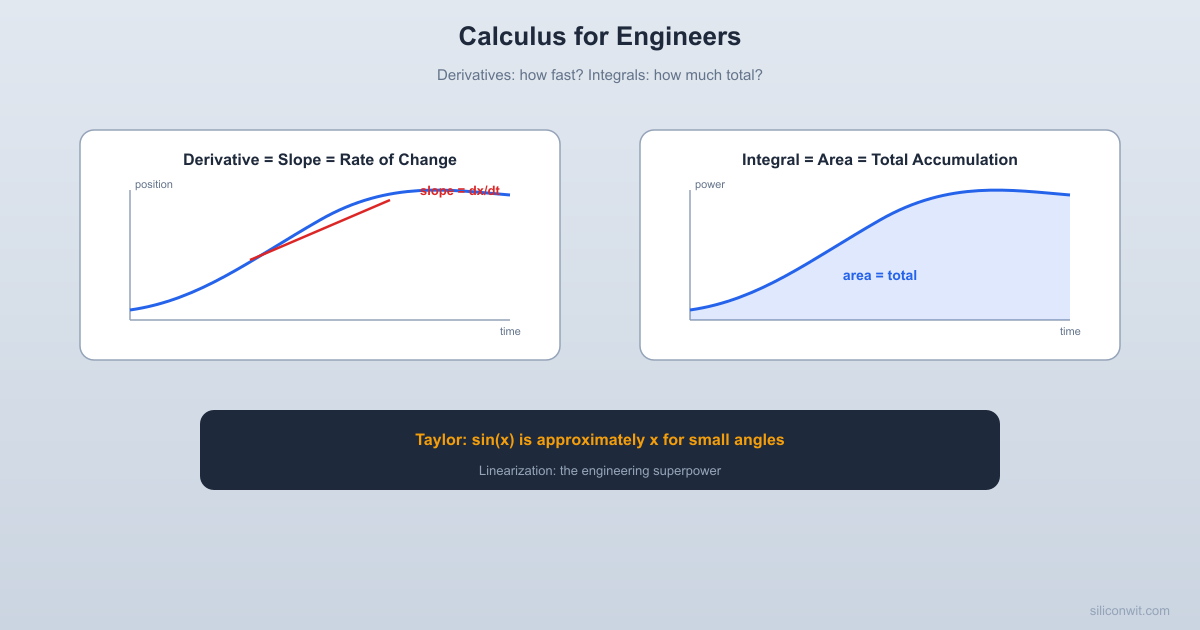
This is not a full calculus course. This is the parts of calculus that engineers reach for every single day. If calculus were a toolbox, we are going to focus on the hammer, the screwdriver, and the wrench: the tools you will actually hold in your hands, not the specialty bits that stay in the drawer. #Calculus #Engineering #AppliedMath
A derivative answers one question: at this exact moment, how fast is something changing?
You are driving. Your odometer reads distance. Your speedometer reads the derivative of distance with respect to time. Your speed tells you how fast the distance is accumulating right now.
Your car’s speedometer is literally displaying the derivative of your odometer reading. Every time you glance at the speedometer, you are reading a derivative.
That is the entire concept. The derivative of position is velocity. The derivative of velocity is acceleration. The derivative of charge is current. The derivative of temperature with respect to position is the temperature gradient. Every time you ask “how fast is this quantity changing?” you are asking for a derivative.
Graphically, the derivative at a point is the slope of the tangent line at that point. If you plot temperature versus time for a cooling cup of coffee, the derivative at any moment tells you how fast the coffee is cooling right then.
T (C) 90 |* | * | * | * <-- steep slope here = fast cooling | * | * | * * <-- gentle slope = slow cooling | * * * * 22 |--------------------------------------- T_room +---------------------------------------- t (min) 0 5 10 15 20 25 30 35When the curve is steep, the derivative is large (the coffee is cooling quickly). When the curve flattens out, the derivative approaches zero (the coffee has nearly reached room temperature).
Here are the derivatives that appear most often in engineering work:
| Function | Derivative | Engineering meaning |
|---|---|---|
| Power relationships | ||
| Exponential growth/decay | ||
| AC signals | ||
| AC signals | ||
| Logarithmic sensors |
The exponential function
If the charge on a capacitor varies as
The negative sign tells you the charge is decreasing (the capacitor is discharging). The current magnitude starts at
If derivatives answer “how fast?”, integrals answer “how much in total?” Your monthly electricity bill is the integral of your power usage over time: the utility company measures how many watts you draw each moment, accumulates that over the billing period, and charges you for the total kilowatt-hours.
You are driving at a varying speed. Your speedometer changes moment to moment. How far did you travel in total? You add up all the tiny distances: speed times a tiny time interval, over and over. In the limit, that sum becomes an integral:
Graphically, the integral is the area under the curve. The area under a velocity-time graph is the total distance traveled.
  v (m/s)  20 |        ****     |      **    **     |    **        **  10 |  **            **     | *                **     |*                   ****   0 +----------------------------- t (s)     0    2    4    6    8    10
The shaded area = total distance traveled| Integral | Result | Engineering meaning |
|---|---|---|
| Power relationships | ||
| Exponential processes | ||
| AC signal energy | ||
| AC signal energy |
A solar panel produces power
If the power follows a rough sinusoidal pattern (zero at dawn and dusk, peak at noon):
where
For
That is a useful estimate for sizing a battery bank.
The fundamental theorem of calculus says that differentiation and integration are inverse operations. If you integrate a function and then differentiate the result, you get back the original function:
This is not just a mathematical curiosity. It means that if you know the rate of change of something (the derivative), you can find the total change by integrating. And if you know the total accumulated quantity, you can find the rate by differentiating. Velocity and position. Current and charge. Power and energy. These pairs are connected by the fundamental theorem.
Here is one of the most useful ideas in all of applied mathematics: any smooth function can be approximated near a point by a polynomial. The Taylor series of a function
Most of the time, you only need the first one or two terms. That turns a complicated function into a simple linear or quadratic approximation.
The small-angle approximation:
For small
This is the first-term Taylor expansion around
The exponential approximation:
This appears constantly in engineering. For a small perturbation
Linearization:
The Taylor series with just the first two terms is linearization. You are replacing a curved function with a straight line that touches the curve at one point. This is how engineers turn nonlinear problems into linear ones, which are far easier to solve.
import numpy as np
theta = np.array([0.1, 0.2, 0.3, 0.5, 1.0])sin_exact = np.sin(theta)sin_approx = theta
print("theta (rad) | sin(theta) | approx  | error (%)")print("-" * 50)for i in range(len(theta)):    error = abs(sin_exact[i] - sin_approx[i]) / sin_exact[i] * 100    print(f"  {theta[i]:.1f}       |  {sin_exact[i]:.5f}  | {sin_approx[i]:.5f} | {error:.2f}%")
Output:
theta (rad) | sin(theta) | approx | error (%)-------------------------------------------------- 0.1 | 0.09983 | 0.10000 | 0.17% 0.2 | 0.19867 | 0.20000 | 0.67% 0.3 | 0.29552 | 0.30000 | 1.52% 0.5 | 0.47943 | 0.50000 | 4.29% 1.0 | 0.84147 | 1.00000 | 18.83%At 0.3 radians the approximation is excellent. At 1.0 radian it is poor. Knowing the domain of validity of your approximations is critical.
The chain rule tells you how to differentiate a composition of functions. If
In plain language: if
A thermistor’s resistance varies with temperature:
An ADC converts this resistance to a digital reading through a voltage divider. The voltage across the thermistor is:
If you want to know how the voltage reading changes with temperature, you need the chain rule:
Each piece is straightforward on its own. The chain rule lets you compose them. This tells you the sensitivity of your measurement system: how many millivolts per degree of temperature change.
The chain rule is also why unit conversions work the way they do for rates. If a car travels at 90 km/h and you want m/s:
Each conversion factor is a
In practice, you often have discrete data, not continuous functions. A sensor gives you temperature readings every second, not a formula. You need numerical methods.
The simplest approximation to a derivative uses two adjacent data points:
This is the central difference formula. It is more accurate than the forward difference
To integrate discrete data, approximate the area under the curve as a series of trapezoids:
import numpy as np
# Simulated sensor data: temperature readings every 1 secondt = np.arange(0, 60, 1.0)          # time in secondsT = 90 * np.exp(-0.05 * t) + 22    # cooling curve (C)
# Numerical derivative: rate of cooling (C/s)dT_dt = np.gradient(T, t)
# Numerical integral: total "degree-seconds" of cooling# (useful for thermal energy calculations)total = np.trapz(T - 22, t)
print(f"Initial cooling rate: {dT_dt[0]:.2f} C/s")print(f"Cooling rate at t=30s: {dT_dt[30]:.2f} C/s")print(f"Integrated thermal energy (proportional): {total:.1f} degree-seconds")
NumPy’s np.gradient() computes the central difference, and np.trapz() computes the trapezoidal integral. These two functions handle 90% of the numerical calculus you will ever need.
Calculus gives you four essential tools:
Derivatives
Rates of change. How fast is the temperature dropping? How much current is flowing? What is the slope of the cost function?
Integrals
Accumulation. How much energy was harvested? What is the total charge? How far did the robot travel?
Taylor Series
Approximation. Replace a complex function with a polynomial. Linearize around an operating point. Turn nonlinear problems into linear ones.
Chain Rule
Composition. How does the output change when the input changes, through a chain of intermediate variables? Sensor calibration, unit conversion, system sensitivity.
These are not separate topics. They are facets of one idea: calculus is the mathematics of change and accumulation. Every engineering system changes over time, and calculus is how you describe, predict, and control that change.
In the next lesson, we will see how linear algebra provides the other essential framework: the mathematics of systems, where multiple quantities interact simultaneously.
Comments