


Measurement Uncertainty
No measurement is exact. Every reported value should be accompanied by an uncertainty estimate. When an engineer writes
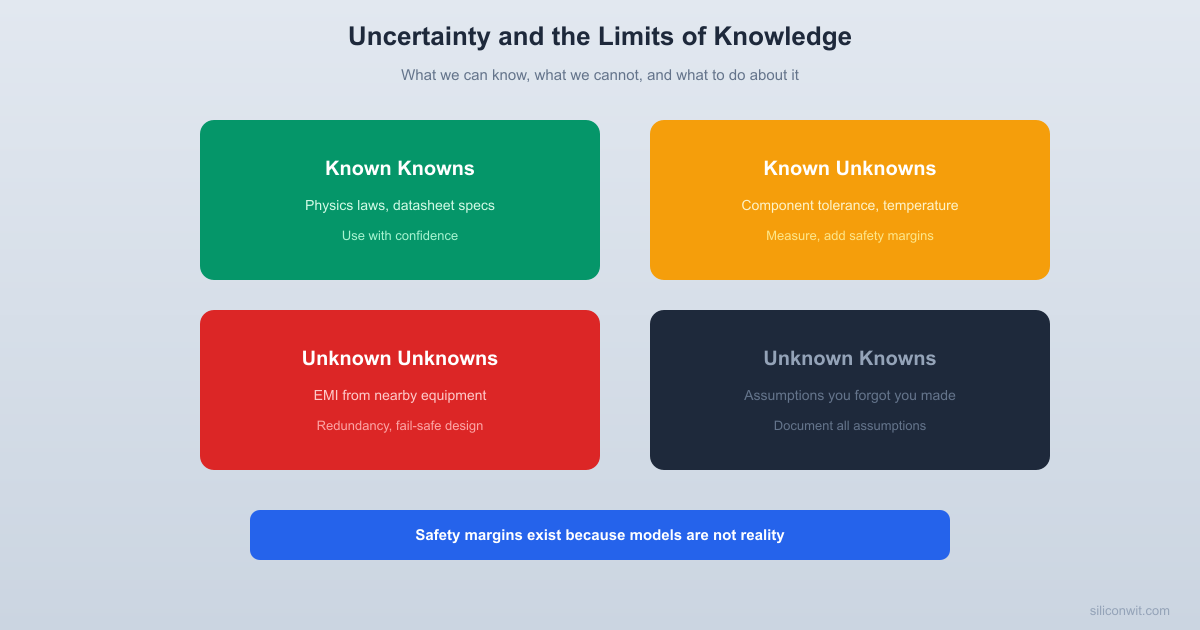
Engineering is built on measurement, calculation, and prediction. But none of these are perfect. Every sensor has noise, every model has assumptions, and every forecast has a horizon beyond which it becomes guesswork. Understanding the limits of knowledge is not a reason for despair; it is the foundation of responsible design. Engineers who know what they cannot know build systems that survive the unexpected. #Uncertainty #EngineeringDesign #ComplexSystems
When you measure the length of a steel beam with a tape measure, you might record 2.450 meters. But the true length is not exactly 2.450 meters. It might be 2.4497 or 2.4503. The tape measure has a resolution limit, your reading angle introduces parallax, and the beam itself expands and contracts with temperature.
Measurement Uncertainty
No measurement is exact. Every reported value should be accompanied by an uncertainty estimate. When an engineer writes
| Source | Example | Typical Magnitude |
|---|---|---|
| Instrument resolution | Digital multimeter with 3.5 digits | Last digit uncertain |
| Systematic bias | Uncalibrated scale reads 0.5 g too high | Constant offset |
| Random noise | Voltage fluctuations in a sensor circuit | Statistical spread |
| Environmental drift | Temperature changes during a 4-hour test | Gradual shift |
| Observer effects | Connecting a scope probe changes circuit impedance | Load-dependent |
Uncertainty compounds through calculations. If you multiply two measured quantities, each with 1% uncertainty, the result has roughly 1.4% uncertainty (the uncertainties add in quadrature). For a system with dozens of measured inputs feeding into a design calculation, the final uncertainty can be surprisingly large.
Consider a simple stress calculation:
This is why safety factors exist. They are not there because engineers are bad at math. They are there because engineers are honest about their math.
In 1999, NASA’s Mars Climate Orbiter was lost because one engineering team used imperial units (pound-force seconds) while another used metric units (newton-seconds) for thruster impulse calculations. The error was not in the physics or the instruments. It was in the interface between two groups, each of which had internally consistent and accurate data.
The total cost of the mission was approximately 327.6 million USD. The root cause was not a measurement error but a failure to explicitly document and verify units at the system boundary. This is a case where uncertainty was not the problem; unexamined assumptions were.
Units Are Assumptions
Every number in an engineering calculation carries implicit assumptions about units, reference frames, coordinate systems, and sign conventions. When those assumptions are not documented, any two engineers looking at the same number might interpret it differently. Explicit documentation of units and conventions is not bureaucracy. It is error prevention.
Engineers who work with uncertainty need at least a basic statistical vocabulary:
| Concept | Meaning | Engineering Use |
|---|---|---|
| Mean | Average value | Central estimate of a measured quantity |
| Standard deviation | Spread of measurements | Quantifies repeatability |
| Confidence interval | Range within which the true value likely falls | Defines how much you trust your estimate |
| Distribution | Shape of the spread (normal, uniform, etc.) | Determines how to combine uncertainties |
| Outlier | A data point far from the rest | May indicate a real problem or a measurement error |
The temptation is to take the average and discard the spread. Resist this temptation. The spread is information. A measurement with a mean of 5.0 V and a standard deviation of 0.01 V tells a very different story from one with the same mean and a standard deviation of 0.5 V.
In the early 1960s, meteorologist Edward Lorenz was running a simple weather simulation on a computer. To save time, he restarted a run from the middle, entering the intermediate values by hand. But he rounded one number from 0.506127 to 0.506. The result was a completely different weather pattern.
This was not a bug. It was chaos theory in action.
Chaos Theory
A chaotic system is fully deterministic: the same initial conditions always produce the same outcome. But tiny differences in initial conditions produce wildly different outcomes over time. Since we can never measure initial conditions with infinite precision, long-term prediction becomes impossible in practice.
Lorenz’s discovery has real consequences for engineers:
Weather and climate: You can predict tomorrow’s weather reasonably well, next week’s weather poorly, and next month’s weather hardly at all. This is not because meteorologists are incompetent. It is because the atmosphere is a chaotic system with a prediction horizon of roughly 10 to 14 days.
Turbulent flow: The Navier-Stokes equations governing fluid dynamics are deterministic. But turbulent flow is chaotic. Two nearly identical initial flow states diverge exponentially. This is why you cannot predict exactly where a plume of smoke will go, even though the physics is completely known.
Electronic oscillators: Certain nonlinear circuits exhibit chaotic behavior. A Chua’s circuit, for example, follows deterministic equations but produces an output that looks random. The same sensitivity to initial conditions applies.
For engineers, chaos means that some systems cannot be predicted beyond a certain time horizon, no matter how good your instruments or how powerful your computer. The response is not to give up on prediction. It is to understand the prediction horizon and design accordingly.
Weather forecasters use ensemble methods: run the simulation hundreds of times with slightly different initial conditions and look at the spread of outcomes. If all ensemble members agree, confidence is high. If they diverge, you know the forecast is unreliable.
Engineers can apply the same principle to any system with chaotic behavior.
For any chaotic system, there is a characteristic timescale called the Lyapunov time, beyond which prediction becomes unreliable. This timescale depends on the system:
| System | Approximate Prediction Horizon |
|---|---|
| Turbulent fluid flow | Seconds to minutes |
| Weather | 10 to 14 days |
| Planetary orbits (inner solar system) | Millions of years |
| Double pendulum | Seconds |
| Stock market prices | Practically zero for individual trades |
The Lyapunov time tells you how far ahead your model can reliably predict. For engineering purposes, this determines whether prediction-based control is feasible (if the Lyapunov time is long relative to your control cycle) or whether you need reactive, feedback-based strategies (if the Lyapunov time is short).
A control system for a turbulent combustion process cannot predict the flow pattern 10 seconds ahead. But it can measure the current state and adjust in real time. The uncertainty does not make control impossible. It changes the kind of control that works.
Chaos involves simple systems with sensitive dependence on initial conditions. Complexity involves systems with many interacting parts that produce collective behavior no individual part exhibits.
Consider traffic flow. Each driver follows simple rules: maintain speed, keep distance, brake when needed. No driver intends to create a traffic jam. But jams emerge from the interaction of thousands of drivers making independent decisions. The jam is an emergent property of the system, not a feature of any individual car.
Other examples of emergence:
Ant Colonies
Individual ants follow simple pheromone rules. The colony as a whole solves complex optimization problems (shortest path to food, efficient nest construction) that no single ant understands.
Market Crashes
Individual traders make rational decisions based on available information. But the collective behavior can produce bubbles and crashes that no trader intended or predicted.
Internet Routing
Each router makes local forwarding decisions. The global behavior of the network (congestion patterns, failure cascades, latency spikes) emerges from millions of local decisions.
Ecosystems
Individual species compete and cooperate locally. The overall stability or collapse of the ecosystem is an emergent property that cannot be predicted from studying any single species.
When you design a component, you can test it in isolation. But the behavior of the system containing that component may surprise you. A software module that passes all unit tests can cause a system failure when it interacts with other modules under load. A structural member that meets all specifications can contribute to a resonance failure when combined with other members.
The lesson: testing components is necessary but not sufficient. You must also test the system, and you must accept that some system-level behaviors will only appear in the field.
Sociologist Charles Perrow introduced the concept of “normal accidents” in his study of complex systems. He argued that in tightly coupled systems (where components interact quickly and with little slack), failures can cascade faster than operators can respond.
A power grid is tightly coupled: a failure at one node can cascade through the network in seconds. The Northeast blackout of 2003 started with an alarm system failure at a utility in Ohio, combined with untrimmed trees touching power lines. Within hours, 55 million people lost power across the northeastern United States and Ontario, Canada.
For engineers designing tightly coupled systems, the implication is clear: you must design for cascading failure, not just individual component failure. Circuit breakers, rate limiters, bulkheads, and graceful degradation mechanisms are all strategies for preventing local failures from becoming system-wide catastrophes.
In 2002, U.S. Secretary of Defense Donald Rumsfeld gave a press conference that was widely mocked but contained a genuinely useful epistemological framework:
“There are known knowns: things we know we know. There are known unknowns: things we know we don’t know. But there are also unknown unknowns: things we don’t know we don’t know.”
Engineers deal with all three categories constantly.
  The Known/Unknown Matrix
| Known to us | Unknown to us ---------+----------------+------------------ Known | KNOWN KNOWNS | KNOWN UNKNOWNS to exist | Steel strength | Wind load in a | at 20 C | 100-year storm | Ohm's law | Exact user count ---------+----------------+------------------ Unknown | (impossible | UNKNOWN UNKNOWNS to exist | by definition) | Aeroelastic flutter | | (Tacoma Narrows) | | Fukushima tsunami ---------+----------------+------------------ Response: Use directly Add safety factors in design Build redundancy Monitor for anomalies| Category | Definition | Engineering Example | Response |
|---|---|---|---|
| Known knowns | Facts we are confident about | Steel’s yield strength at room temperature | Use directly in design |
| Known unknowns | Gaps we are aware of | Exact wind load during a 100-year storm | Use statistical models and safety factors |
| Unknown unknowns | Surprises we have not imagined | A failure mode nobody anticipated | Build in redundancy, monitor, and iterate |
Known unknowns are manageable. You know the soil composition at a construction site is uncertain, so you do geotechnical surveys and add safety margins. You know the exact user load on your server is unpredictable, so you build in auto-scaling.
Unknown unknowns are the dangerous ones. The Tacoma Narrows Bridge collapsed in 1940 due to aeroelastic flutter, a failure mode that bridge engineers had not considered. The Fukushima Daiichi nuclear disaster in 2011 resulted partly from a tsunami exceeding the design basis that planners had considered sufficient.
You cannot prepare for every unknown unknown. But you can build systems that degrade gracefully rather than catastrophically, and you can create feedback loops that detect anomalies before they become failures.
The most effective strategy for handling unknown unknowns is to convert them into known unknowns as quickly as possible. This requires:
Diverse teams. People with different backgrounds, disciplines, and experiences see different risks. A mechanical engineer and a software engineer looking at the same system will identify different potential failure modes. An engineer from a different cultural context may question assumptions that the rest of the team takes for granted.
Pre-mortem analysis. Before a project launches, ask the team: “Imagine this project has failed spectacularly. What went wrong?” This technique, borrowed from cognitive psychology, activates different thinking patterns than asking “what could go wrong?” People are better at explaining a failure after it happens (even hypothetically) than at predicting it beforehand.
Incident review from other industries. Many engineering failures have analogs in other industries. A software team can learn from aviation incidents. A civil engineer can learn from software failures. The NASA Lessons Learned database and the Chemical Safety Board’s investigation reports are freely available and contain decades of hard-won knowledge.
Operational monitoring. Systems in the field generate data about how they actually behave, as opposed to how you designed them to behave. Monitoring for anomalies (unexpected patterns, out-of-range values, unusual sequences) can reveal unknown unknowns before they cause failures.
Modern engineering relies heavily on simulation. Finite element analysis, computational fluid dynamics, circuit simulation, and system-level modeling are all essential tools. But every simulation is a model, and every model is a simplification of reality.
George Box's Insight
“All models are wrong, but some are useful.” A simulation captures certain aspects of reality while ignoring others. The question is whether the aspects it ignores matter for the decision you are making.
You can model a bridge under static load with high accuracy. But consider what a real bridge experiences that your simulation might miss:
A simulation that accounts for items 1 through 4 might be quite good. But items 5 through 7 involve human behavior and organizational decisions that no physical simulation captures.
The simulation community distinguishes between two questions:
Verification: Does the code solve the equations correctly? This is a math question. You can answer it by comparing against analytical solutions or by running convergence studies.
Validation: Do the equations describe the real world correctly? This is a physics question. You can only answer it by comparing against experimental data.
A simulation can be perfectly verified (it solves the equations right) and still be invalid (the equations do not capture the relevant physics). Engineers must always ask both questions.
Modern simulation tools are powerful and easy to use. A junior engineer can run a finite element analysis in an afternoon with minimal training. This is both a gift and a danger.
The gift is accessibility: more engineers can use simulation to inform their designs. The danger is that the tool can produce a plausible-looking result even when the model is fundamentally wrong. Incorrect boundary conditions, inappropriate element types, unconverged meshes, and invalid material models can all produce numbers that look reasonable but are meaningless.
The defense against this is validation: always compare simulation results against experimental data, analytical solutions, or engineering judgment. If a simulation predicts a stress concentration of 50 MPa but a handbook formula predicts 200 MPa, something is wrong with one of them. Investigate before trusting either.
The Heisenberg uncertainty principle in quantum mechanics states that you cannot simultaneously know a particle’s position and momentum with arbitrary precision. This is a fundamental limit, not a technology problem.
Engineers face an analogous challenge at the macroscopic scale: the act of measuring a system often changes the system.
When you connect an oscilloscope probe to a circuit, you add capacitance (typically 10 to 15 pF) and a parallel resistance (typically 10 megaohms). For a low-frequency, low-impedance circuit, this does not matter. For a high-frequency, high-impedance circuit, the probe changes the signal you are trying to measure.
An engineer debugging a 100 MHz signal with a 15 pF probe load might see a waveform that does not exist in the unloaded circuit. The measurement is not wrong in the sense of being inaccurate; it is wrong in the sense of measuring a different system than the one you care about.
Performance profiling in software has the same character. Adding instrumentation to measure execution time changes execution time. Logging I/O operations to diagnose a performance issue may itself cause I/O contention. Running a debugger changes memory layout, timing, and sometimes program behavior.
The principle extends further. In sociology and economics, measuring human behavior changes human behavior (the Hawthorne effect). Workers at the Hawthorne Works factory in the 1920s and 1930s improved their productivity simply because they knew they were being observed. The specific changes to lighting and break schedules mattered less than the attention itself.
In product testing, the test environment differs from the deployment environment in ways that matter. A device tested in a clean laboratory performs differently in a dusty factory. Software tested on a developer’s machine behaves differently on a customer’s aging hardware with background processes consuming resources. A structural prototype tested under controlled loading may respond differently to the irregular, dynamic loads of actual use.
| Domain | Observer Effect | Impact |
|---|---|---|
| Electronics | Scope probe capacitance loads the circuit | High-frequency signals distorted |
| Software | Profiler overhead changes timing | Performance bottleneck appears to shift |
| Mechanical testing | Strain gauge stiffens the test specimen locally | Measured strain slightly lower than actual |
| Network analysis | Packet capture increases latency | Timing-sensitive protocols behave differently |
| User testing | Users behave differently when watched | Test results do not reflect real usage |
The response is not to stop measuring. It is to understand how your measurement affects the system and to account for that effect. Use low-capacitance probes. Use statistical profiling instead of instrumented profiling. Run tests in environments that match production as closely as possible.
And when you cannot eliminate the observer effect, document it. “This measurement was taken with a 10x probe adding approximately 12 pF to the node” is far more useful than a bare number.
Once you accept that knowledge is always incomplete, the question becomes: how do you design systems that work despite what you do not know?
The simplest response to uncertainty is to add margin. If the calculated maximum stress is 200 MPa and the material’s yield strength is 300 MPa, you have a safety factor of 1.5. That margin absorbs the uncertainty in your stress calculation, the uncertainty in the material properties, and some of the unknown unknowns.
Different fields use different safety factors because they face different uncertainties:
| Application | Typical Safety Factor | Reason |
|---|---|---|
| Aircraft structures | 1.5 | Weight is critical; extensive testing compensates |
| Buildings | 2.0 to 3.0 | Long service life, variable loads, less testing |
| Pressure vessels | 3.0 to 4.0 | Catastrophic failure mode, hard to inspect internally |
| Elevator cables | 8.0 to 12.0 | Human life depends on it, degradation over time |
Safety margins protect against larger-than-expected loads. Redundancy protects against component failure. A dual-engine aircraft can fly on one engine. A RAID array survives a disk failure. A triple-redundant flight computer tolerates a single computer malfunction.
The key insight is that redundancy only works if the failure modes are independent. Two engines mounted side by side are not truly redundant if a single fire can destroy both. Two software modules running the same algorithm are not redundant against a software bug.
Fail-Safe vs. Fail-Secure vs. Fail-Operational
Fail-safe: On failure, the system moves to a state that is safe (a traffic light turns all-red on failure). Fail-secure: On failure, the system maintains security (a door locks on power failure). Fail-operational: On failure, the system continues operating, possibly at reduced capability (a fly-by-wire aircraft with redundant computers).
The choice between these strategies depends on the application. A chemical plant valve should fail closed (fail-safe) to prevent a release. A fire exit should fail open (different kind of fail-safe) to allow evacuation. An aircraft flight control system must fail operational because “fail-safe” is not an option when you are at 35,000 feet.
No single strategy handles all sources of uncertainty. The most robust designs layer multiple strategies:
Each layer protects against a different category of uncertainty. Safety margins handle known unknowns. Redundancy handles component-level failures. Monitoring detects conditions drifting outside expectations. Fail-safe mechanisms handle the cases where everything else fails. And maintenance prevents slow degradation from eroding the other layers over time.
This layered approach is called “defense in depth,” and it is used in nuclear engineering, aviation, cybersecurity, and any domain where failure has severe consequences. No single layer is perfect. But the probability of all layers failing simultaneously is much lower than the probability of any single layer failing alone.
Every engineering decision carries implicit assumptions about confidence. When you select a bolt, you are confident that the manufacturer’s specification is accurate. When you choose a network protocol, you are confident that the error-correction scheme catches the error rates you will encounter.
These confidence assumptions should be explicit, not implicit.
Not all knowledge deserves equal trust:
| Level | Description | Example |
|---|---|---|
| Textbook physics | Thoroughly validated over centuries | Ohm’s law, beam bending equations |
| Material datasheet | Manufacturer-tested, but for their conditions | Tensile strength of a specific alloy |
| Simulation result | Only as good as the model and inputs | FEA stress analysis of a custom bracket |
| Expert judgment | Informed opinion without rigorous data | ”This should handle the load” |
| Extrapolation | Extending known data beyond its range | Performance at temperatures never tested |
The further down this table you go, the more margin you should add.
Always report uncertainty
A number without context is not information. Include error bars, confidence intervals, or at minimum a qualitative assessment of how much you trust the value.
Know your prediction horizon
Some systems are predictable for seconds, others for centuries. Know which kind you are dealing with and do not pretend otherwise.
Test the system, not just the parts
Emergent behavior only appears at the system level. Component-level testing is necessary but never sufficient.
Design for what you do not know
Safety margins, redundancy, and fail-safe design are not signs of over-engineering. They are rational responses to the limits of knowledge.
Pick a measurement you have made recently (voltage, temperature, weight, anything). Estimate the uncertainty from at least three different sources (instrument resolution, environmental factors, measurement technique). Calculate the combined uncertainty.
Research the Tacoma Narrows Bridge collapse. What was the unknown unknown? How would modern engineering practice (wind tunnel testing, aeroelastic analysis) have caught it? What unknown unknowns might modern bridge engineers still be missing?
Find a simulation result you have used or produced. List three things the simulation assumes that reality does not guarantee. For each, estimate how much the result would change if the assumption were wrong.
Choose a product you use daily (phone, car, elevator, building). Identify at least two safety margins, two redundancies, and one fail-safe mechanism in its design. For each, explain what uncertainty it is designed to absorb.
Knowledge has limits, and engineering lives at those limits every day. Measurement uncertainty means no number is exact. Chaos means some systems are inherently unpredictable beyond a time horizon. Complexity means system behavior can surprise you even when you understand every component. And unknown unknowns mean you must prepare for scenarios you have not imagined. The engineering response is not to despair but to design honestly: report uncertainty, add appropriate margins, build in redundancy, test at the system level, and document your assumptions. The question “how confident should I be?” is not a philosophical curiosity. It is one of the most practical questions an engineer can ask.
Comments