An engineer who is only rigorous never ships. An engineer who is only pragmatic ships products that fail in unexpected ways. And an engineer who never questions assumptions builds confidently on foundations that may be wrong. The previous lessons examined each of these failure modes separately: bad models, unquestioned paradigms, hidden uncertainties, unintended consequences. This final lesson synthesizes them into a practical framework for knowing when to be precise, when to be fast, and when to stop and ask whether you should be building the thing at all. #ScientificThinking #EngineeringPractice #IntellectualHonesty
Two Questions That Define Two Disciplines
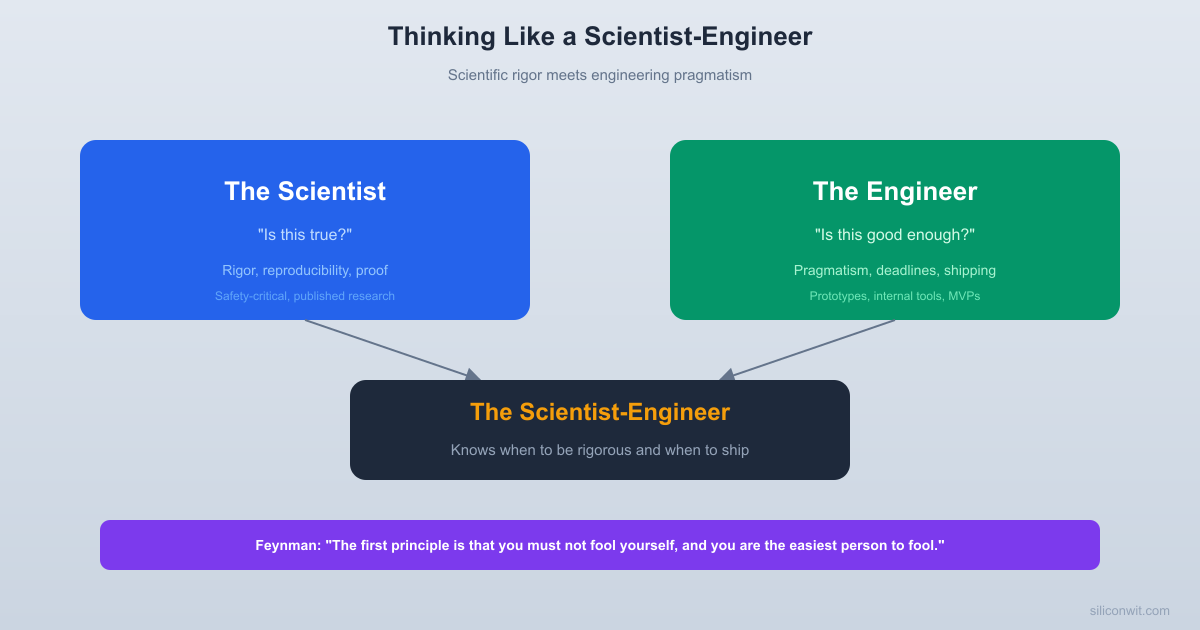
At their core, science and engineering ask different questions.
The scientist asks: “Is this true?” The goal is to understand the world as it is, regardless of whether that understanding is immediately useful. A physicist studying quantum entanglement is not trying to build anything. They are trying to know something.
The engineer asks: “Is this good enough?” The goal is to build something that works within constraints of time, cost, materials, and human needs. An engineer designing a bridge is not trying to discover new physics. They are trying to get people safely across a river.
The Synthesis
The best engineering practice combines both questions. You need scientific rigor to ensure your designs are based on reality, not wishful thinking. And you need engineering pragmatism to ensure your designs actually get built, deployed, and used by real people.
Where the Two Questions Diverge
Situation
Scientist’s Approach
Engineer’s Approach
Measuring a voltage
Repeat 100 times, calculate standard deviation, report confidence interval
Measure once with a calibrated meter, check if it is within spec
Modeling fluid flow
Develop a novel turbulence model, validate against DNS data, publish
Use an established CFD code with validated settings, check if flow meets requirements
Testing a prototype
Systematic parameter sweep, control all variables, full statistical analysis
Functional test: does it work under expected conditions? Ship if yes, debug if no
Discovering an anomaly
Investigate deeply; anomalies are where discoveries hide
Assess impact; if it does not affect function or safety, document and move on
  The Rigor vs. Pragmatism Spectrum
  RIGOR                              PRAGMATISM  (Is this true?)                   (Is this good  |                                    enough?)  |---|--------|---------|---------|---------|  ^   ^        ^         ^         ^         ^  Pub- Safety-  Founda-  Production Proto-  Quick  lish critical tional   firmware   types   scripts  ed   medical  archi-  re-  device   tecture  search
  More rigor: slower, more certain  More pragmatism: faster, more risk  Choose based on consequences of failure.
Neither approach is wrong. They are optimized for different objectives. The scientist who never ships anything is not a bad scientist; they are doing science. The engineer who never investigates anomalies is not necessarily a bad engineer, unless the anomaly was safety-relevant.
The problem arises when you apply the wrong approach to the wrong situation.
When to Be Rigorous
Some situations demand scientific rigor, regardless of schedule pressure.
Safety-Critical Systems
If your design failure can kill someone, rigor is not optional. The Therac-25, the 737 MAX, and every bridge collapse in history demonstrate what happens when engineers cut corners on safety analysis.
For safety-critical systems:
Every assumption must be documented and justified
Every calculation must be independently verified
Every test must be systematic and comprehensive
Every anomaly must be investigated, not dismissed
The extra time spent on rigor is not waste. It is the cost of responsible engineering.
Published Research
If you are publishing results that other engineers will rely on, those results must meet scientific standards. This means:
Reproducibility. Someone else should be able to repeat your experiment and get the same result. If they cannot, your result is not reliable enough to build on.
Statistical validity. A single measurement is an anecdote. You need enough data points to distinguish signal from noise.
Honest reporting. Include the data that did not support your hypothesis. Omitting inconvenient results is not just bad science; it is dangerous when other engineers rely on your work.
Uncertainty quantification. Every result should include an estimate of its uncertainty. Reporting GPa is useful. Reporting “about 3.7 GPa” is not.
Foundational Architecture Decisions
When you choose the architecture for a system that will be in production for years, rigor pays off enormously. A hasty architecture decision can create technical debt that costs orders of magnitude more to fix later than it would have cost to get right initially.
This does not mean spending six months on architecture before writing any code. It means spending enough time to:
Identify the key requirements (including the ones that are hard to change later)
Evaluate alternatives against those requirements with real data, not gut feeling
Document the decision and its rationale so future engineers understand why
When to Be Pragmatic
Other situations call for speed over precision. The art of engineering is knowing which situation you are in.
Prototypes
A prototype exists to answer a question: “Does this concept work?” It does not need to be optimal, beautiful, or production-ready. It needs to answer the question quickly enough that you can iterate.
Prototype Mindset
The best prototype is the one that teaches you the most with the least effort. If you can answer your question with a breadboard and some jumper wires, do not design a PCB. If you can test a software concept with a script, do not build a framework.
Perfectionism kills prototypes. An engineer who spends three weeks making a prototype “clean” before testing it has wasted two and a half weeks. The prototype might prove the concept is wrong, making all that polish meaningless.
Internal Tools
Tools used only by your team have different quality requirements than products shipped to customers. An internal data processing script does not need comprehensive error handling for every edge case. It needs to work correctly for the inputs it will actually receive and to fail loudly (not silently) when it encounters something unexpected.
This does not mean internal tools should be careless. It means the level of rigor should match the consequences of failure. If the internal tool’s failure means you rerun it with fixed input, that is different from a tool whose failure means corrupted production data.
Speed-Sensitive Experiments
Sometimes you are exploring a solution space and need to test many options quickly. In machine learning, this might mean training dozens of models with different hyperparameters. In hardware, it might mean testing several sensor configurations. In software, it might mean benchmarking multiple algorithms.
In these situations, statistical rigor on each individual experiment matters less than covering the space efficiently. You can always go back and rigorously validate the most promising options.
The Art of “Good Enough”
Every optimization has diminishing returns. The first 80% of performance comes from 20% of the effort. The last 5% of performance might require 50% of the total effort. Knowing when to stop optimizing is one of the most valuable skills an engineer can develop.
The Optimization Curve
Consider a firmware engineer optimizing the execution time of a sensor reading function:
Optimization Stage
Time Spent
Execution Time
Improvement
Unoptimized baseline
0 hours
850 microseconds
Baseline
Obvious fixes (remove unnecessary copies, fix data types)
If the requirement is “under 500 microseconds,” the engineer should stop after stage 1. If the requirement is “under 200 microseconds,” they should stop after stage 2. Going further is not engineering; it is hobby optimization.
When “Good Enough” Is Not Good Enough
There are domains where optimization to the limit is genuinely necessary:
Aerospace: Every gram matters when you are launching to orbit at thousands of dollars per kilogram
High-frequency trading: Microseconds of latency translate directly to profit
Battery-powered medical devices: Every milliamp-hour of battery life affects how long the patient can go between charges
Competitive products: When your competitor’s product is 10% faster, “good enough” might mean losing the market
The question is always: what is the cost of further optimization versus the value of the improvement? When the cost exceeds the value, stop.
The Danger of Premature Optimization
Donald Knuth’s famous observation applies far beyond software: “Premature optimization is the root of all evil.” Optimizing before you understand the problem often means optimizing the wrong thing.
An engineer who spends weeks optimizing the memory layout of a data structure before profiling the application might discover that the bottleneck is in network I/O, making the memory optimization irrelevant. An engineer who optimizes the structural weight of a bracket before testing the overall assembly might discover that the bracket does not experience the loads they assumed.
The sequence matters: make it work, make it right, make it fast. In that order.
Technical Debt as a Design Decision
When you choose pragmatism over rigor, you are taking on technical debt. Like financial debt, technical debt is not inherently bad. Taking a mortgage to buy a house can be a good decision. Taking on technical debt to ship a prototype quickly can also be a good decision.
The problem is unacknowledged technical debt. When engineers cut corners without documenting what they cut and why, the debt accumulates invisibly until it causes a crisis: a production outage, a security breach, a design that cannot be extended.
Managing Technical Debt
Document every shortcut. “This module does not handle negative inputs because the current use case never produces them” is a debt acknowledgment. When the use case changes, future engineers know exactly what to fix. An undocumented shortcut is a trap.
The scientist-engineer treats technical debt like any other engineering tradeoff: acknowledge it explicitly, quantify its cost, and schedule its repayment before it compounds.
The Exploration vs. Exploitation Tradeoff
In machine learning, the exploration-exploitation tradeoff describes the tension between trying new approaches (exploration) and optimizing known approaches (exploitation). The same tradeoff appears throughout engineering.
Phase
Exploration (try new things)
Exploitation (optimize what works)
Early design
Test multiple architectures, materials, algorithms
Premature; you do not know enough to optimize
Prototyping
Acceptable for non-critical experiments
Appropriate for critical-path components
Production
Risky; changes can introduce regressions
Essential; reliability matters
Maintenance
Necessary for long-term evolution
Default mode for stable systems
The scientist-engineer knows when to explore and when to exploit. Early in a project, exploration dominates: try many approaches quickly and discard the ones that do not work. As the project matures, exploitation dominates: optimize the chosen approach and make it robust. Getting this balance wrong in either direction is costly.
Building a Personal Scientific Practice
The habits of scientific thinking are not just for laboratories. They can be practiced daily in any engineering role.
1. Keep an Engineering Notebook
Scientists keep lab notebooks. Engineers should keep engineering notebooks. Not a formal document, but a running record of:
Hypotheses: “I think the sensor readings are drifting because of temperature” is a hypothesis. Write it down before you start investigating.
Experiments: “I put the board in a thermal chamber and logged readings at 10-degree intervals from 0 to 60 C” is an experiment. Record what you did, exactly, including the things that seemed unimportant at the time.
Results: Record the actual data, not just your interpretation of it. You might reinterpret it later.
Decisions: “I chose algorithm X over algorithm Y because of Z” is a decision record. Your future self (or your successor) will thank you.
Notebook Formats
The format does not matter much. A bound paper notebook, a text file per project, a wiki page, or a Git repository of markdown files all work. What matters is consistency: write things down as they happen, not from memory days later.
2. Write Your Assumptions Down
Every design rests on assumptions. Most engineers carry these assumptions in their heads, which means they cannot be examined, challenged, or tested.
Writing assumptions down transforms them from invisible background beliefs into testable statements:
This cannot be tested because “accurate enough” is not defined, and the assumption is not visible to anyone reviewing the design.
“The BME280 temperature sensor has an accuracy of plus or minus 1 degree C over the 0 to 65 C range, which is sufficient for our application because the control algorithm only needs 2 degree C resolution.”
This can be verified against the datasheet, tested in the lab, and evaluated by anyone reviewing the design. If the requirement changes to 0.5 degree C resolution, the assumption is immediately flagged as invalid.
3. Seek Disconfirmation
Confirmation bias is the tendency to seek evidence that supports what you already believe and ignore evidence that contradicts it. It is the most common reasoning error in engineering.
The scientific antidote is to actively seek disconfirmation: try to prove yourself wrong before shipping.
Before testing, predict what failure would look like. If you expect the system to handle 1,000 requests per second, define what “failure” means (response time over 200 ms? error rate over 0.1%?) before you run the test.
Design tests that could fail. A test that always passes is not a test; it is a ritual. The most valuable tests are the ones that exercise boundary conditions, edge cases, and failure modes.
When a test passes, ask why. Is it because the design is good, or because the test is weak? Could there be a condition you did not test that would cause failure?
When you find a bug, ask what else might be wrong. Bugs are rarely isolated. A race condition in one module suggests that the codebase may have race conditions elsewhere.
4. Share Your Failures
In most organizations, successes are celebrated and failures are hidden. This is backwards. Failures are more informative than successes because they reveal the boundaries of your knowledge.
A culture where engineers openly share and discuss failures learns faster than one where failures are concealed. Post-mortem analyses (sometimes called “retrospectives” or “incident reviews”) should be blame-free and focused on understanding what happened and what to change.
Individually, you can contribute by:
Documenting failed approaches in your engineering notebook (not just the approach that worked)
Mentioning dead ends in design reviews (“We tried X first, and it failed because Y”)
Writing up significant failures for your team’s knowledge base
5. Read Outside Your Field
The most significant breakthroughs in engineering often come from applying ideas from one field to another:
Breakthrough
Source Field
Application Field
Genetic algorithms
Evolutionary biology
Optimization, design
Neural networks
Neuroscience
Machine learning, pattern recognition
Biomimetic materials
Biology
Materials science
Kanban
Manufacturing (Toyota)
Software development
Monte Carlo simulation
Statistical physics
Finance, engineering design
CRISPR gene editing
Bacterial immune systems
Biotechnology, medicine
You do not need to become an expert in adjacent fields. But reading broadly exposes you to patterns, metaphors, and approaches that may transform how you think about problems in your own domain.
Subscribe to journals or newsletters outside your specialty. Attend talks in departments other than your own. When you encounter an elegant solution in another field, ask whether the underlying principle applies to a problem you face.
6. Practice Calibrated Confidence
Calibrated confidence means that when you say you are 90% sure of something, you are right about 90% of the time. Most people are overconfident: they say “I’m pretty sure” about things they are wrong about 30% of the time.
You can improve your calibration through practice:
Before investigating a bug or anomaly, write down your hypothesis and your confidence level (e.g., “I am 70% sure the issue is in the I2C initialization”).
After investigating, record whether your hypothesis was correct.
Over time, compare your stated confidence levels with your actual accuracy.
Adjust your confidence estimates based on your track record.
Engineers with well-calibrated confidence make better decisions because they know when to trust their judgment and when to seek more data. They are less likely to commit to a wrong approach out of false confidence, and less likely to waste time investigating a correct approach out of unnecessary doubt.
7. Learn to Estimate
Estimation is a core engineering skill that bridges rigor and pragmatism. A Fermi estimate (named after physicist Enrico Fermi, who was famous for quick, surprisingly accurate calculations) breaks a complex question into simpler parts that can be estimated individually.
For example: “How many piano tuners are in Nairobi?” You do not need exact data. You need reasonable estimates of Nairobi’s population (roughly 5 million), the fraction of households with pianos (perhaps 1 in 2,000 in a developing country), how often pianos need tuning (once or twice a year), and how many pianos a tuner can service per day (4 to 5). Chain these estimates together and you get a rough but useful answer.
The value of Fermi estimation is not the answer. It is the process of decomposing an unknown into knowable parts and identifying which parts matter most. This skill transfers directly to engineering: estimating project timelines, power consumption, server load, manufacturing cost, and a hundred other quantities that you need to know approximately before you can know precisely.
Feynman’s “Cargo Cult Science”
In his 1974 Caltech commencement address, physicist Richard Feynman described what he called “cargo cult science.” During World War II, islanders in the South Pacific observed military bases where cargo planes landed bringing supplies. After the war, some islanders built replica runways with bamboo control towers and coconut headphones, performing the rituals they had observed, hoping to attract more cargo planes.
The planes did not come. The islanders had replicated the form of the activity without understanding the substance.
Feynman argued that much of what passes for science (and, by extension, engineering) suffers from the same problem: it has the appearance of rigor without the substance.
Cargo Cult Engineering
Cargo cult engineering is performing the rituals of good practice without the underlying discipline. Running tests that are designed to pass rather than to find bugs. Writing documentation that nobody reads. Holding code reviews where nobody disagrees. Collecting data without analyzing it. Following a process because it is the process, not because it serves a purpose.
The Antidote: Intellectual Honesty
Feynman’s central point was about intellectual honesty:
“The first principle is that you must not fool yourself, and you are the easiest person to fool.”
For engineers, this means:
Report all the results, not just the ones that support your conclusion. If three tests passed and one failed, report all four.
Do not hide behind process. Following ISO 9001 does not make your product good. It means you documented what you did. The product is good if it works safely and reliably.
Acknowledge uncertainty honestly. “I do not know” is a valid engineering statement. “I think this is fine but I am not sure” is more useful than false confidence.
Do not cherry-pick data. If you ran the simulation ten times and the best result meets the requirement but the average does not, you have not met the requirement.
Credit your sources. If your design is based on someone else’s work, say so. If you adapted a circuit from a reference design, cite it. Honest attribution makes the entire profession stronger.
The Course Summarized
This course has explored the foundations of how we know what we know and how that knowledge shapes engineering practice.
The scientific method provides a systematic way to move from ignorance to knowledge. Form a hypothesis, design an experiment, collect data, analyze results, revise the hypothesis. This cycle, repeated honestly and rigorously, is the most reliable path to understanding that humans have discovered.
For engineers, the scientific method means: do not guess when you can measure. Do not assume when you can test. Do not trust intuition over data.
Philosophy of science reveals the assumptions, limitations, and potential failures in our reasoning. It teaches us about confirmation bias, the limits of induction, the problem of demarcation, paradigm shifts, and the boundaries of what can be known.
For engineers, philosophy means: question your assumptions. Recognize your cognitive biases. Understand that your models are simplifications. Accept that some things are fundamentally uncertain and design accordingly.
Engineering transforms knowledge into artifacts that serve human needs. It operates under constraints that pure science does not face: deadlines, budgets, material limitations, manufacturing processes, and the unpredictable behavior of real users.
For engineers, the purpose is always practical: build something that works, that is safe, that serves its users, and that does not cause unnecessary harm to the broader world.
The scientist-engineer combines all three: the method of science, the awareness of philosophy, and the purpose of engineering. They measure before they design, question their assumptions before they commit, and consider the consequences before they ship.
Where to Go from Here
This course is one thread in a larger curriculum. Here are natural next steps depending on your interests:
Critical Thinking for Engineers
Dive deeper into reasoning skills, cognitive biases, logical fallacies, and evidence evaluation. The Critical Thinking course provides tools for evaluating arguments, spotting flawed reasoning, and making better decisions under uncertainty.
Applied Mathematics
Build the quantitative foundation for rigorous engineering analysis. Mathematical literacy enables you to go beyond intuition and gut feeling to precise, verifiable calculations.
Embedded Systems Courses
Apply scientific thinking and engineering pragmatism to real hardware. The embedded systems track (ATmega328P, STM32, ESP32, RPi Pico, RTOS) teaches you to build physical systems where abstractions meet reality.
IoT Systems and Edge AI
Explore the intersection of connected devices, data, and machine learning at the edge. These courses raise many of the ethical and societal questions discussed in this course in a concrete, practical context.
A Final Thought
Engineering is one of the most consequential human activities. The things engineers build shape how people live, work, travel, communicate, and understand the world. That power requires not just technical competence but intellectual honesty, ethical awareness, and a habit of thinking beyond the immediate problem.
The scientist-engineer does not just ask “Can I build this?” They ask “Should I build this? What happens when I do? Who is affected? What do I not know? Am I being honest with myself?”
These questions do not slow you down. They make your work better. They make your designs safer. They make your career more meaningful. And they make the world a little better than it would have been without them.
The Compound Effect of Small Habits
None of the practices in this lesson requires a dramatic change in how you work. Keeping a notebook adds five minutes to your day. Writing down assumptions takes thirty seconds per assumption. Reading outside your field takes an hour a week. Seeking disconfirmation means running one extra test.
Individually, these are small investments. Compounded over a career, they are transformative. The engineer who has kept a notebook for 20 years has a searchable record of every problem they have solved, every mistake they have made, and every insight they have gained. The engineer who has read outside their field for 20 years sees connections that specialists miss. The engineer who has practiced calibrated confidence for 20 years makes better decisions under uncertainty than their peers.
The scientist-engineer is not born. They are built, one small habit at a time.
Exercises
Choose a recent engineering decision you made (selecting a component, choosing an algorithm, picking a library, designing a circuit). Classify it: did you apply scientific rigor, engineering pragmatism, or some combination? In retrospect, was the level of rigor appropriate? Would you change your approach if you made the decision again?
Start an engineering notebook if you do not already have one. For the next two weeks, record every hypothesis you form, every test you run, and every decision you make on a current project. At the end of two weeks, review your notes. What patterns do you see? What assumptions were you carrying that you had not written down before?
Read Feynman’s “Cargo Cult Science” address (it is short and available online). Identify three examples of cargo cult engineering in your own experience or in an organization you have observed. For each, describe what the ritual looks like and what the substance behind it should be.
Pick one field outside your primary discipline (biology, economics, urban planning, psychology, art, anything). Spend an hour reading about a current problem or breakthrough in that field. Write a paragraph about what, if anything, the ideas or approaches used in that field could teach you about a problem in your own work.
Write a one-page “engineering philosophy” statement for yourself. What principles guide your work? When do you prioritize rigor? When do you prioritize speed? How do you handle ethical conflicts? What are your intellectual blind spots? This is not a document for anyone else; it is a tool for self-awareness.
Summary
The scientist-engineer combines scientific rigor with engineering pragmatism, guided by philosophical awareness. Rigor is essential for safety-critical systems, published research, and foundational architecture decisions. Pragmatism is essential for prototypes, internal tools, and exploratory experiments. The art of “good enough” is knowing when further optimization costs more than it delivers. A personal scientific practice built on engineering notebooks, explicit assumptions, disconfirmation seeking, failure sharing, and cross-disciplinary reading makes you a more effective and more honest engineer. Feynman’s warning against cargo cult science applies directly to engineering: performing the rituals of good practice without the underlying intellectual honesty achieves nothing. Science gives you the method, philosophy gives you the awareness, and engineering gives you the purpose. The best work happens when all three operate together.



Comments