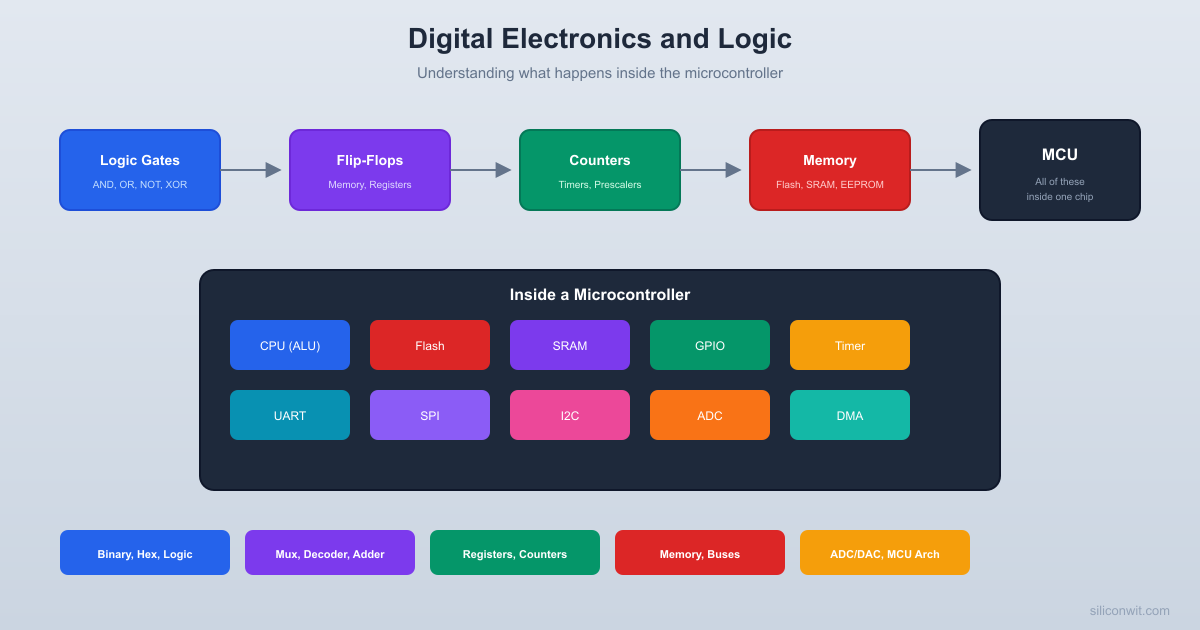
This course shows you what happens inside the microcontroller when your code runs. You will build real circuits on a breadboard, watch logic signals with LEDs, and connect every concept back to the embedded programming you will do in other courses. Whether you are about to start your first embedded course or you have already written firmware and want to understand the hardware beneath it, this is your reference. #DigitalElectronics #LogicDesign #EmbeddedFoundations
This Is Not a Prerequisite
Jump straight into embedded programming
You do not need to complete this course before starting any of our embedded programming courses. Every embedded course (ATmega328P, STM32, ESP32, RPi Pico, RTOS) is designed to be self-contained. This course exists as helpful background that will make everything else easier to understand and as a reference you can come back to when you want deeper insight into what your code is doing at the hardware level.
What You Will Learn
Binary and Number Systems
How computers represent numbers. Binary, hexadecimal, BCD, and two’s complement signed integers. Read register values in hex and understand what each bit controls.
Logic Gates and Boolean Algebra
AND, OR, NOT, NAND, NOR, XOR. Truth tables, De Morgan’s theorems, and simplification. See how bitwise C operators map directly to physical gates.
Combinational and Sequential Circuits
Multiplexers, decoders, adders, flip-flops, shift registers, and counters. These are the building blocks of every peripheral inside your MCU.
Memory, Buses, ADC/DAC, and MCU Architecture
How SRAM, Flash, and EEPROM store data. How SPI, I2C, and UART work at the wire level. How ADCs convert analog voltages to digital values. How the CPU fetches and executes your instructions.
Lessons
Lesson 1: Binary, Hex, and Number Systems
Binary, Hex, and Number Systems. Count in binary and hexadecimal, convert between bases, understand BCD and two’s complement. Learn to read MCU register values in hex and know what each bit means.
Practical: Convert register values, decode GPIO configuration bits.
Lesson 2: Logic Gates and Boolean Algebra
Logic Gates and Boolean Algebra. Build AND, OR, NOT, NAND, NOR, XOR circuits with 74HC series ICs. Verify truth tables with LEDs. Apply De Morgan’s theorems and simplify Boolean expressions.
Practical: Wire logic gates on a breadboard, verify outputs with LEDs.
Lesson 3: Combinational Logic Circuits
Combinational Logic: Multiplexers, Decoders, Adders. Build multiplexers, decoders, encoders, and adders from gates. Understand how these circuits form the foundation of address decoding and arithmetic in a CPU.
Practical: Build a 4-to-1 mux and a 2-bit adder on a breadboard.
Lesson 4: Flip-Flops, Latches, and Registers
Flip-Flops, Latches, and Registers. Move from combinational to sequential logic. SR latches, D flip-flops, JK flip-flops, shift registers, and parallel load registers. Drive 8 LEDs from 3 MCU pins using a 74HC595.
Practical: Build a shift register LED driver with the 74HC595.
Lesson 5: Counters, Timers, and Frequency Dividers
Counters, Timers, and Frequency Dividers. Build ripple and synchronous counters, up/down counters, and frequency dividers. See how the timer/counter peripherals inside your MCU work at the gate level.
Practical: Build a 4-bit binary counter with LEDs, divide a clock signal.
Lesson 6: Memory: SRAM, Flash, EEPROM
Memory: SRAM, Flash, EEPROM. Understand how SRAM cells store bits, how Flash uses floating gates, and how EEPROM provides byte-level erase. Explore address buses, data buses, and memory maps.
Practical: Read an MCU memory map and locate peripheral registers.
Lesson 7: Bus Architecture and Communication Interfaces
Bus Architecture and Communication Interfaces. See SPI, I2C, and UART at the signal level. Understand clock polarity, data framing, acknowledge bits, and baud rates. Parallel vs serial bus tradeoffs.
Practical: Trace SPI/I2C/UART signals with a logic analyzer or oscilloscope.
Lesson 8: ADC and DAC Fundamentals
ADC and DAC Fundamentals. Learn successive approximation ADC, resolution, quantization error, and the Nyquist sampling theorem. Explore R-2R ladder DACs and PWM as a pseudo-DAC.
Practical: Calculate ADC resolution and quantization error for real sensors.
Lesson 9: Introduction to Microcontroller Architecture
Introduction to Microcontroller Architecture. Von Neumann vs Harvard, the ALU, registers, stack, program counter, and interrupt vector table. Trace what happens when you write int x = 5; down to the assembly level.
Practical: Map C code to assembly instructions, locate GPIO registers in memory.
Parts Kit
All the components you need for hands-on exercises across the course: