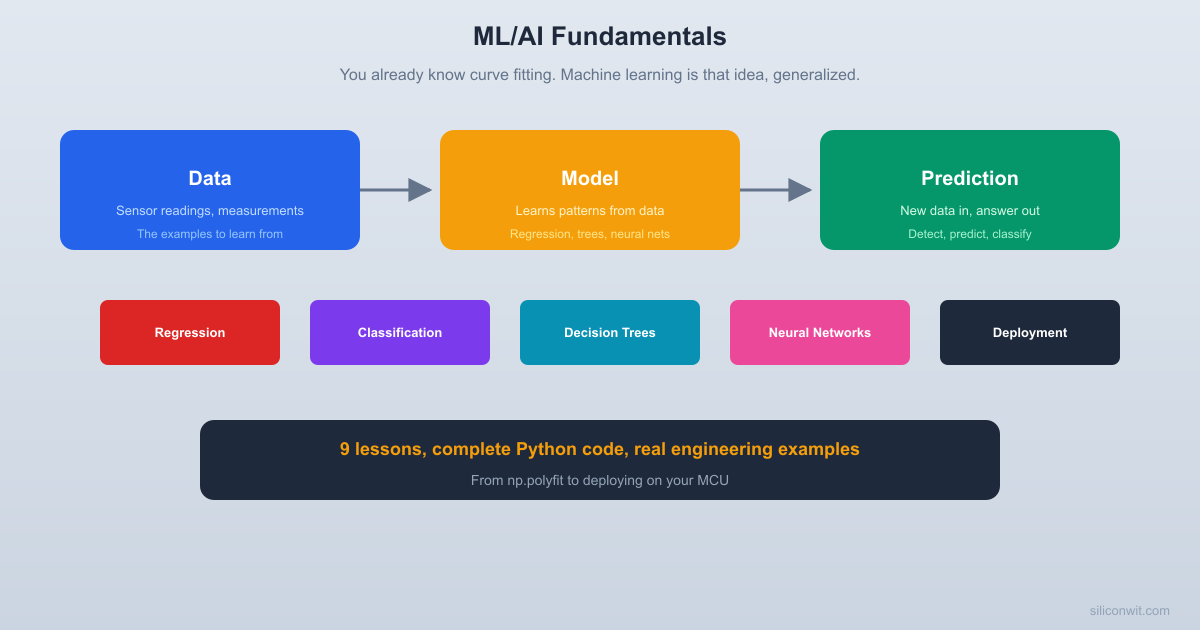
You already know curve fitting. Machine learning is that idea, generalized. Instead of fitting a polynomial to a handful of points by hand, you let the computer discover the best function from thousands (or millions) of data points. The math underneath is the same calculus, linear algebra, and statistics you have already studied. This course connects those foundations to the tools and techniques that power modern ML, with complete Python code you can run in every lesson. #MachineLearning #Python #Engineering
What This Course Covers
Lesson 1: What Machine Learning Actually Is
What Machine Learning Actually Is. Start with curve fitting. Move to train/test splits. See overfitting and underfitting with your own eyes. Understand the central tension of all ML: models that are too simple miss patterns, models that are too complex memorize noise.
Lesson 2: Linear Regression and Prediction
Linear Regression and Prediction. Predict indoor temperature from outdoor temperature, humidity, and time of day. Build the full scikit-learn pipeline: feature scaling, train/test split, evaluation metrics, residual analysis.
Lesson 3: Classification: Yes or No Decisions
Classification: Yes or No Decisions. Detect defective sensor boards from test measurements. Logistic regression, confusion matrices, precision, recall, ROC curves, and the problem of class imbalance.
Lesson 4: Decision Trees and Random Forests
Decision Trees and Random Forests. Predict equipment failure from vibration, temperature, and operating hours. Visualize the decision rules the model discovers. Compare single trees to random forests.
Lesson 5: How Models Learn: Gradient Descent
How Models Learn: Gradient Descent. Implement gradient descent from scratch in 25 lines of NumPy. Watch the loss decrease iteration by iteration. Understand learning rate, batch size, and why this is the engine behind all modern ML.
Lesson 6: Neural Networks from Scratch
Neural Networks from Scratch. Build a two-layer neural network in pure NumPy. Forward pass, backpropagation, sigmoid and ReLU activations. Solve XOR and classify sensor readings into three categories. No TensorFlow needed.
Lesson 7: Practical ML with Scikit-Learn
Practical ML with Scikit-Learn. The complete, reusable ML workflow: Pipeline, StandardScaler, cross-validation, GridSearchCV. Compare 5 models on the same dataset. Save and load models with joblib.
Lesson 8: Working with Real Sensor Data
Working with Real Sensor Data. Handle missing values, outliers, and drift. Engineer features from raw sensor readings: rolling statistics, rate of change, FFT peaks. Build a predictive maintenance model.
Lesson 9: From Training to Deployment
From Training to Deployment. Three deployment paths: Python script, Flask REST API, or C arrays for MCU firmware. Model monitoring, data drift detection, and the retraining lifecycle.
The Applied Mathematics course on SiliconWit (we reference it when relevant)
Probability and statistics concepts
Experience with Matplotlib for plotting
Setup
All lessons use the same Python environment. Install the dependencies once:
Terminal window
pipinstallnumpymatplotlibscikit-learn
Every code block in this course is complete and runnable. Copy it, paste it into a .py file or a Jupyter notebook, and run it. Every script uses np.random.seed(42) so you will get the same numbers and plots we show.
Where This Course Leads
ML/AI Fundamentals (this course)
Understand the core ideas: fitting, generalization, loss functions, gradient descent, and evaluation.
Edge AI / TinyML
Take trained models and deploy them on microcontrollers. The Edge AI / TinyML course picks up where this course leaves off.
IoT Systems
Combine ML inference with sensor networks and cloud integration in the IoT Systems course.