

Utilisation
Spindle turning as a share of available time. This is the number your quotes should be built on, and it is almost never the number people assume.
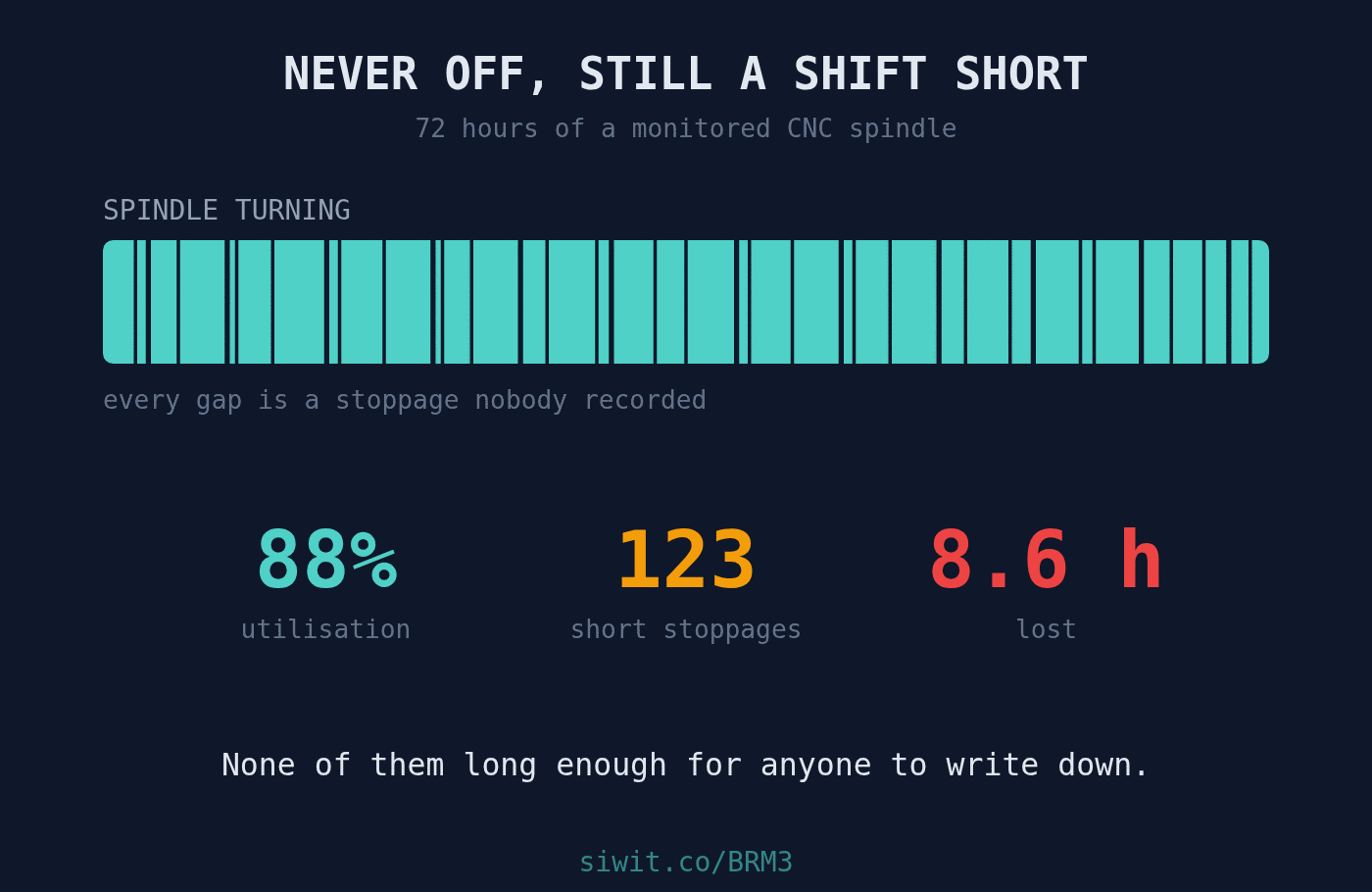
Quoting a machining job means deciding how many hours the machine will need, and that decision is almost always made from memory. The machine ran fine last week. It has been busy. Nobody remembers it stopping. So the quote assumes it runs, and when the job comes in late the explanation is that this particular job was awkward. It usually was not. #Manufacturing #RemoteMonitoring #Utilisation
A CNC machine tool, monitored for spindle load and utilisation. The owner says it is mainly useful when quoting, which is a less common reason to instrument a machine than watching for a breakdown, and a more interesting one.
Over the three days behind this post the spindle ran for 63.7 hours out of 72.3:
By the standards of most workshops that is very good. It is also eight and a half hours short, and where those hours went is not where anybody would guess.
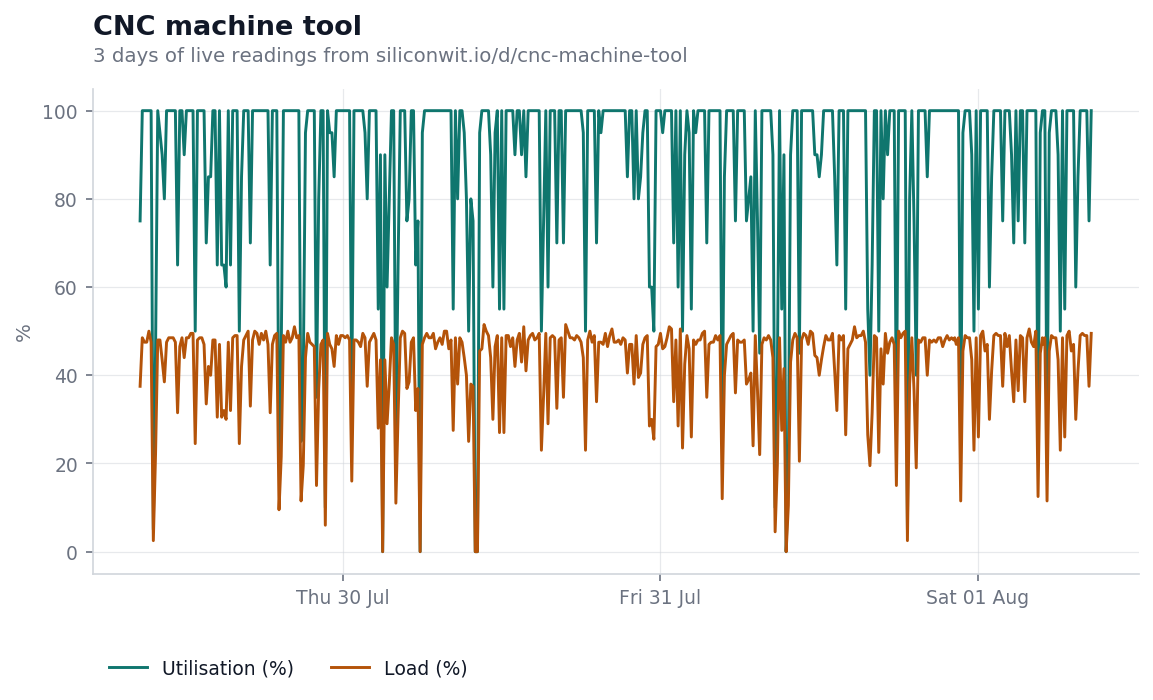
Two readings that sound like the same thing and are not.
Utilisation is the share of each reporting window the spindle was actually turning. Load is how hard it was working while it turned, as a percentage of what the machine can deliver. A machine can be at 100% utilisation and 20% load, which means it is busy doing nothing much, and that is a different problem from being idle.
The utilisation line here is pinned at 100% for most of its length. Just under two thirds of all the readings sit at a flat hundred. That is the shape of a machine that is genuinely working, and it is why the answer from memory is always “it runs all the time.”
But the line is not solid. It is cut, over and over, by notches down to 80, to 60, to 40. Each notch is a slice of a ten minute window where the spindle was not turning. Individually every one of them is trivial. There are enough of them that they add up to more than a shift.
Meanwhile the load line holds a tight band whenever the spindle is actually turning: 48% on average, never below 45.5% and never above 51.5%. It drops only where utilisation drops. Steady load with a stable ceiling is a healthy signal: the machine is not being asked for more than it has, and it is not degrading. The problem is not how hard it works. It is how often it stops.
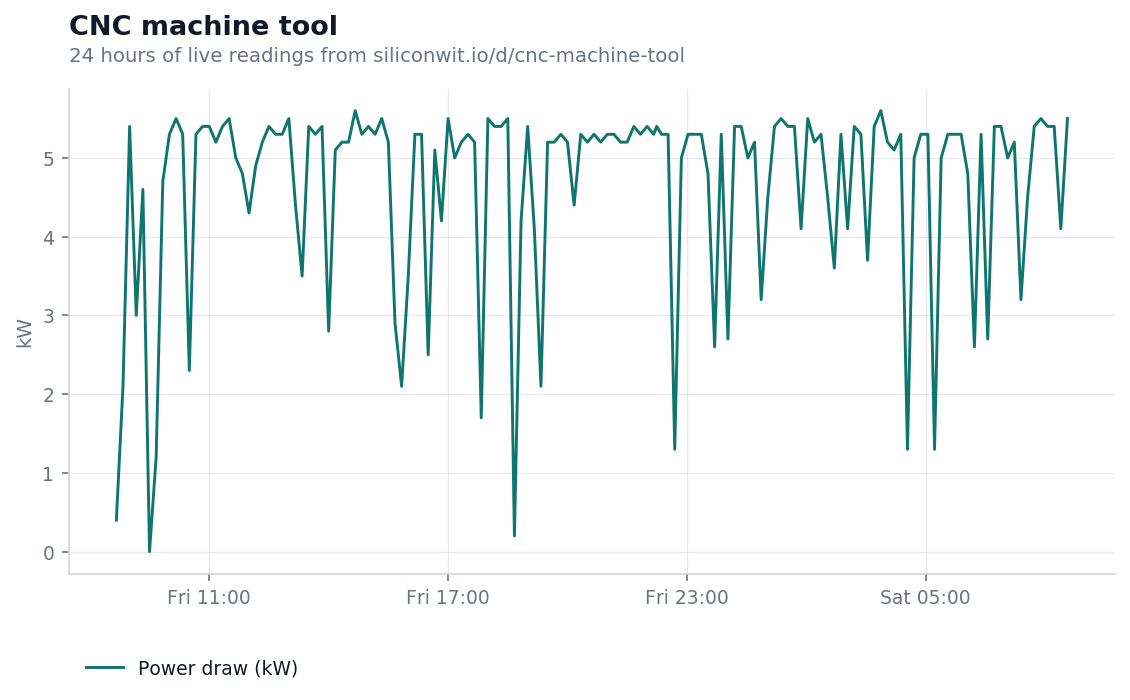
This is one day of raw power draw, which makes the texture easier to see than three days does.
The plateau is around 5.3 kW, and it is interrupted constantly. Drops to 4 kW, to 2 kW, a couple all the way to zero. Note what this chart does not have: a night. There is no overnight shutdown, no weekend cliff, no block of hours where the machine is off. Over the full three days only 50 minutes of readings were at zero power.
So the eight and a half missing hours are not downtime in any form a person would report. They are 123 short stoppages spread across the window, landing in 27% of every ten minute sample taken. Roughly one sample in four contained an interruption.
That is the finding, and it is the reason this machine is monitored for quoting rather than for failure. A short stoppage is a tool change that took longer than it should, a part that did not seat, an operator waiting on material, a program pause. None of them are faults. None of them get written down. Every one of them is invisible by the end of the shift, and together they are a full working day a week.
The numbers below are a worked example, not a promise. Put your own figures in.
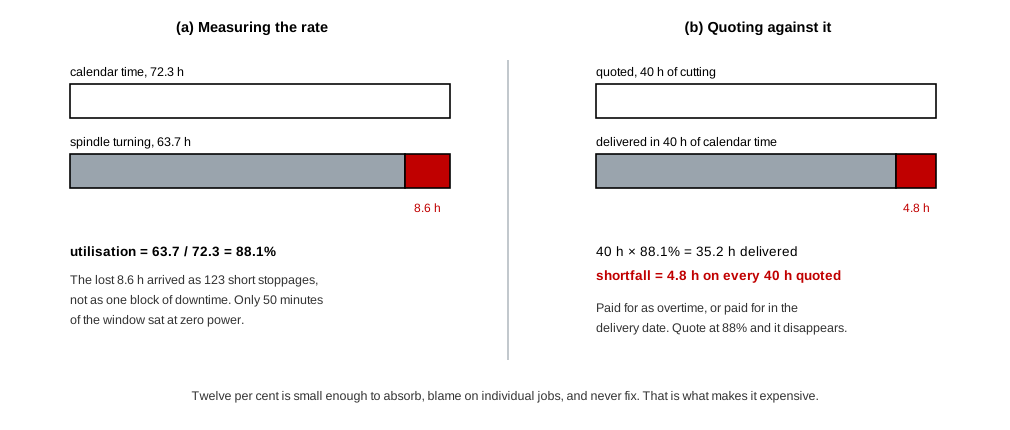
Take the ordinary version of this mistake. You quote a job at 40 machine hours, priced on the assumption that the machine delivers 40 hours of cutting in 40 hours of calendar time. At the measured rate it delivers
leaving a shortfall of
You are 4.8 hours short, which either comes out of margin as overtime or comes out of the delivery date.
Do that across a year of quotes and the shape of the business changes. Not dramatically, which is the difficulty. Twelve per cent is small enough to absorb, blame on individual jobs, and never fix.
Against that:
The honest framing is that this device will probably never prevent a catastrophe. It just stops a workshop from quoting against a machine that does not exist.
Utilisation
Spindle turning as a share of available time. This is the number your quotes should be built on, and it is almost never the number people assume.
Short stoppages
Counted automatically or not at all. Nobody writes down a four minute stop, and four minute stops are where the capacity goes.
Load percentage
Separates a machine that is busy from a machine that is working. High utilisation at low load means you are paying for time, not parts.
Bearing temperature and vibration
Not part of the quoting story, but the pair that tells you the spindle is wearing while everything else still looks normal.
Power draw, load, bearing temperature and vibration run across the rest of the plant, and what differs is the reason each machine is watched. A production line drive motor is instrumented for the vibration trend and almost nothing else. A plant air compressor is there because compressed air costs more than lighting and heating together, and its owner needed somewhere to prove it. An injection moulding machine counts cycles and short stops for the same quoting reason this machine does, because quoted capacity and actual capacity have never been the same number.
Two more are worth opening for the failures behind them. A steam boiler feed pump threw a bearing and took the boiler with it, and a materials test rig once stopped on a Friday night and was not found until Monday, which is the same lesson this post makes about short stoppages, scaled up to a whole weekend.
The device page shows the live readings, the charts above in their interactive form, and the alert history, including the short stoppage clusters that triggered rules of their own. If the device link below ever stops resolving, the public device gallery lists everything currently shared, and devices come and go from it as owners decide.
To put your own machine on a chart, you can send readings without creating an account and see them arrive on a live chart in a couple of minutes, or read how to connect a first device.
Open this device Monitor your own equipment
Comments