

Internal and peak temperature
The peak matters more than the mean. Alert on the peak, not the average.
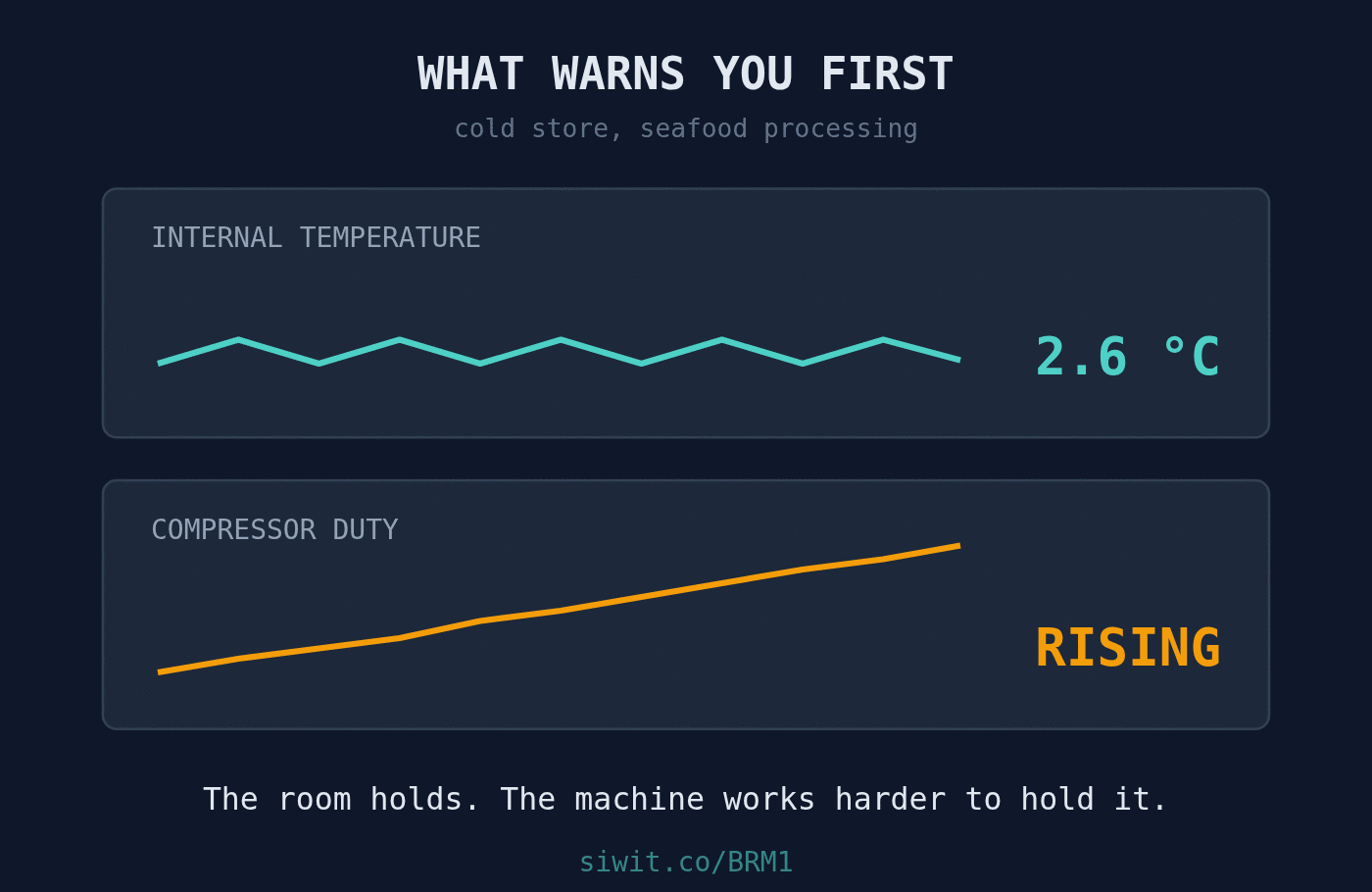
A cold store does not fail loudly. It drifts. The compressor works a little harder each week, a door seal hardens, someone props a door open during a busy offload, and the room sits two degrees warm for a weekend. On Monday everything looks normal again, and nothing in the room can tell you what happened. #ColdChain #RemoteMonitoring #FoodSafety
This installation watches the main cold store of a seafood processing operation. The product is destined for export, which changes the stakes in two ways. The obvious one is value: a store like this holds stock worth far more than the building it sits in. The less obvious one is that an export buyer can reject a consignment on suspicion alone, and without a temperature record, suspicion is all anyone has.
The store runs at a target of about 2.5 °C. Over the readings behind this post it held a mean of 2.57 °C, never dropped below 1.20 °C, and its peak never rose above 4.30 °C. The door was opened 56 times for a total of 74.5 minutes, which averages out at
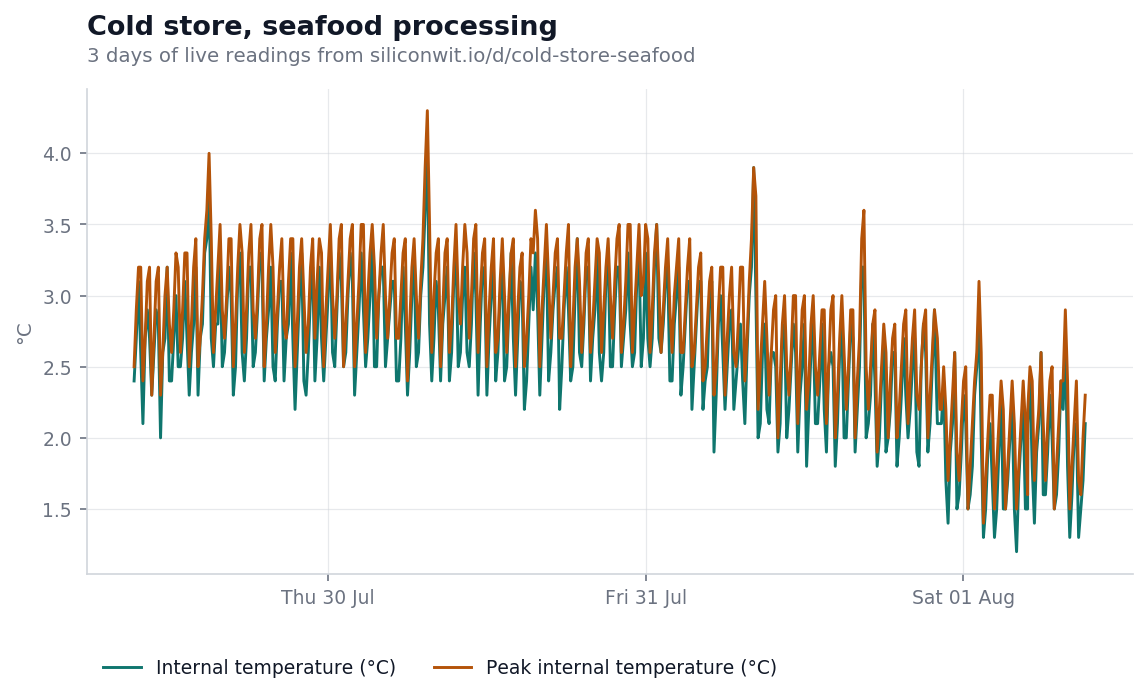
Two lines, and the gap between them is the interesting part.
Internal temperature is the room as the sensor sees it right now. Peak internal temperature is the highest value reached within each reporting window. On a healthy store the two track each other closely, separated by the normal sawtooth of the compressor cutting in and out.
What you are looking for is not the average. It is the peaks. Every upward spike is a moment the room was warmer than the average suggests, and product does not care about your average. The spikes here reach about 4 °C and fall back within one cycle, which is the signature of a door opening during work: heat comes in, the compressor answers, the room recovers.
The signature you do not want looks different. It is a peak that does not fall back, or a slow lift in the whole band over several days. That is a door seal, a low refrigerant charge, or a condenser that needs cleaning, and it is visible in the data long before it is visible in the product.
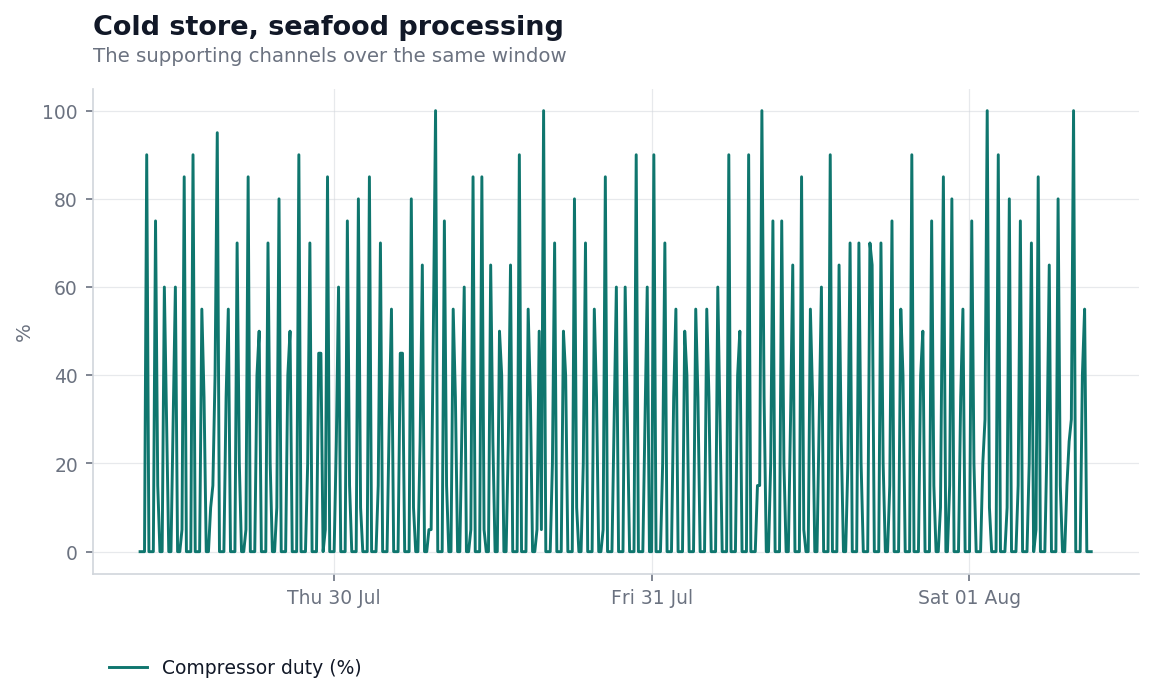
Compressor duty is the percentage of time the compressor is actually running. Over the three days in this chart it ran for 14.65 hours out of 72.2 elapsed:
That number is the single best early warning a cold store gives you, because it has somewhere to go. A store holding temperature at 20% duty has four fifths of its capacity in reserve. The same store holding the same temperature at 60% duty is in trouble and the thermometer will not say so.
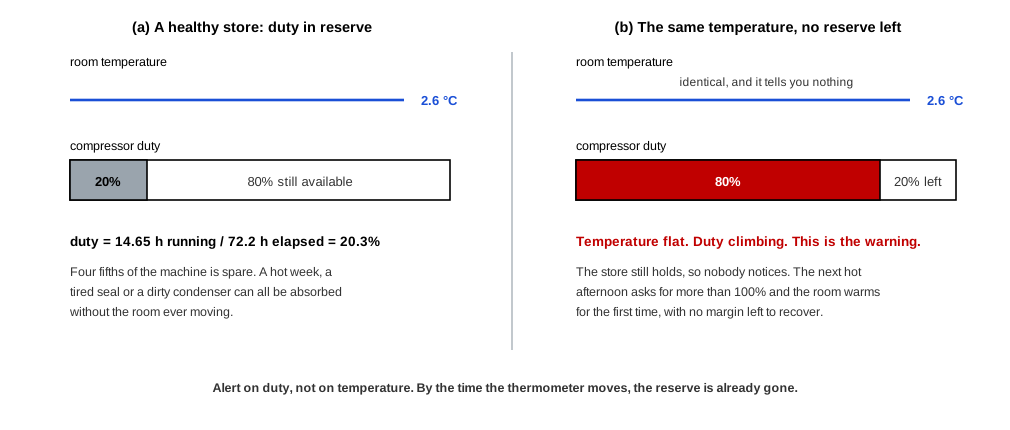
A store in good condition holds its temperature with duty to spare. As seals age, as ice builds on the evaporator, as the charge drops, the room still holds temperature but the compressor works longer to do it. Temperature stays flat while duty climbs. By the time the temperature itself starts moving, the machine has been shouting for weeks.
That is why duty is worth an alert rule of its own. A rule that fires when duty stays above a threshold for several hours catches degradation while it is a service call, not a failure.
The numbers below are a worked example, not a promise. Put your own figures in.
Take a store holding 12 tonnes of export seafood at a conservative USD 6 per kilogram:
That is the value sitting in one room. A weekend excursion that a buyer will not accept does not have to spoil the fish to cost you the consignment; it only has to be undocumented.
Against that:
The arithmetic is not close. One prevented consignment loss pays for the monitoring of a small cold chain for years. The honest framing is that most weeks it saves nothing at all, and then one week it saves everything.
Internal and peak temperature
The peak matters more than the mean. Alert on the peak, not the average.
Compressor duty
Rising duty at flat temperature is degradation. This is your earliest warning.
Door open time
Cheap to measure, changes behaviour immediately, settles disputes.
Evaporator temperature
Separates an icing problem from a charge problem when duty starts to climb.
The same four readings run on the other cold chain installations, and the differences between them are the interesting part. A supermarket display case is open to the aisle, so door time is continuous rather than occasional and the question becomes whether the shrinkage is the case or the staff. A refrigerated container holds minus eighteen through a journey where nobody is watching, which makes the log the only thing that survives the trip. A restaurant walk-in freezer turned out to be dominated by door openings rather than by the load in the room, which its owner did not expect.
The same instrument set also shows up well outside the cold chain. A server room cooling unit and a laboratory incubator both measure internal temperature, peak, compressor duty and door time, because the question underneath is identical: is the box holding, and how hard is it working to hold?
The device page shows the live readings, the charts above in their interactive form, and the alert history. If the device link below ever stops resolving, the public device gallery lists everything currently shared, and devices come and go from it as owners decide.
To put your own store on a chart, you can send readings without creating an account and see them arrive on a live chart in a couple of minutes, or read how to connect a first device.
Open this device Monitor your own equipment
Comments